
Geometric topology: manifolds, knots, and embeddings
Branch of topology concerned with manifolds, embeddings and the geometric structures and invariants that classify them, including knot theory, braid groups and low-dimensional results.
Overview
Geometric topology is the area of mathematics that studies topological spaces with a strong geometric or manifold flavor: the shapes of spaces, how they embed in one another, and the structures that remain invariant under continuous deformation. It emphasizes concrete objects such as smooth or topological manifolds, embeddings of submanifolds, and objects like knots and links. For a general introduction to the field see related resources and for background on manifolds consult manifold theory.
Image gallery
3 Images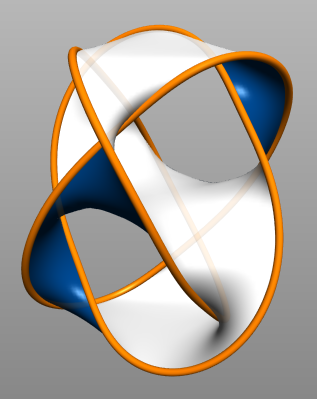


Typical objects and concepts
Central notions include n-dimensional manifolds, embeddings and immersions, knot and link types in three dimensions, and braid groups that encode strand exchanges. Geometric topologists use invariants — for example the fundamental group, homology, and more refined algebraic or analytic invariants — to distinguish non-equivalent objects. Knot theory and link invariants are a major subfield with both combinatorial and geometric approaches; see knot theory for illustrative examples.
History and development
The subject grew rapidly in the mid-20th century as geometric, analytic and algebraic methods converged. Foundational results in higher dimensions came from surgery theory and the h-cobordism theorem in the 1960s, while four-dimensional topology revealed exceptional behavior leading to deep discoveries in the 1980s and beyond. More recent breakthroughs include the geometric classification of three-manifolds and related analytic techniques; historical surveys appear at topology history.
Methods and applications
Common techniques are handle decompositions, surgery, Morse theory, hyperbolic geometry, and gauge-theoretic or Floer-type invariants. These tools connect geometric topology to differential geometry, algebraic topology, and mathematical physics. Concrete applications include the classification of surfaces and three-manifolds, the study of knot energies and DNA knotting models, and interactions with dynamics and group theory.
Subareas and notable distinctions
Important subareas include low-dimensional topology (dimensions two through four), high-dimensional manifold classification, and knot and braid theory. Geometric topology differs from purely algebraic topology by its attention to geometric structures and embeddings, and from differential topology by accepting topological manifolds that may lack smooth structures. Typical research topics are listed below.
- Classification of manifolds and existence of exotic smooth structures
- Knot and link invariants, concordance and cobordism
- Geometric structures on manifolds (e.g., hyperbolic structures)
- Relations with mapping class groups and Teichmüller theory
Related articles
Author
AlegsaOnline.com Geometric topology: manifolds, knots, and embeddings Leandro Alegsa
URL: https://en.alegsaonline.com/art/38148