
Manifold (mathematics): spaces locally equivalent to Euclidean space
Overview of mathematical manifolds: spaces that are locally like Euclidean n-space, assembled from coordinate charts and atlases. Explains examples (curves, surfaces, hyperbolic plane), dimension and fundamental properties.
Manifold is a term used in mathematics for a space that, when examined sufficiently close up, looks like ordinary flat space of some fixed number of dimensions. Intuitively, every small neighborhood can be described by a coordinate system (a "chart") that behaves like a patch of Euclidean space; collections of such charts that cover the whole space must follow certain rules so the descriptions agree where they overlap. The overlapping areas allow different charts to be compared and glued together into a single global object called an atlas.
Image gallery
6 Images


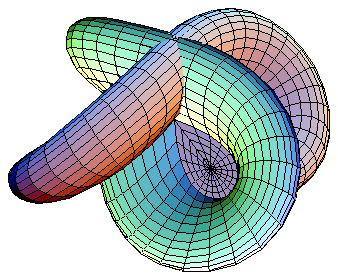

Simple illustration
A common way to picture the idea is to think about the Earth, which is essentially a sphere studied in geometry. Although the sphere is a curved, two-dimensional surface embedded in three-dimensional space, cartographers make many different flat maps that each represent part of the globe. No single flat map can represent the entire surface without distortion or cutting; instead, several maps are used with overlaps so that together they describe the whole sphere.
Other examples
- The hyperbolic plane is a two-dimensional manifold with a geometry unlike the usual plane: it has a saddle-like local shape and expands in a way that makes it impossible to flatten without distortion.
- Curves, surfaces, and higher-dimensional analogues occurring in physics and engineering are also manifolds if they satisfy the local-flatness condition.
Dimension
Every manifold has a fixed dimension, meaning the number of coordinates needed in each local chart. For the Earth example the dimension is two because each map is two-dimensional; a line is a one-dimensional manifold, and ordinary space around us is modeled as a three-dimensional manifold in many contexts.
Related articles
Author
AlegsaOnline.com Manifold (mathematics): spaces locally equivalent to Euclidean space Leandro Alegsa
URL: https://en.alegsaonline.com/art/61334