
Goldbach's conjecture
A major unsolved problem in additive number theory: the strong form asserts every even integer >2 is the sum of two primes; a related weak form concerns sums of three primes.
Goldbach's conjecture is a central open question in number theory that concerns expressing integers as sums of prime numbers. It exists in two closely related forms: the strong (or binary) Goldbach conjecture and the weak (or ternary) version. The conjecture has inspired much work in analytic and computational number theory and remains an accessible statement with deep consequences.
Image gallery
4 Images
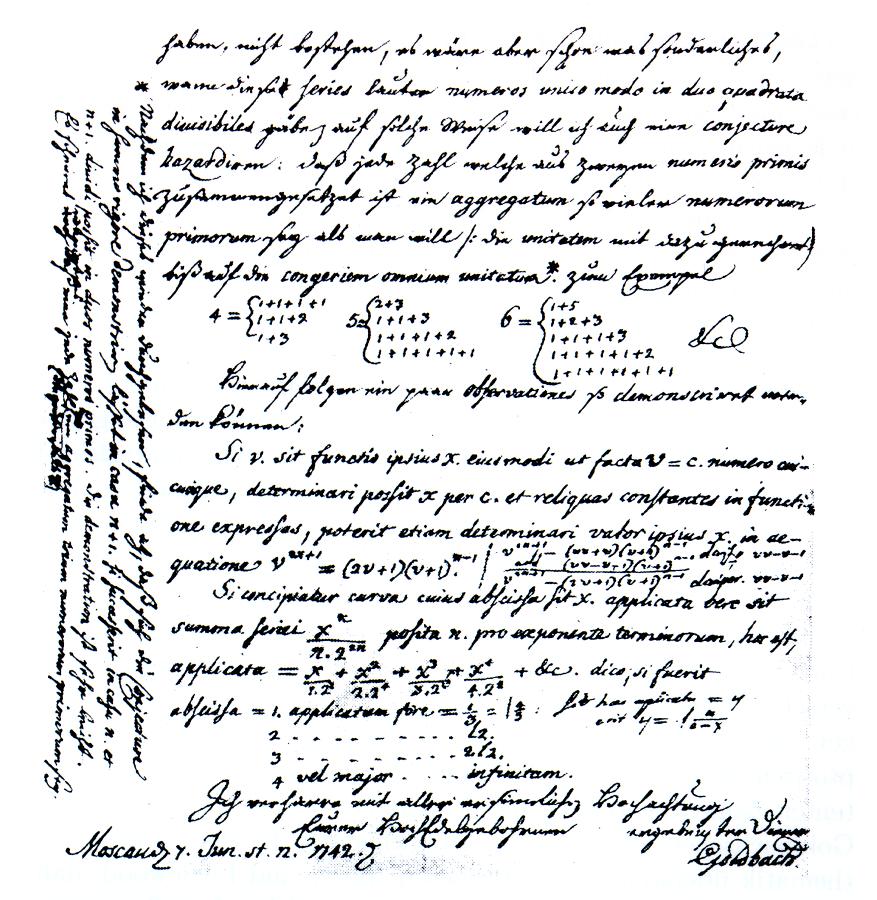


Statement and simple examples
The strong Goldbach conjecture asserts: every even integer greater than 2 can be written as the sum of two prime numbers. Examples familiar from small numbers include:
- 4 = 2 + 2
- 6 = 3 + 3
- 8 = 3 + 5
The weak Goldbach conjecture states that every odd integer greater than 5 can be expressed as the sum of three primes. These two formulations are related: if the strong conjecture holds, the weak follows quickly for large odd numbers.
History and major progress
The conjecture originated in a 1742 correspondence between Christian Goldbach and Leonhard Euler. Since then, partial results have accumulated. Analytic methods, including the circle method developed by Hardy and Littlewood and later refinements, established that sufficiently large integers meet the required representations under various technical conditions. Notably, Ivan Vinogradov showed in the 1930s that every sufficiently large odd integer is a sum of three primes. More recently, improvements and a complete proof of the weak form for all odd integers were announced by researchers building on these techniques.
Computational checks and methods
Extensive computer verifications have tested the strong conjecture for even numbers up to very large bounds, lending empirical support though not providing a proof. Techniques used in study of Goldbach include sieve methods, the Hardy–Littlewood circle method and estimates for exponential sums. Heuristic models predict how many representations an even number should have, but turning those heuristics into a rigorous proof remains difficult.
Significance and current status
Goldbach's conjecture is important as a concrete, easy-to-state problem that connects primes, additive structure and analytic techniques. It has motivated advances in prime distribution and computational number theory. Despite centuries of effort, the strong conjecture remains unproved, while the weak form, long treated as progress toward the strong, has been largely resolved by modern work. For further summaries and technical accounts see introductory resources and specialist surveys at research overviews.
Related articles
Author
AlegsaOnline.com Goldbach's conjecture Leandro Alegsa
URL: https://en.alegsaonline.com/art/39476
Sources
- math.dartmouth.edu : math.dartmouth.edu/~euler/correspondence/letters/OO0765.pdf