
Knot theory
Knot theory is the branch of topology that studies closed loops embedded in three-dimensional space, their classification, invariants, and applications in science and mathematics.
Knot theory is the area of mathematics concerned with the study of knots: closed loops embedded in three-dimensional space that cannot be undone without cutting. Unlike everyday knots in rope, mathematical knots have no loose ends and are considered up to continuous deformations (ambient isotopies). The subject blends visual intuition with algebraic and geometric tools to decide when two knot shapes are equivalent and to distinguish genuinely different knots.
Image gallery
10 Images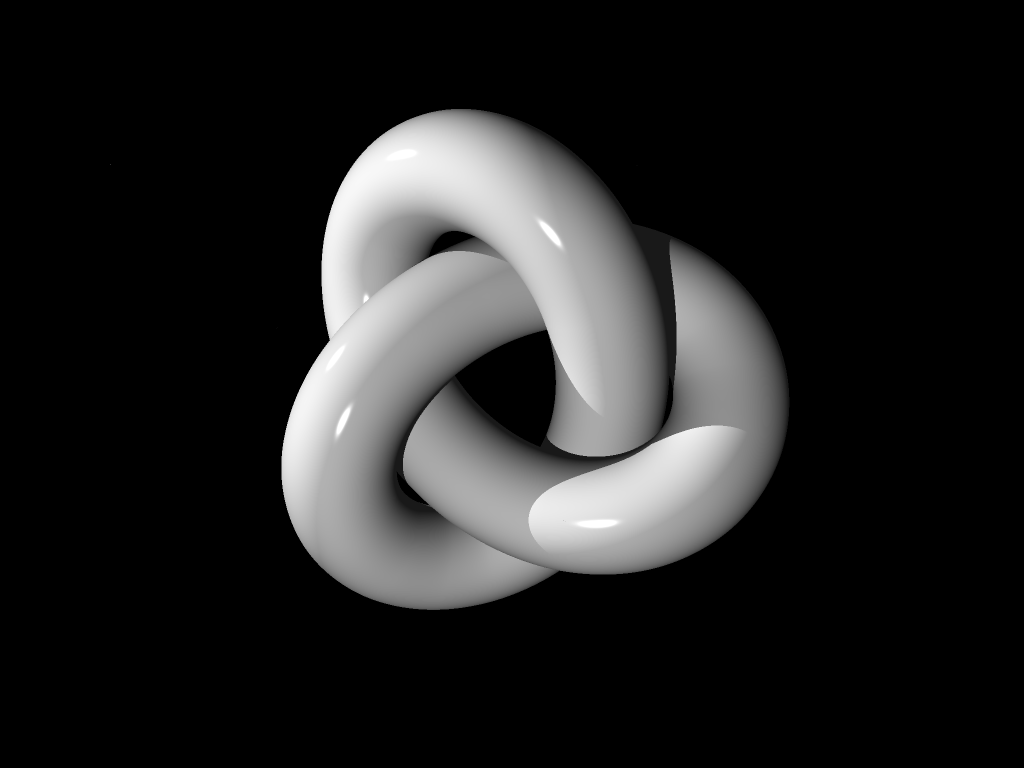



Key concepts and invariants
Important notions in knot theory include the knot diagram (a planar projection with crossing information), the crossing number (minimal crossings in any diagram), and the concept of the unknot (a simple loop equivalent to a round circle). To classify and compare knots mathematicians use invariants—quantities or algebraic objects unchanged by deformation. Common invariants are:
- Polynomial invariants such as the Alexander polynomial and the Jones polynomial;
- The knot group, the fundamental group of the knot complement;
- Topological measures like genus, bridge number, and unknotting number.
Reidemeister moves are three local diagrammatic operations that characterize when two diagrams represent the same knot; they form the basis for many algorithmic and theoretical arguments.
History and development
The modern study began in the 19th century when Peter Guthrie Tait compiled tables of knots while exploring physical theories of matter. Work continued through the 20th century with algebraic and combinatorial advances: Reidemeister's move-based approach, J. W. Alexander's polynomial invariant, and later breakthroughs such as Vaughan Jones's discovery of the Jones polynomial in the 1980s. More recent developments connect knot theory to quantum field theory and homological invariants.
Applications and examples
Knot theory has practical impact: the topology of DNA and proteins involves knotting and unknotting processes studied by biologists; chemists have synthesized molecular knots; and theoretical physics links knot invariants to quantum models. Classic examples include the trefoil knot (the simplest nontrivial knot, which is chiral) and the figure-eight knot (the simplest nontrivial knot that is amphichiral).
Distinctions such as knots versus links (several interlaced loops), prime versus composite knots, and chirality (mirror asymmetry) help organize the subject. While classification of small knots is well developed, many algorithmic and conceptual problems remain active areas of research.
Related articles
Author
AlegsaOnline.com Knot theory Leandro Alegsa
URL: https://en.alegsaonline.com/art/54013