
Gang of Four (Chinese political faction)
Political faction of four Chinese Communist Party officials who rose during the Cultural Revolution, were arrested after Mao's death, tried and imprisoned; their influence and legacy remain debated.
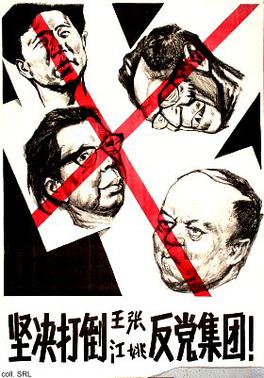
The Gang of Four was a political grouping of four high-profile Chinese Communist Party officials who became prominent during the Cultural Revolution. The group was centered on Jiang Qing, the last wife of Mao Zedong, and included Zhang Chunqiao, Yao Wenyuan and Wang Hongwen. Their name in Chinese appears in different scripts and romanization systems, for example 四人帮 (simplified), 四人幫 (traditional) and Sìrén bāng (pinyin).
Image gallery
3 Images

Who they were and what they did
Members of the group occupied influential positions in propaganda, cultural policy and political organization during a period of political upheaval. Jiang Qing was a leading figure in directing cultural affairs and left a strong imprint on theater, film and artistic campaigns. Yao Wenyuan acted as a critic and propagandist whose writings were used to justify political campaigns. Zhang Chunqiao emerged from Shanghai politics and was involved in organizational matters, while Wang Hongwen, a comparatively younger leader, held party posts that helped the group extend power within the central apparatus.
Rise during the Cultural Revolution
The Gang of Four rose to prominence amid the mass movement known as the Cultural Revolution, a decade-long campaign that reshaped Chinese politics and society. They were associated with radical policies that attacked perceived ideological enemies and promoted strict cultural controls. Their influence relied on close ties to Mao Zedong and on their ability to direct media and cultural institutions. Broadly speaking, their prominence reflected factional struggles inside the Chinese Communist Party as much as their personal initiatives.
Arrest, trial and sentences
After the death of Mao Zedong, party leaders moved to reassert control and remove powerful radicals. The members of the Gang of Four were arrested in 1976 and subsequently detained; official accounts accused them of conspiring to seize power and of responsibility for the excesses of the Cultural Revolution. Contemporary reports describe their detention as part of an effort to stabilize leadership. The arrests are often characterized as an attempt to prevent a power grab (coup) and to restore party order. The group was formally charged, tried, and given prison sentences: initial death sentences for two members were later commuted to long terms, while other members received lengthy prison terms. Official reports and later accounts discuss the legal proceedings and sentence changes in that context (arrested, trial, sentence revisions).
Aftermath and deaths
Their convictions and imprisonment marked a turning point in post-Mao Chinese politics. Over subsequent decades members were released at different times; public attention to them declined as the country moved in new directions. Jiang Qing died by suicide in 1991, a fact noted in many historical summaries (Jiang Qing death). The other three members died later, after release from prison, and their fates have been recorded in public sources. The handling of the Gang of Four—both their rise and their removal—remains a significant episode in understanding the transition from the Cultural Revolution to the reform era.
Significance and interpretations
Historians and commentators offer multiple interpretations of the Gang of Four's role. Some portray them as the chief architects of repressive policies during the Cultural Revolution; others view them as part of a wider system of factional politics centered on Mao's personality and the radicalizing pressures of the time. Their story is frequently cited in discussions of how revolutionary movements can produce concentrated personal power, and how successor leaderships address the legacy of political turmoil. For background on the broader institutional setting, see references to the Chinese Communist Party (CCP), Mao Zedong (Mao), and the country where these events took place (China) during the Cultural Revolution (Cultural Revolution).
Key facts at a glance
- Principal figures: Jiang Qing, Zhang Chunqiao, Yao Wenyuan, Wang Hongwen.
- Period of greatest influence: Cultural Revolution era.
- Removed from power and arrested in 1976; later tried and imprisoned.
- The episode marks a major shift in Chinese politics after Mao's death.
The Gang of Four remains a focal subject for studies of political power, cultural policy, and the dynamics of revolutionary leadership. For additional context and primary-source materials see archival and scholarly discussions linked from specialist pages (Chinese name, traditional script, romanization, and other resources listed above).
Related articles
Author
AlegsaOnline.com Gang of Four (Chinese political faction) Leandro Alegsa
URL: https://en.alegsaonline.com/art/37455