
Galileo (spacecraft): NASA's exploration of Jupiter and its moons
Uncrewed NASA spacecraft launched in 1989 that studied Jupiter, its atmosphere, rings and Galilean moons; delivered an atmospheric probe in 1995 and was deliberately deorbited in 2003.
The Galileo mission was an uncrewed planetary exploration program led by NASA that examined the Jovian system in detail. Launched in 1989, the mission delivered both an orbiting spacecraft and an atmospheric entry probe to the neighborhood of Jupiter. Over nearly a decade of operations, Galileo returned the most comprehensive set of observations of Jupiter, its faint rings and its large moons, transforming our understanding of the largest planet in the Solar System.
Image gallery
10 Images




Spacecraft design and components
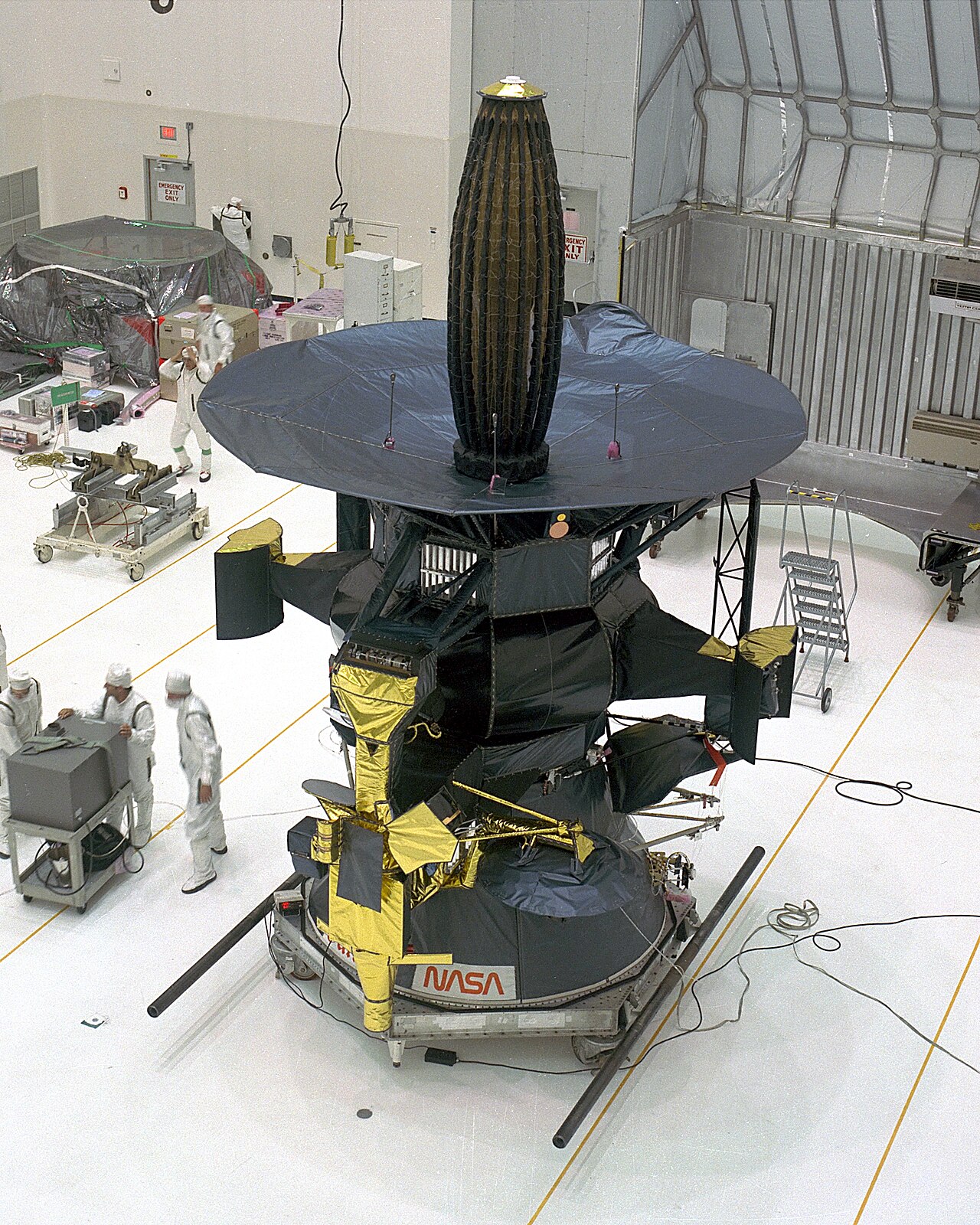
Galileo consisted of two primary elements: an orbiter that conducted long-term remote sensing and in-situ studies from orbit, and a separate atmospheric probe that descended directly into Jupiter's atmosphere. The craft carried a suite of scientific instruments, including imaging systems, spectrometers, magnetometers and particle detectors to measure fields and charged particles, along with radio and atmospheric sensors. Electrical power and heating came from radioisotope thermoelectric generators rather than solar panels because of the low sunlight at Jupiter. A deployment issue with the spacecraft's high-gain antenna reduced data rates, but mission teams compensated with clever use of data compression, onboard storage and careful planning.
Mission timeline and key events
After its 1989 launch, Galileo used gravity-assist flybys to reach Jupiter, arriving in the system in 1995. The mission released its atmospheric entry probe on July 13, 1995; that probe entered Jupiter and transmitted direct measurements of temperature, pressure and composition for about 57 minutes before its instruments were disabled by intense heat and pressure. The orbiter itself began a long campaign of observations after insertion into Jovian orbit on December 8, 1995, making repeated close encounters with the Galilean moons and numerous passes through Jupiter's magnetosphere.
Scientific discoveries and importance
Galileo's observations delivered several landmark results. The mission documented active volcanism on Io, mapped complex interactions between Io's eruptions and Jupiter's magnetosphere, and provided strong evidence that Europa harbors a subsurface saltwater ocean beneath its icy crust. Galileo also established that Ganymede possesses its own intrinsic magnetic field and supplied detailed information on Callisto's ancient, heavily cratered surface. In addition to moon science, the orbiter studied Jupiter's atmospheric dynamics, chemistry and layered cloud structure, and investigated the planet's ring system and plasma environment.
Operational challenges and legacy
Technical and operational hurdles—most notably the partially stuck high-gain antenna—constrained data return but did not prevent major scientific success. The mission's extended observations and targeted moon flybys enabled discoveries that shaped future exploration priorities, influencing follow-on missions to Jupiter and its moons. Data from Galileo continue to be a foundation for planning and interpreting missions such as Juno and the upcoming Europa-focused missions.
End of mission and planetary protection
To prevent the unlikely but unacceptable risk of contaminating potentially habitable worlds, mission planners chose to end Galileo by sending the orbiter into Jupiter's atmosphere. The spacecraft made a controlled descent and was destroyed on impact on September 21, 2003, ensuring it could not accidentally collide with Europa or another satellite. For background and technical references about the mission and its instruments, see the program pages and archival resources at mission archives, detailed mission timelines at arrival and operations summaries, and compilations of Galilean moon studies at related lunar science portals. Additional public resources and historical notes can be found via agency archives and scientific review pages at technical reports and mission closure summaries. For further outreach and educational materials consult public data sets and mission overviews at NASA and affiliated repositories.
Related articles
Author
AlegsaOnline.com Galileo (spacecraft): NASA's exploration of Jupiter and its moons Leandro Alegsa
URL: https://en.alegsaonline.com/art/37292
Sources
- spaceref.com : "The Final Day on Galileo - Sunday, September 21, 2003"
- jpl.nasa.gov : "Galileo Jupiter Arrival"
- ui.adsabs.harvard.edu : 1992SSRv...60...23D
- doi.org : 10.1007/BF00216849
- ipnpr.jpl.nasa.gov : "Galileo Early Cruise, Including Venus, First Earth, and Gaspra Encounters"
- solarsystem.nasa.gov : "NASA: Solar System Exploration: Missions: By Target: Jupiter: Past: Galileo"
- solarsystem.nasa.gov : "NASA: Solar System Exploration: Galileo Legacy Site"
- commons.wikimedia.org : Galileo mission