
Gamma-ray burst
A concise encyclopedia article on gamma‑ray bursts: brief, extremely energetic flashes of gamma rays from distant galaxies, their types, origins, detection history, afterglows, and scientific importance.
Gamma‑ray bursts (GRBs) are short, intense flashes of high‑energy radiation observed from outside the Solar System. They are produced as sudden releases of gamma rays, and rank among the most luminous phenomena in the electromagnetic sky. Distant GRBs have been detected across the universe, typically followed by a longer‑lasting "afterglow" at lower energies.
Image gallery
10 Images




Characteristics
Bursts vary widely in duration and brightness. Individual events can last from milliseconds to minutes, though many last only a few seconds. The prompt emission is dominated by gamma rays and is succeeded by afterglow emission observed in X‑ray, ultraviolet, optical, infrared and radio bands. Observed light curves and spectra differ from one burst to another, and often show rapid variability and spectral evolution.
- Duration classes: "short" (milliseconds–~2 s) and "long" (seconds–minutes).
- Afterglows allow precise localization and host galaxy identification.
- Many bursts are strongly beamed, so observed energy can exceed ordinary supernova output when corrected for direction.
Origins and progenitors
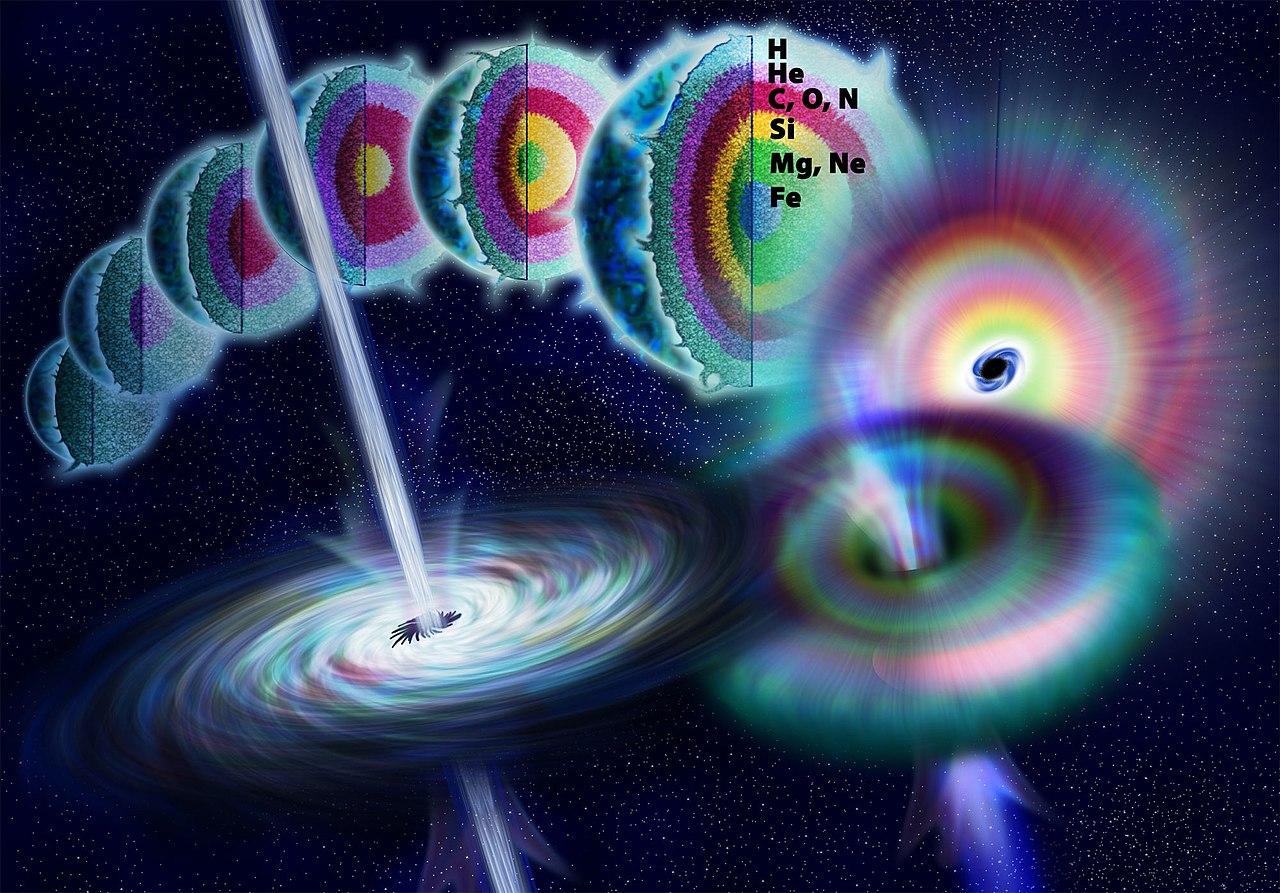
GRBs arise from more than one astrophysical channel. Long‑duration bursts are closely linked to the deaths of massive stars: a collapsing, rapidly rotating star can power a relativistic jet during a core collapse and associated supernova, ultimately producing a compact remnant such as a black hole. Short‑duration bursts are widely attributed to mergers of compact objects, for example binary systems containing neutron stars or a neutron star and a black hole. These catastrophic events release enormous amounts of energy on short timescales.
History and detection
GRBs were first discovered accidentally by military satellites monitoring nuclear tests and later established as cosmic in origin. Dedicated space observatories and instruments, including wide‑field gamma‑ray detectors and rapid‑response X‑ray and optical telescopes, have mapped thousands of events. Measurements routinely place GRBs at cosmological distances: many sources are located billions (billions) of light years from Earth, implying prodigious intrinsic energies compared with ordinary stellar processes.
Importance and effects
Because a single GRB can emit as much energy in seconds as a star like the Sun emits over its multi‑billion‑year lifetime, GRBs are important probes of extreme physics, jet formation, relativistic shocks and nucleosynthesis. They serve as beacons for studying star formation, the interstellar medium and the early universe. Although the rate per galaxy is low—roughly a few per million years—astronomers consider the potential hazard from a nearby GRB; a burst inside our galaxy could have serious atmospheric effects.
Distinctions and notable facts
All well‑established classical GRBs observed so far originate beyond the Milky Way, whereas certain high‑energy transients inside our galaxy, such as giant flares from magnetars, produce repeating gamma‑ray activity but differ in origin and timescale. Scientists have speculated that a sufficiently close GRB might trigger biological consequences on Earth and contribute to mass extinctions, though no confirmed historical example exists and the scenario remains a subject of study in astrobiology and planetary protection literature (extinction research).
Questions and answers
Q: What are gamma-ray bursts?
A: Gamma-ray bursts (GRBs) are flashes of gamma rays from extremely energetic explosions.
Q: How long do GRBs typically last?
A: GRBs can last from milliseconds to several minutes, although a typical burst lasts a few seconds.
Q: What is the source of most GRBs?
A: Most GRBs are a narrow beam of intense radiation released during a supernova, as a huge rapidly spinning star collapses to form a black hole.
Q: Where do most observed GRBs come from?
A: All observed GRBs have come from outside the Milky Way galaxy.
Q: How much energy does an average burst release?
A: A typical burst releases as much energy in a few seconds as the Sun will in its entire 10 billion year lifetime.
Q: How rare are GRB events?
A: They are very rare (a few per galaxy per million years).
Q: Could there be any danger posed by gamma-ray bursts within our own galaxy?
A: It has been suggested that a gamma-ray burst in the Milky Way could cause a mass extinction on Earth, but no such case is known.
Related articles
Author
AlegsaOnline.com Gamma-ray burst Leandro Alegsa
URL: https://en.alegsaonline.com/art/37423
Sources
- ui.adsabs.harvard.edu : 2001ApJ...562L..55F
- doi.org : 10.1086/338119
- ui.adsabs.harvard.edu : 2004ApJ...607L..17P
- doi.org : 10.1086/421347
- doi.org : 10.1017/S1473550404001910
- articles.adsabs.harvard.edu : articles.adsabs.harvard.edu/full/1973ApJ...182L..85K
- ui.adsabs.harvard.edu : 2006ARA&A..44..507W
- doi.org : 10.1146/annurev.astro.43.072103.150558
- ui.adsabs.harvard.edu : 2010MNRAS.402.1523P
- doi.org : 10.1111/j.1365-2966.2009.16017.x
- ui.adsabs.harvard.edu : 2009arXiv0904.0261R
- doi.org : 10.1088/0004-637X/702/1/489
- ui.adsabs.harvard.edu : 2009Sci...323.1688A
- doi.org : 10.1126/science.1169101
- pubmed.ncbi.nlm.nih.gov : 19228997