
Fresnel lens — design, history and applications
A Fresnel lens is a lightweight, segmented optical lens developed for lighthouses; it allows large apertures and short focal lengths with far less material than conventional lenses.
Overview
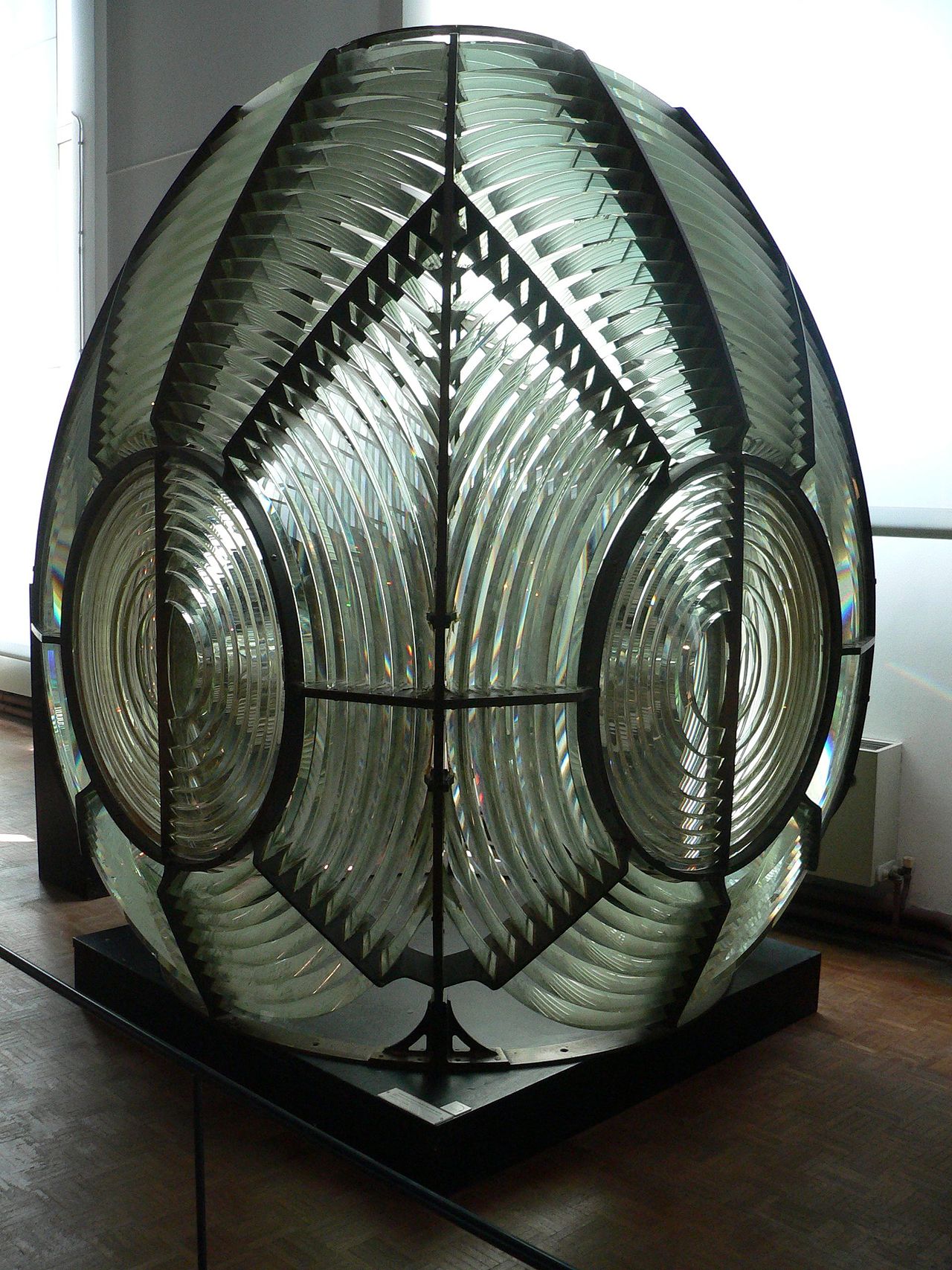
A Fresnel lens is a type of optical lens designed to capture or project light efficiently while using much less bulk than a traditional solid lens. The structure breaks a conventional curved surface into a series of concentric annular sections, each one a portion of the original curvature. This stepped form preserves the focusing or collimating action of a thick lens but dramatically reduces weight and material. The design is widely associated with maritime navigation and lighthouses, but it has found many modern uses in optics, lighting and solar energy.
Image gallery
10 Images




Design and characteristics
Instead of a single continuous curved surface, a Fresnel lens approximates that surface by many thin rings (called "grooves" or "zones"). Each ring refracts light as the corresponding part of the original lens would have done. Because the lens is much thinner, it can have a very large aperture and relatively short focal length without the mass or absorption losses of a thick lens. Materials range from molded acrylics and other plastics used for inexpensive or lightweight versions to glass in historical and high-performance examples.
History and development
The lens is named after Augustin-Jean Fresnel, the French physicist who developed the practical design in the early 19th century to improve lighthouse beams. The pronunciation of Fresnel is /freɪˈnɛl/ (fray-NELL), with a silent 's'. Earlier thinkers, including Buffon and Condorcet, had suggested similar concepts for concentrating sunlight, but Fresnel created the form and optical theory that made large, efficient navigation lenses possible. His work transformed coastal lighting and greatly extended the visible range of beacons.
Applications and examples
Fresnel lenses appear in many settings beyond maritime beacons. Typical uses include:
- Optical collimators and spotlights, where a compact lens can create a narrow beam.
- Overhead projectors, stage lighting and camera flashes, taking advantage of light-gathering ability.
- Magnifiers and reading aids that offer large, lightweight viewing areas.
- Solar concentrators and collectors that focus sunlight onto a smaller receiver for heating or photovoltaics.
- Modern compact devices such as virtual-reality headsets, traffic signals and automotive lighting.
Advantages and limitations
Advantages include lower weight and cost, the ability to produce large apertures, and efficient transmission for many illumination tasks. Manufacturing methods such as molding, stamping or precise machining make production economical for plastics and glass alike. However, stepped surfaces introduce trade-offs: prominent ridges can scatter or diffract light, reducing image sharpness compared with a continuous lens. Chromatic aberration, reduced resolving power for imaging, and surface wear in plastic versions are common limitations to consider when choosing a Fresnel lens for precision optics.
Types and notable distinctions
Fresnel lenses come in several forms. A classical lighthouse Fresnel is often large and glass-made, sometimes described by "orders" that indicate size and focal properties in historical practice. Compact, molded plastic Fresnel sheets are used as lightweight magnifiers or in backlight assemblies. Some designs are "binary" or stepped for manufacturing simplicity, while others use smoother segment transitions to improve optical quality. When comparing a Fresnel lens to a conventional plano-convex or biconvex lens, the chief considerations are weight, image quality needs, and cost.
For further technical details or historical references, consult specialist texts on optical engineering or dedicated heritage sources on maritime lighting. Related entries include general optical lens theory and biographies of key figures such as French scientists and inventors. Technical guides on lighthouse optics, materials, and manufacturing may be found via archival and contemporary resources: see materials on lighthouse engineering (Fresnel technologies), historical proposals by Buffon and Condorcet, and modern applications in lighting and solar design (aperture and focal length considerations).
Related articles
Author
AlegsaOnline.com Fresnel lens — design, history and applications Leandro Alegsa
URL: https://en.alegsaonline.com/art/36656