
Ampersand: history, forms, and uses
Overview of the ampersand (&): its origin as a ligature of Latin 'et', typographic and handwritten forms, modern uses in writing and design, and technical considerations.
Overview
The ampersand (&) is a single-character symbol used to represent the conjunction "and." It functions as a logogram — a written sign that stands for a word or morpheme — and is widely recognised in many modern scripts and typefaces. The character commonly appears in printing, signage, branding, and informal handwriting as a compact alternative to the word "and". For a concise definition see logogram.
Image gallery
6 Images


Origins and development
The ampersand began as a ligature: a fusion of the Latin letters e and t that spelled the conjunction et, meaning "and". Over centuries of cursive writing and scribal abbreviation the joined form simplified and stylised into a distinct glyph. Early medieval and Renaissance scribes used variations of this ligature; later, printers and type designers incorporated myriad designs into metal type and digital fonts. The basic historical connection to the Latin et remains the defining origin story.
Characteristics and typographic forms
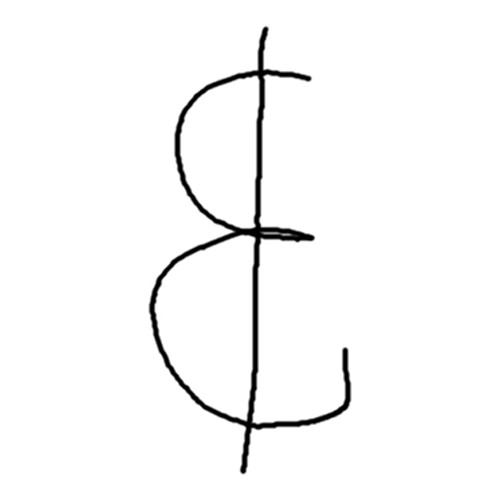
Ampersands appear in many shapes depending on handwriting, typeface anatomy and historical style. In serif typefaces the ampersand often recalls the original calligraphic join of e and t, while in modern sans-serif faces it may reduce to a geometric or stroke-based mark. Handwritten ampersands are frequently drawn as a reversed "3" with a crossing stroke. The symbol is also encoded in character standards; developers and designers refer to mappings such as Unicode and to conventions for escaping it in markup languages.
Uses and examples
The ampersand sees broad use in company names, book titles, legal firm listings and artistic logos because it connects elements while conserving space and visual balance. In informal notes it shortens text; in typography it can serve as a decorative element. In computing and markup languages the character can carry special meaning: for example, in HTML the ampersand introduces character entities and therefore must be escaped in text according to HTML rules. In several programming languages a related single-character token (often &) represents logical or bitwise operations rather than the word "and."
Related forms and notable facts
An historic shorthand for "et cetera" uses the ampersand: older texts and printers frequently wrote "&c" as an abbreviation corresponding to "etc." Modern practice favours the three-letter form "etc." but the surviving notation provides a visible link to earlier typographic habits. The ampersand also appears in decorative and calligraphic contexts where designers create ornamental variants distinct from the functional symbol.
Practical guidance
- Use an ampersand in names and branding when space, style or legal usage prefers the symbol.
- Avoid replacing the word "and" with an ampersand in formal prose unless part of a proper name or required by style guidelines.
- When producing web content remember to escape or encode the ampersand per HTML and character-encoding recommendations to prevent parsing issues.
For further historical background and typographic examples see linked resources on script history and symbol usage such as etymology and typographic studies, and introductory references on written symbols at logogram and Unicode.
Related articles
Author
AlegsaOnline.com Ampersand: history, forms, and uses Leandro Alegsa
URL: https://en.alegsaonline.com/art/3644
Sources
- merriam-webster.com : "The ampersand & more"