
Ammonium sulfate
Ammonium sulfate ((NH4)2SO4) is a white crystalline salt used mainly as a fertilizer to supply nitrogen and sulfur; it has industrial and laboratory uses and is produced by neutralizing ammonia with sulfuric acid.
Ammonium sulfate is an inorganic salt with the chemical formula (NH4)2SO4. It appears as a white crystalline solid that dissolves in water and is widely produced for agricultural and industrial use. As a soluble source of nitrogen and sulfur it is an important fertilizer for many crops and soils.
Image gallery
2 Images
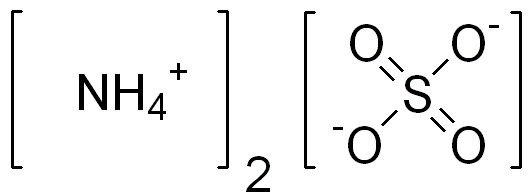
Chemistry and physical properties
The compound contains ammonium cations and sulfate anions. In aqueous solution it is mildly acidic because the ammonium ion is the conjugate acid of ammonia. When heated strongly it decomposes, releasing nitrogen‑ and sulfur‑containing gases rather than melting to a stable liquid. It is generally odorless and non‑volatile under normal storage conditions.
Production
Commercially, ammonium sulfate is produced by neutralizing gaseous or aqueous ammonia with sulfuric acid, a reaction that yields the crystalline salt: two equivalents of ammonia plus one of sulfuric acid. It can also appear as a by‑product in some chemical manufacturing processes. For more technical details see compound information.
Uses and applications
The leading use is as a fertilizer (fertilizers), supplying both nitrogen and sulfur to plants. It is favored on alkaline soils because its acidity helps lower pH locally. Industrial and laboratory roles include protein precipitation in biochemistry, textile dyeing, and as a component in certain fire retardant formulations. Agricultural and technical literature discuss ammonium (ammonium) and sulfate (sulfate) dosing strategies.
History, occurrence and regulation
Pure ammonium sulfate is uncommon as a natural mineral but can form in volcanic fumaroles or in decomposing organic deposits. It is manufactured in large quantities worldwide. Because the salt supplies accessible nitrogen and sulfur, some jurisdictions have adopted controls or monitoring where diversion to illicit uses has been a concern; guidance is available from regulatory and safety sources (ammonia, sulfuric acid).
Handling and environmental notes
- Safe storage: keep dry and avoid contamination.
- Agronomic note: over‑application can acidify soils and affect crop uptake.
- Laboratory: used routinely for protein fractionation ("salt out").
For practical use and safety data consult material safety sheets and agricultural extension resources or technical summaries available from suppliers and research organizations (compound data).
Related articles
Author
AlegsaOnline.com Ammonium sulfate Leandro Alegsa
URL: https://en.alegsaonline.com/art/3596