
Arabic alphabet
Overview of the Arabic alphabet: its abjad nature, cursive letter forms, vowel marks and diacritics, historical development, calligraphic styles, adaptations for other languages, and modern digital use.
The Arabic writing system is an abjad and is written from right to left. It developed to write the Arabic language and later adapted to write many other languages across the Middle East, Central and South Asia and parts of Africa. As an abjad, its basic letters primarily represent consonants; short vowels are normally indicated by optional diacritics while long vowels are represented by letters. The script is among the world’s most widely used writing systems, alongside the Latin and Chinese scripts.
Image gallery
9 Images




Basic features
The classical Arabic inventory includes twenty-eight primary letters. The script is inherently cursive: most letters connect to adjacent letters and display distinct initial, medial, final and isolated forms. A small group of letters do not join to the following letter, creating visible breaks within words. Common orthographic elements include the hamza (glottal stop), madda (long initial vowel), shadda (consonant doubling) and a set of marks for short vowels and nunation.
Orthography and diacritics
- Short vowels: fatḥa, kasra and ḍamma are written as diacritic marks above or below letters.
- Consonant doubling and absence of vowel: shadda indicates gemination; sukun marks the absence of a vowel.
- Hamza and madda: special signs handle the glottal stop and long initial vowels, with rules that affect writing and pronunciation.
- Definite article and assimilation: orthographic conventions such as the article and the sun–moon letter distinction influence pronunciation and spelling.
Letter joining, ligatures and order
Most letters have up to four contextual forms; a small set of non-joining letters (for example alef, dal, dhal, ra, zay and waw in Arabic) interrupt the cursive flow. Some combinations produce mandatory ligatures in traditional typography, the most common being the lam–alif ligature. Alphabetical order exists in traditional abjad order and in a modern order used for dictionaries and educational materials.
History and calligraphy
The script evolved from earlier Semitic writing systems and the Nabataean script before becoming widely used with the spread of Arabic as a written language. Over centuries it developed a rich calligraphic tradition: early monumental Kufic, the clear and widely used Naskh, the ornamental Thuluth, and the flowing Nastaliq associated with Persian and South Asian literatures. Calligraphic practice shaped letter proportions, ligatures and decorative conventions.
Adaptations to other languages
When adopted for languages such as Persian, Pashto and Urdu, writers added letters and diacritics to represent sounds not present in Arabic. Examples include letters for /p/, /g/ and affricates. The script also appears in other regional contexts and has been used to write a range of minority and regional languages with further modifications.
Modern use, typography and computing
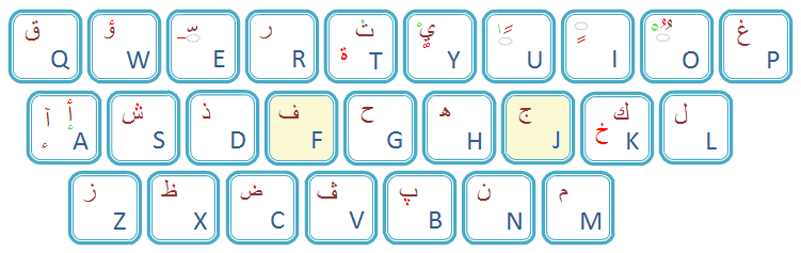
Printing, publishing and digital typography have standardized many letter shapes and introduced fonts suited to display and body text, while preserving calligraphic styles for art and headings. In computing, the Arabic script is encoded in Unicode and supported by modern operating systems and web technologies; open and proprietary fonts implement contextual shaping, ligatures and bidirectional layout required by right-to-left text. Keyboard layouts and input methods vary by language and region.
For introductory overviews and more detailed technical treatments consult general references on scripts, typographic resources and language-specific orthographies. This article provides a concise summary; specialized topics include historical paleography, regional orthographic rules and script pedagogy for non-native learners. See examples of the script in different languages and contexts: Persian, Pashto, Urdu, and broad overviews at general language and script resources: abjad, region, Arabic, Latin comparison, other major scripts.
Questions and answers
Q: What is the Arabic alphabet?
A: The Arabic alphabet is a writing system that is used to write several languages of the Middle East such as Arabic, Persian, Pashto and Urdu.
Q: Which languages use the Arabic alphabet?
A: The Arabic alphabet is used to write several languages of the Middle East such as Arabic, Persian, Pashto and Urdu.
Q: How widely is the Arabic script used in the world?
A: The Arabic script is the third most widely used writing system in the world.
Q: What are the two most widely used scripts in the world?
A: The two most widely used scripts in the world are the Latin and Chinese scripts.
Q: Is the Arabic script only used for writing Arabic language?
A: No, the Arabic script is used to write several languages of the Middle East such as Arabic, Persian, Pashto and Urdu.
Q: What is unique about the Arabic alphabet?
A: The Arabic alphabet is an abjad (a writing system that doesn't include vowels) which is unique as most writing systems including vowels.
Q: How important is the Arabic alphabet in the world?
A: The Arabic alphabet is an important writing system, especially in the Middle East, where it is widely used. It is also used in Islamic religious texts and calligraphy.
Author
AlegsaOnline.com Arabic alphabet Leandro Alegsa
URL: https://en.alegsaonline.com/art/5134
Sources
- basementgeographer.com : "Conversion to the Latin Alphabet in Post-Soviet Asia"