
Flag of Mexico
The national flag of Mexico is a vertical tricolor of green, white and red with a central coat of arms showing an eagle, a snake and a cactus; its design dates to 1821 and the emblem was last revised in 1968.
The flag of the United Mexican States is a vertical tricolor of green, white and red with a distinctive national coat of arms centered on the white stripe. The flag represents the modern state of Mexico and is one of the country's primary national symbols, used on public buildings, during ceremonies, and on official documents.
Image gallery
10 Images






Design and components
The basic composition is three equal vertical bands—green at the hoist, white in the center and red at the fly—with the Mexican coat of arms placed in the middle of the white band. The coat of arms depicts a golden eagle perched on a prickly pear cactus while holding a serpent in its beak and talon; the cactus rises from a rock set in water. Beneath the scene a wreath is formed by branches of oak and laurel bound with a ribbon in the national colors. Together these elements are rendered with heraldic detail and appear only on the central stripe.
Symbolism and meanings
The meanings attached to the flag's colors have evolved. Early republican interpretations linked green to independence, white to religion or purity, and red to union or the blood of nationals who fought. Over time popular explanations shifted toward ideals such as hope (green), unity or faith (white), and the blood of national heroes (red). The same tricolor first identified the forces that sought independence from Spain in the early 19th century.
Origins and historical development
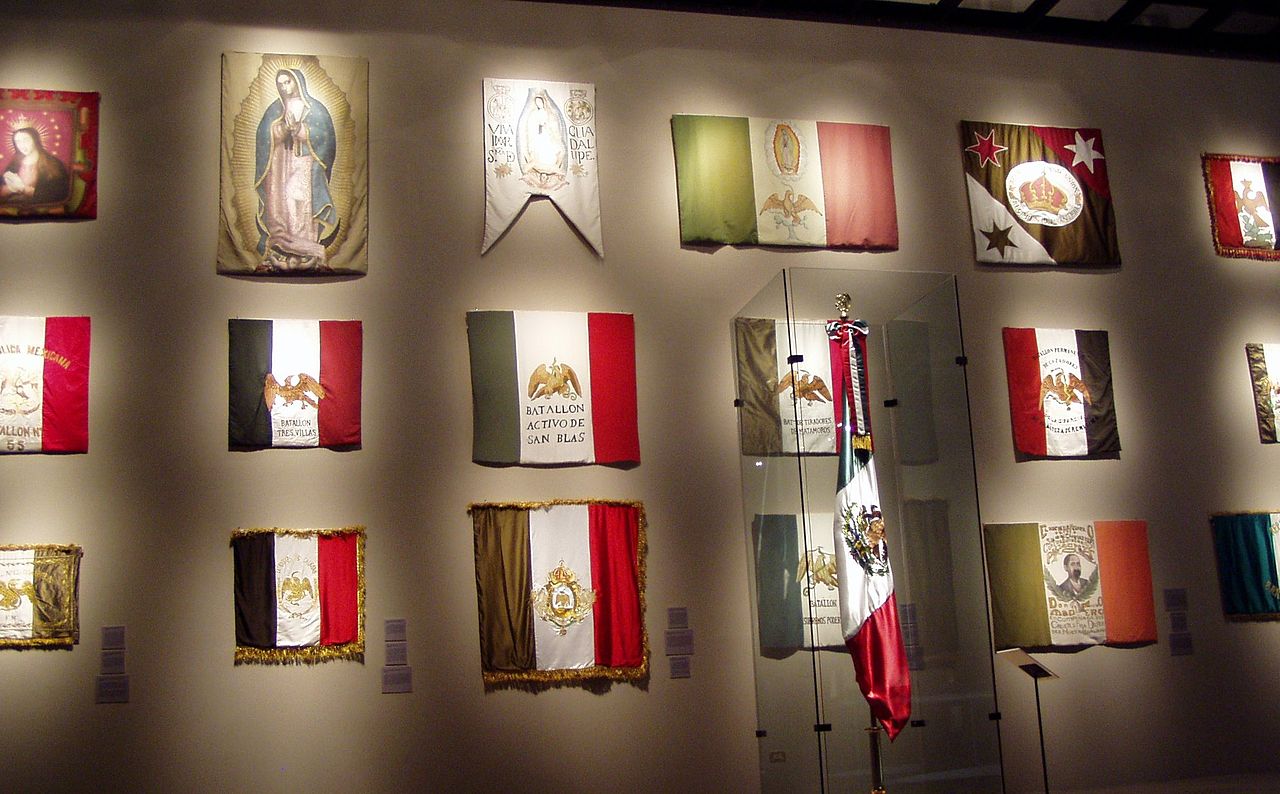
The tricolor arrangement emerged during the independence era and has been associated with Mexican national identity since around 1821. The central emblem is derived from an ancient Aztec foundation legend: hungry migrants were to establish a capital where they saw an eagle perched on a cactus devouring a serpent, the sign that marked Tenochtitlan, the island city that later became Mexico City. The image alludes to the former Aztec Empire and links modern Mexico to its pre‑Hispanic past. While the tricolor layout dates to the early republican period, the artistic form of the coat of arms has been modified periodically and was standardized in 1968.
Legal status, protocol and use
Mexican law regulates how the flag and its emblem may be displayed and reproduced. The flag is treated with ceremonial respect and specific rules cover cases such as vertical hanging, half‑mast display for mourning, and use by government agencies and schools. The nation's legislation on symbols—covering the coat of arms, flag and anthem—codifies these practices. The national emblem appears on the flag and in many official seals; care is taken to reproduce its details correctly in color and proportion.
Notable facts and distinctions
- The flag's tricolor echoes other national flags but is readily distinguishable by the central coat of arms on the white stripe.
- Mexico celebrates its flag and civic symbols through ceremonies and an annual Flag Day, which emphasizes respect and education about national emblems.
- The image of the eagle, cactus and serpent is among the country's most recognizable motifs and appears in monuments, currency and institutional logos.
For further references on specific elements, historical documents and official protocols see the national descriptions and official publications associated with the flag and coat of arms (national emblem). Additional resources discuss the flag's colors (green, white, red), the eagle motif (eagle), and the historical context of independence and pre‑Hispanic symbolism (Spain, Aztec, Tenochtitlan, Mexico City, Aztec Empire).
Questions and answers
Q: What are the colors of the Mexican flag?
A: The colors of the Mexican flag are green, white, and red.
Q: What is the significance of the colors of the Mexican flag?
A: The meaning of the colors has changed over time, but they were adopted by Mexico during the country's War of Independence. Red, white, and green are the colors of the national liberation army in Mexico.
Q: What is the emblem in the center of the white stripe of the Mexican flag?
A: The emblem in the center of the white stripe of the Mexican flag is an eagle charged.
Q: What is the significance of the emblem in the center of the white stripe of the Mexican flag?
A: The emblem in the center of the white stripe of the Mexican flag is the ancient Aztec symbol for Tenochtitlan (now Mexico City), the center of the Aztec Empire. It recalls the legend that inspired the Aztecs to settle on what was originally a lake-island.
Q: When was the current design of the Mexican flag adopted?
A: The current design of the Mexican flag was adopted in 1968, but the design has been used since 1821.
Q: What law governs the use of the national flag of Mexico?
A: The law that governs the use of the national flag of Mexico is the Law on the National Arms, Flag, and Anthem. It has been in place since 1984.
Q: What is the legend behind the coat of arms on the Mexican flag?
A: The legend behind the coat of arms on the Mexican flag is that the Aztecs should found their city on the spot where they saw an eagle on a cactus, eating a snake.
Author
AlegsaOnline.com Flag of Mexico Leandro Alegsa
URL: https://en.alegsaonline.com/art/34851