
Fazlur Rahman Khan
Bangladeshi‑American structural engineer (1929–1982) who pioneered tubular systems for skyscrapers and led the designs of the John Hancock Center and the Willis Tower in Chicago.
Fazlur Rahman Khan (April 3, 1929 – March 27, 1982) was a Bangladeshi‑American structural engineer and designer whose innovations reshaped high‑rise architecture. Working primarily in Chicago, Illinois, Khan developed structural systems that made very tall buildings more efficient, economical and architecturally expressive.
Khan was born on April 3, 1929, in Dhaka (then part of British India). He completed undergraduate studies in civil engineering at institutions in South Asia and later moved to the United States for graduate study, earning advanced degrees at the University of Illinois. He joined the Chicago office of Skidmore, Owings & Merrill, where he led structural design on several landmark projects.
Image gallery
10 Images


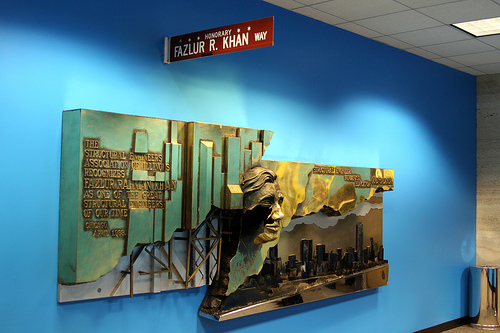

Design innovations
Khan is best known for inventing and popularizing the tubular structural concept for tall buildings. Variants include the framed tube, the trussed tube (with visible exterior bracing), and the bundled tube. These approaches treat the exterior perimeter of a skyscraper as a hollow tube, resisting lateral loads such as wind more efficiently than earlier column‑and‑beam systems.
- Framed tube: columns and deep spandrel beams at the exterior create a stiff, load‑bearing perimeter.
- Trussed tube: diagonal bracing on the façade reduces interior columns and becomes a visual element.
- Bundled tube: multiple tubes of different heights are combined to form a single tower mass, allowing variations in silhouette without sacrificing strength.
These innovations reduced material costs, expanded open interior space, and made practical the construction of much taller buildings. Khan’s engineering allowed architects greater freedom in shaping tall structures while keeping them safe and economical.
Major works and legacy
Working with architect Bruce Graham and others at SOM, Khan was the structural designer for two of Chicago’s best‑known skyscrapers: the Willis Tower (originally the Sears Tower) and 875 North Michigan Avenue (the John Hancock Center). The John Hancock Center showcases exterior X‑bracing, while the Willis Tower is a celebrated example of the bundled‑tube form.
Khan’s methods quickly spread worldwide and remain fundamental to modern tall‑building engineering. He is widely regarded as one of the most influential structural engineers of the 20th century; his work continues to inform the design of supertall towers and urban skylines around the globe.
Related articles
Author
AlegsaOnline.com Fazlur Rahman Khan Leandro Alegsa
URL: https://en.alegsaonline.com/art/33723