
Fascism: origins, features, and historical impact
Fascism is a 20th‑century far‑right authoritarian ideology and set of regimes characterized by dictatorial leadership, nationalist mobilization, suppression of dissent, and state‑directed economic control.
Fascism is a political movement and form of government most closely associated with the period between World War I and World War II. It is generally described as a far‑right, authoritarian and often totalitarian phenomenon that rejects liberal democracy and Marxist socialism, stresses intense nationalism, and concentrates power in a single leader or ruling party.
Image gallery
10 Images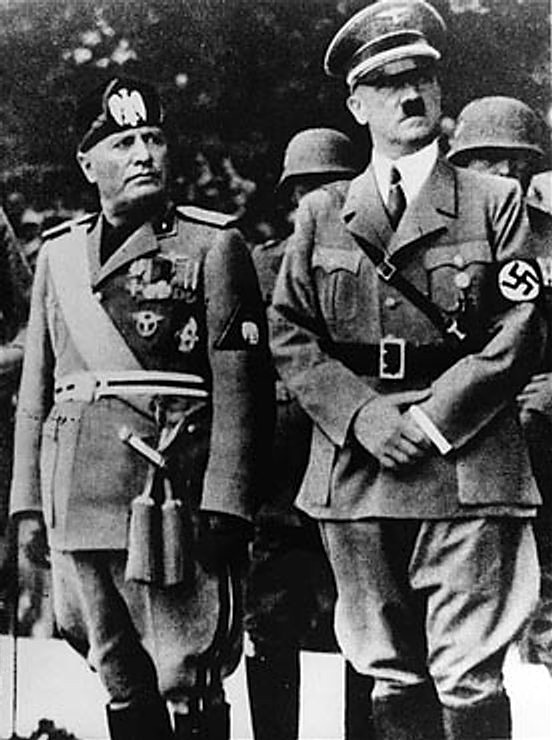


Key characteristics
- Authoritarian leadership: a centralized hierarchy with a dominant leader and a powerful executive.
- One‑party rule: political competition is eliminated or tightly controlled by a one‑party system that subsumes other organizations.
- State control of the economy: markets and industry remain largely private but are subordinated to the needs of the economy of the nation through planning, contracts and corporatist institutions.
- Nationalism and militarism: aggressive promotion of national unity, often linked to expansionist or militarized policies.
- Suppression of dissent: censorship, police power, political violence and legal measures to neutralize opponents.
- Propaganda and cult of personality: mass media and cultural institutions are used to create loyalty to the regime and its leader.
The combination and intensity of these features varied from place to place. Fascist parties commonly organized paramilitary groups, staged mass rallies, and sought to remake social life around the idea of national rebirth and unity.
Historical origins and major examples
Fascism emerged in the aftermath of World War I amid social unrest and fears of socialist revolution. The movement is most closely identified with early 20th‑century Italy under Benito Mussolini, where a political movement called Fascism consolidated power in the 1920s. Later developments in Germany produced Nazi Germany under Adolf Hitler, which borrowed organizational methods and many themes from Italian fascism but incorporated an explicit racial ideology. Spain under Franco and Francisco Franco has elements often associated with fascism while also differing in important ways; scholars debate whether some regimes are best labeled fascist or authoritarian variants.
Mussolini and his circle articulated a program that combined nationalism, syndicalist influences and a rejection of parliamentary pluralism; texts such as The Doctrine of Fascism (published in the early 1930s) set out many of the movement’s themes, though authorship and interpretations are contested.
Organization, economy and governance
Fascist regimes typically preserved private property and corporate enterprise but placed them under strict state supervision: businesses were expected to serve national goals, labor organizations were integrated into state structures, and economic policy favored militarization and self‑sufficiency. Legal changes and repression were used to dismantle independent parties, trade unions and civil society institutions, producing a public sphere dominated by the ruling movement.
Impact and legacy
In practice, fascist governments were responsible for widespread political repression, social exclusion of minorities, and—in the case of Nazi Germany—state‑sponsored genocide. The defeat of Axis powers in World War II discredited fascist movements as governing systems, and the term has since been tightly associated with totalitarian violence. In contemporary discourse the label is sometimes applied broadly or polemically; careful historical study distinguishes the core ideological commitments and institutional arrangements of fascism from other forms of authoritarianism and extreme right‑wing politics.
Questions and answers
Q: What is fascism?
A: Fascism is a far-right form of government in which most of the country's power is held by one ruler or a small group, under a single party. Fascist governments are usually totalitarian and authoritarian one-party states.
Q: How does the government control society under fascism?
A: Under fascism, the economy and other parts of society are heavily and closely controlled by the government, usually by using a form of authoritarian corporatism, where companies and workers are supposed to work together under national unity. The government uses violence and police power to arrest, kill or stop anyone it does not think useful.
Q: Who were three large fascist countries?
A: Three large fascist countries were Italy under Benito Mussolini, Nazi Germany under Adolf Hitler, and Spain under Francisco Franco.
Q: When did Mussolini invent fascism in Italy?
A: Mussolini invented fascism in Italy in the late 1910s, and developed it fully in the 1930s. He came to power in late 1922 and introduced a complete dictatorship in the mid-1920s, by eliminating all other parties and changing the electoral law to make sure his Fascist party got the most seats.
Q: How did Hitler copy Mussolini when he came to power?
A: When Hitler came to power in Germany in the 1930s, he copied Mussolini by eliminating all other parties and changing electoral law so that his Fascist party got most seats.
Q: What was written by Giovanni Gentile for Mussolini?
A: Giovanni Gentile wrote The Doctrine of Fascism for Mussolini which was published in 1932. Most of it was probably written by Giovanni Gentile who joined fascism and became an important influence on its development.
Q: When did Mussolini start writing The Doctrine of Fascism?
A:Mussolini started writing The Doctrine of Fascism paper in 1927 but it was only published five years later in 1932
Related articles
Author
AlegsaOnline.com Fascism: origins, features, and historical impact Leandro Alegsa
URL: https://en.alegsaonline.com/art/33591
Sources
- dictionary.com : "the definition of fascism"
- oxfordreference.com : "Fascist Grand Council"