
Benito Mussolini: Italian Prime Minister and Leader of the National Fascist Party (1922–1943)
Benito Mussolini (1883–1945), Prime Minister of Italy 1922–1943 and leader of the National Fascist Party, established an authoritarian regime, pursued expansionist policies and allied with Nazi Germany.
Benito Amilcare Andrea Mussolini KSMOM GCTE (29 July 1883 – 28 April 1945) was an Italian politician and journalist. He served as Prime Minister of Italy from 1922 until 1943 and was the leader of the National Fascist Party.
Image gallery
10 Images



Early life and career
Mussolini was born in Predappio, in the region of Emilia-Romagna. He trained briefly as a schoolteacher and later became active in socialist politics and the press, working as an editor for several newspapers. His early career combined political agitation with journalism, and he spent periods abroad, notably in Switzerland, where he continued political organizing.
Rise to power
After World War I he broke with the socialist movement and helped to create a new political current that promoted nationalism, strong state authority, and the suppression of leftist movements. His organization, which evolved into the National Fascist Party, grew rapidly in the volatile postwar years. In October 1922 Mussolini and his followers staged the March on Rome; the king appointed him prime minister shortly afterward. Over the next few years Mussolini and his allies dismantled most parliamentary checks, banned opposition parties, and established a one-party authoritarian state.
Rule and domestic policy
Mussolini’s government implemented a program that combined state-directed economic measures, public works, and propaganda to reshape Italian society. The regime imposed strict controls on the press, used secret police and censorship to suppress dissent, and promoted a corporatist organization of the economy as an alternative to liberal capitalism and socialism. The arrest and murder of the socialist deputy Giacomo Matteotti in 1924 proved a major crisis for the regime; it contributed to Mussolini’s decision to strengthen his personal control, an outcome contested and debated by historians regarding his direct responsibility.
Foreign policy and World War II
Internationally, Mussolini pursued expansionist policies aimed at recreating an Italian empire. His government invaded Ethiopia in 1935–1936, an action that prompted international condemnation and economic sanctions from the League of Nations. In the late 1930s Italy moved closer to Nazi Germany; the two states formalized their alignment with agreements such as the Pact of Steel (1939). Italy entered the Second World War on the Axis side in 1940, but a series of military setbacks and strategic failures weakened the regime.
Downfall and death
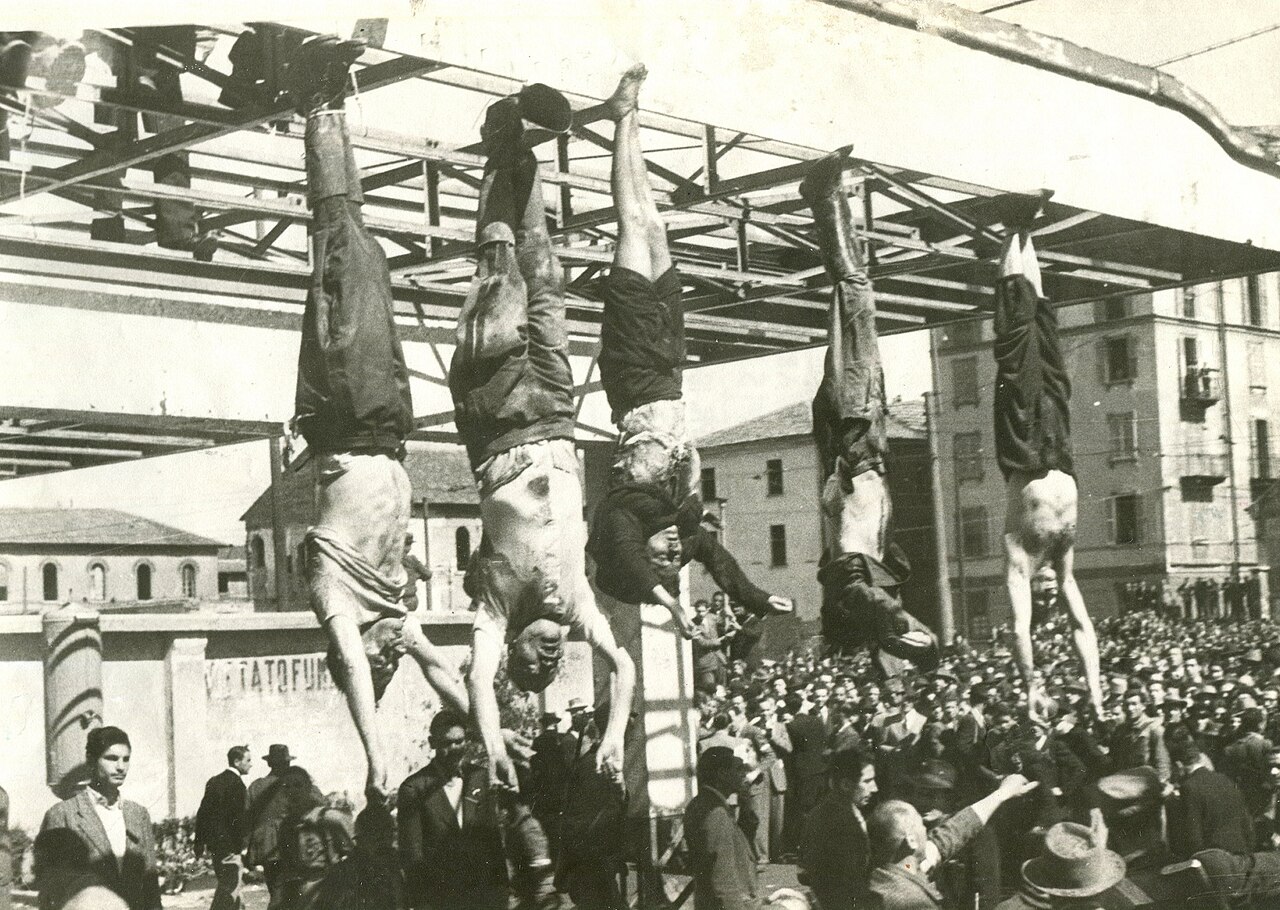
By mid-1943, following defeats abroad and the Allied invasion of Sicily, King Victor Emmanuel III dismissed Mussolini and had him arrested. German forces later freed him and installed him as head of a German-backed state in northern Italy, the Italian Social Republic. As German resistance collapsed in April 1945, Mussolini attempted to escape but was captured by Italian partisans and executed on 28 April 1945. His death marked the definitive end of his rule and the collapse of Italian fascist institutions.
Legacy
Mussolini’s rule is widely remembered for its authoritarian repression, aggressive nationalism, and role in precipitating Italy’s participation in a destructive world war. The period left lasting political, social, and moral questions for Italy and for scholars studying authoritarian movements in the 20th century.
Questions and answers
Q: Who was Benito Mussolini?
A: Benito Mussolini was an Italian politician and journalist.
Q: What was Mussolini's role as a politician?
A: Mussolini served as the Prime Minister of Italy from 1922 until 1943.
Q: Which political party was led by Mussolini?
A: Mussolini led the National Fascist Party.
Q: When was Mussolini born and when did he die?
A: Mussolini was born on July 29, 1883, and he died on April 28, 1945.
Q: What are the post-nominals "KSMOM GCTE" after Mussolini's name?
A: "KSMOM GCTE" are post-nominals representing the orders of the Knights of Malta and the Spanish Civil War Medal.
Q: What was Mussolini's full name?
A: Mussolini's full name was Benito Amilcare Andrea Mussolini.
Q: Was Mussolini's leadership style controversial?
A: Yes, Mussolini's leadership style was controversial due to his fascist ideology and dictatorial rule.
Related articles
Author
AlegsaOnline.com Benito Mussolini: Italian Prime Minister and Leader of the National Fascist Party (1922–1943) Leandro Alegsa
URL: https://en.alegsaonline.com/art/114960
Sources
- kennethbillings.org : kennethbillings.org/mussolini.html