
Sunset: definition, causes, phases, and cultural significance
Sunset is the daily event when the Sun disappears below the western horizon. This article explains its geometry, the atmospheric causes of color, twilight phases, practical uses, and notable phenomena.
Overview
A sunset is the moment each day when the Sun drops below the visible horizon toward the West. In some regional varieties of English it is also called sundown. The term refers specifically to the Sun’s apparent position crossing the horizon; it is distinct from later stages of fading light collectively known as twilight. The reverse event is the sunrise, when the Sun appears above the horizon in the morning.
Image gallery
9 Images




Cause of colors and appearance
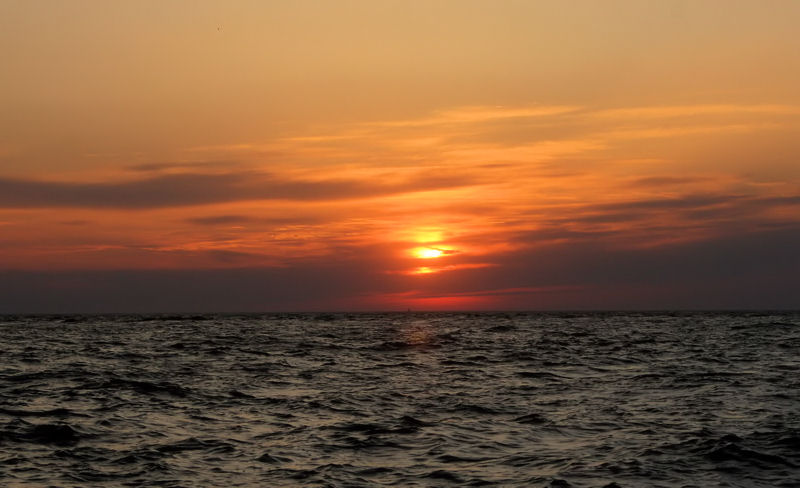
Colors at sunset arise because sunlight passes through a longer column of the atmosphere than at midday. Shorter blue wavelengths are scattered away by molecules and small particles (Rayleigh scattering), leaving longer red and orange wavelengths to dominate the sky. Larger particles such as dust, smoke, or volcanic ash increase scattering and can deepen reds. Atmospheric conditions, humidity, and the angle of the Sun all influence the hues and contrast seen at the horizon.
Phases of fading light
After the geometric sunset there are recognized twilight stages based on the Sun’s angle below the horizon. These are useful for navigation and astronomy:
- Civil twilight: Sun 0–6° below horizon; outdoor activities often remain possible without artificial light.
- Nautical twilight: Sun 6–12° below; horizon at sea becomes hard to distinguish.
- Astronomical twilight: Sun 12–18° below; sky becomes sufficiently dark for most astronomical observations.
Practical uses and cultural importance
Sunset has practical roles in daily life: it marks changes in work or worship schedules in many cultures, sets times for tides in maritime contexts, and determines lighting conditions for transportation. Artists, poets, and photographers prize sunsets for their transient color effects. Pilots and sailors historically used the Sun’s setting and twilight durations for timing and orientation.
Notable phenomena and observations
Atmospheric refraction prolongs the apparent day by lifting the Sun slightly above its true geometric position, so the Sun is visible a few minutes after it is geometrically below the horizon. Under certain clear conditions observers may glimpse the "green flash," a brief green spot at the upper rim as the Sun sets. Polar regions experience very long, drawn-out sunsets or continuous twilight for months around solstices. These variations depend on latitude, season, and local topography.
Distinctions and further reading
It is important to distinguish sunset from dusk: sunset marks the Sun’s position; dusk occurs later when darkness is established. For more technical definitions of twilight and observing conditions, see sources on atmospheric optics and celestial coordinate geometry. Related entries include twilight and sunrise.
Related articles
Author
AlegsaOnline.com Sunset: definition, causes, phases, and cultural significance Leandro Alegsa
URL: https://en.alegsaonline.com/art/94929