
Egyptian Museum (Museum of Egyptian Antiquities), Cairo
Major Cairo museum holding one of the world’s largest collections of ancient Egyptian antiquities, including Tutankhamun treasures, royal mummies, extensive statuary and important papyri; a centre for research.
The Egyptian Museum in Cairo, formally the Museum of Egyptian Antiquities, is one of the world’s principal repositories of ancient Egyptian material culture. Situated near Tahrir Square in central Cairo, the museum houses a broad assemblage of sculptures, funerary equipment, papyri, small finds and human remains spanning more than three millennia of history. Its collection is commonly reported to include about 120,000 items and is renowned for the Tutankhamun treasure and the display of royal mummies.
Image gallery
10 Images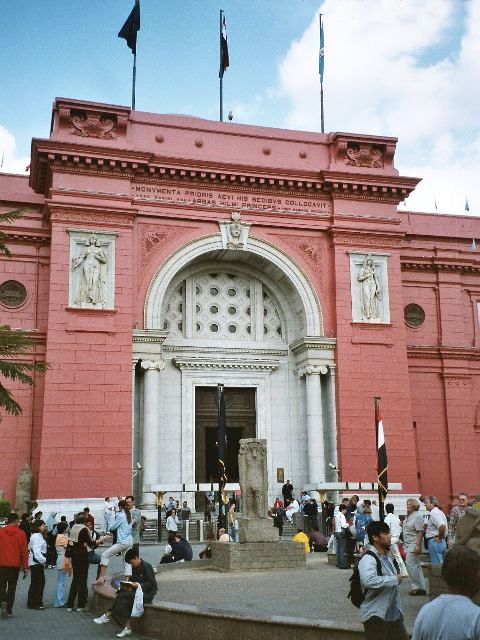


Collections and galleries
Collections are presented by period and object type, with galleries devoted to the Old, Middle and New Kingdoms as well as later eras such as the Late Period and the Graeco-Roman period. Visitors can see large statuary and reliefs, a wide range of burial goods, furniture, amulets, coffins and written materials including papyri and ostraca. For official visitor information and practical details consult the museum’s official information. For tourism-focused guidance see visitor and travel resources.
Notable rooms and highlights
- Royal Mummy Room — a prominent display that presents several New Kingdom pharaohs and queens, illustrating aspects of royal mummification and funerary ritual.
- Tutankhamun collection — a compact but spectacular ensemble of jewelry, funerary objects and the iconic gilded mask associated with the boy king’s tomb.
- Sculpture and relief galleries — large public-facing halls that trace stylistic developments and royal portraiture across dynasties.
- Textual and small-object rooms — papyri, administrative documents and everyday objects that illuminate social, religious and economic life.
History, research and conservation
The museum’s origins lie in 19th-century efforts to collect and protect antiquities; the present neoclassical building became the institution’s public face in the early 20th century. It functions both as an exhibition space and as a centre for conservation, cataloguing and Egyptological research. Curators, conservators and visiting scholars work on conservation projects, publications and archival documentation. Academic resources and research contacts are indicated at research resources.
Contemporary context and related institutions
In recent decades, some high-profile projects — including the development of new museum facilities — have led to transfers or replicas of certain objects; nevertheless the Cairo museum continues to hold many of its most iconic pieces. Like other major collections, it is part of wider discussions about provenance, loans and the repatriation of cultural property. Comparative studies and institutional overviews can be found via comparative museum studies. The Egyptian Museum in Cairo is complemented by specialised institutions elsewhere, including the Egyptian Museum of Turin, another museum dedicated primarily to Egyptian antiquities (Turin museum).
As a public museum and research institution, the Egyptian Museum remains central to the study and presentation of ancient Egyptian civilisation, offering both introductory displays for general audiences and material of interest to specialists. Visitors should consult current sources before visiting, since exhibitions and access to particular galleries can change for conservation or curatorial reasons.
Related articles
Author
AlegsaOnline.com Egyptian Museum (Museum of Egyptian Antiquities), Cairo Leandro Alegsa
URL: https://en.alegsaonline.com/art/30417