
Eodromaeus — an early basal theropod from the Triassic
Eodromaeus, meaning "dawn runner," is a small, early theropod dinosaur from the Late Triassic of Argentina. Its nearly complete skeleton has been central to studies of the origin and early anatomy of theropods.
Overview
Eodromaeus (literally "dawn runner") is a small, basal theropod dinosaur known from Late Triassic deposits in northwestern Argentina. It was named to reflect both its antiquity and its inferred agility. The genus is notable because an almost complete, articulated skeleton was recovered in 1996, providing unusually good anatomical information for such an early dinosaur.
Image gallery
10 Images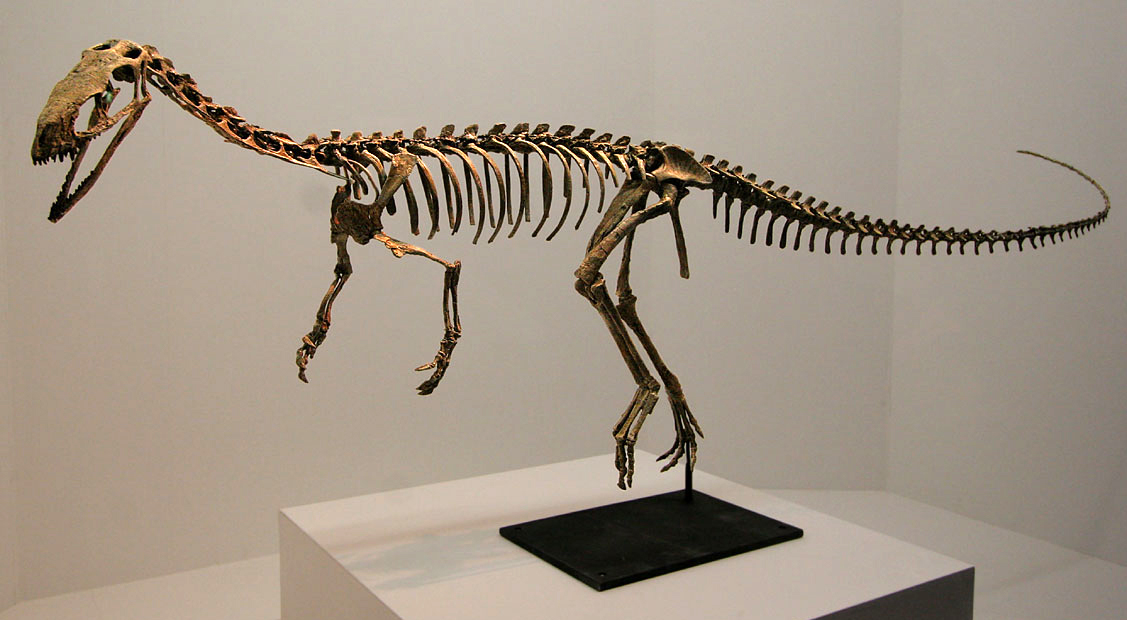


Morphology and identifying features
Eodromaeus was lightly built and bipedal, with long hind limbs and a long, counterbalancing tail. The skull was relatively narrow and the teeth were recurved and serrated, consistent with a carnivorous diet or opportunistic omnivory. Forelimbs were shorter than the hind limbs but retained grasping hands with curved claws, indicating some capacity for manipulation.
- Size: the animal is generally described as small compared with later theropods, with overall proportions suggesting a length on the order of a metre.
- Locomotion: limb proportions and a lightly built skeleton suggest it was capable of running and quick maneuvers.
- Skeletal features: a mix of primitive and derived characters in the skull, hips and vertebrae mark it as an early member of the theropod lineage.
Discovery and geological context
Fossils assigned to Eodromaeus were found in continental Triassic sediments in northwestern Argentina. The material comes from sequences that have produced several of the earliest known dinosaurs and their contemporaries. The articulated nature of the principal specimen makes it especially valuable for reconstructing early dinosaur anatomy and posture.
Classification and scientific importance
When first described, Eodromaeus was interpreted as a basal theropod positioned close to the root of the dinosaur tree. This placement makes it important for understanding the initial split between major dinosaur lineages, such as theropods and sauropodomorphs. Its combination of ancestral and derived traits has been used repeatedly in phylogenetic analyses of early dinosaurs; some studies explore closely related alternative positions near the base of Saurischia, but most emphasize its role as an early theropod-grade form.
Paleoecology and contemporaries
Eodromaeus lived alongside other early dinosaurs and diverse archosauriform reptiles. The fauna of its deposits includes early sauropodomorphs and small omnivorous or herbivorous reptiles, indicating a complex ecosystem in which primitive theropods occupied small carnivore or opportunistic predator niches. Its teeth and limb anatomy suggest active predation on small vertebrates and invertebrates, or scavenging when available.
Research and significance
The quality of the Eodromaeus remains has made it a frequent subject of study in questions about dinosaur origins: how quickly characteristic dinosaurian features evolved, the early evolution of bipedal running, and the ancestral body plan of theropods. Paleontologists continue to compare its anatomy with other Triassic taxa to refine early dinosaur phylogeny, growth patterns, and ecological roles.
Further reading and resources
For general summaries and database entries see: genus listing, a theropod overview, and material on early dinosaur classification. For geological context and Triassic stratigraphy consult Triassic context and formation and dating. Regional information on Argentine discoveries is available via Argentine finds, and specimen descriptions or original analyses can be sought at skeleton description.
Questions and answers
Q: What is Eodromaeus?
A: Eodromaeus is an extinct genus of basal theropod dinosaur from the Upper Triassic of Argentina.
Q: What does the name Eodromaeus mean?
A: Eodromaeus means "dawn runner".
Q: What is the significance of the discovery of the almost complete articulated skeleton of Eodromaeus?
A: The almost complete articulated skeleton of Eodromaeus is significant because the bones were still mostly connected, which allows for a more accurate understanding of the dinosaur's anatomy.
Q: What is the importance of Eodromaeus being close to the root of the dinosaurs?
A: Eodromaeus being close to the root of the dinosaurs makes it an important transitional species in the evolution of dinosaurs.
Q: What is a theropod?
A: A theropod is a group of bipedal saurischian dinosaurs, which includes birds.
Q: Is Eodromaeus the earliest known dinosaur?
A: No, Eodromaeus is the earliest known definite theropod, but there are other dinosaurs that existed earlier that are not as well-defined.
Q: Where was Eodromaeus found?
A: Eodromaeus was found in the Upper Triassic of Argentina.
Related articles
Author
AlegsaOnline.com Eodromaeus — an early basal theropod from the Triassic Leandro Alegsa
URL: https://en.alegsaonline.com/art/31659
Sources
- doi.org : 10.1126/science.1198467
- pubmed.ncbi.nlm.nih.gov : 21233386
- sciencemag.org : sciencemag.org/content/331/6014/206.abstract
- bbc.co.uk : "'Dawn runner casts light on birth of the dinosaurs"
- usatoday.com : "New dog-sized dinosaur discovered"