
Droste effect
A visual motif in which an image contains a smaller copy of itself, repeated recursively; used in art, advertising, photography, and digital imaging to create self-reference and visual recursion.
The Droste effect describes an image that includes a smaller version of itself, which in turn contains an even smaller copy, and so on. The pattern creates a visual loop of self-reference: each contained image repeats the whole, producing the impression of an infinite regress. In practice the repetition terminates because of physical or digital limits such as print detail, screen resolution, or deliberate artistic choice.
Image gallery
9 Images


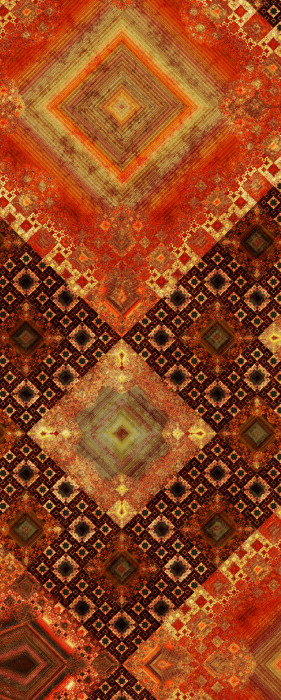
Characteristics and how it works
At its core the effect combines framing and scaling. A region inside the picture acts as a window: the entire composition is reproduced inside that window at a reduced size and often with appropriate perspective or rotation. Each repetition reduces linear dimensions by a roughly constant factor, so the areas form a geometric progression. Because each step multiplies size by a factor less than one, the copies rapidly shrink toward invisibility; in digital images this is limited by the pixel grid and by the smallest reproducible size.
History and terminology
The name comes from a commercial design used by a Dutch company, where the packaging depicted a figure presenting the same package with its image repeated. In art and literary criticism the broader concept of a picture within a picture is called mise en abyme, a French phrase meaning "placed into the abyss." Artists and illustrators have exploited this idea for centuries as a device for self-reference, commentary, or visual punning.
Uses and examples
Designers and photographers use the Droste effect for striking advertisements, album covers, and posters. In fine art and printmaking it can function as a commentary on representation and perception. Digital tools make it easy to generate precise recursive compositions: image editors, scripting, and special filters can map an image into itself with controlled scaling, rotation and perspective. A related technique is video or camera feedback, where a screen shows the camera's output of the screen creating a live recursive stream.
Variations, mathematics, and distinctions
- Mise en abyme: a broader cultural and narrative device that includes visual recursion but also textual and thematic self-reference.
- Fractals and self-similarity: the Droste effect is an example of self-similarity but usually with a discrete, engineered scaling rather than the infinite, often mathematically defined self-similarity of fractals.
- Technical limits: digital implementations are bounded by resolution and by rounding; mathematically one can describe the number of visible iterations using logarithmic relationships between original size, scale factor, and minimum discernible unit.
Notable facts and contemporary practice
Contemporary artists, graphics designers, and software authors continue to explore the Droste motif. In computational art the effect can be combined with transformations from complex analysis or texture mapping to produce surreal warpings and recursive landscapes. Because it plays on the idea of recursion and self-reference, it also appears as a visual metaphor in film, literature and education to illustrate feedback loops and infinite regress.
Further reading and resources: Recursion and visual examples, Mise en abyme and art history, Fractal geometry and self-similarity, Digital techniques and tutorials.
Related articles
Author
AlegsaOnline.com Droste effect Leandro Alegsa
URL: https://en.alegsaonline.com/art/29002
Sources
- escherdroste.math.leidenuniv.nl : "Escher and the Droste effect - Universiteit Leiden"