
Dutch Golden Age painting: genres, makers and cultural context
Seventeenth-century painting in the Dutch Republic marked by realism, varied specialized genres, market orientation, and lasting influence on European art and collecting.
Overview
The term Dutch Golden Age painting describes the remarkable expansion of painting produced in the northern Netherlands during the 17th century, when the newly independent Dutch Republic became a major center of trade, science and art in Europe. The period overlapped the later phases of the Eighty Years' War and the immediate peace that followed, and is usually discussed within the broad European climate of the Baroque period while also notable for its distinctive restraint and attention to everyday observation. A high volume of production, specialized subject matter, and an active market for works for domestic interiors are among the features that distinguish the Dutch output from contemporary grand court or church commissions elsewhere.
Image gallery
10 Images


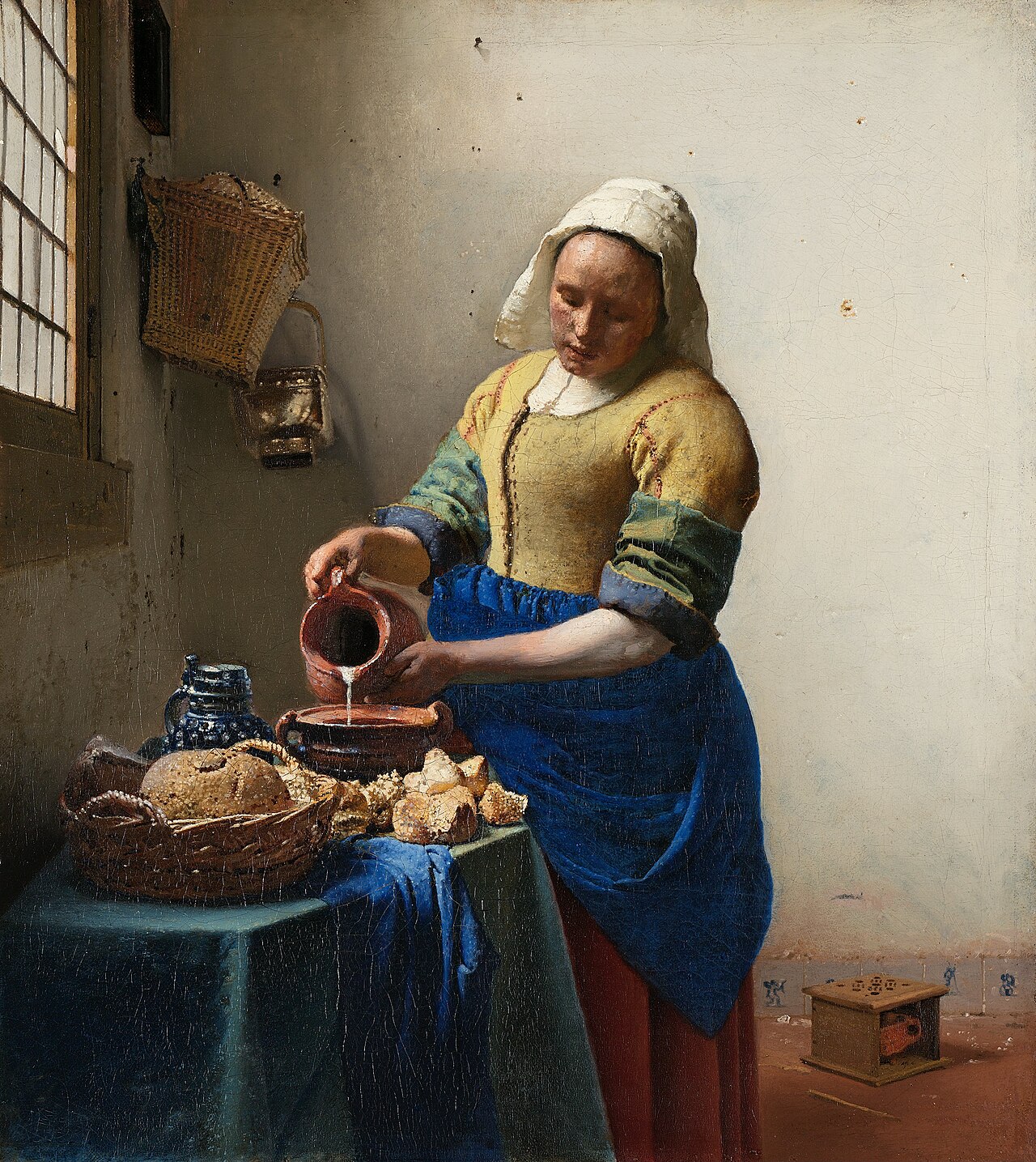


Historical and social context
Economic prosperity driven by maritime commerce and colonial expansion created a wealthy and literate urban citizenry that purchased art for private houses and public institutions. Civic pride, guilds, regent boards and merchant companies commissioned large group portraits and decorative schemes, while prosperous households bought portraits, landscapes and still lifes. The dominance of Protestant, especially Calvinist, belief in much of the Republic influenced public taste and removed many of the traditional outlets for large-scale religious art. At the same time, moral and devotional ideas were often expressed indirectly through allegory, emblematic detail and symbolic motifs within secular subjects.
Principal genres and their specializations
Rather than a single dominant subject, Dutch painters developed a wide range of specialised genres, many of which were subdivided into recognizable types that collectors knew and sought. The diversity of subject matter was shaped in part by the hierarchy of genres—a long-established theory that ranked history painting and allegory above portraiture, genre scenes, landscape and still life—but by market demand artists concentrated on subjects that sold well.
- Portraiture and group portraits. Individual likenesses and civic group portraits (for militia companies, guilds and regent boards) combined public status with personal commemoration. The large, formally arranged group portrait became a distinctive and prestigious format in Dutch civic life.
- Genre painting. Scenes of everyday life range from sober domestic interiors and courtyards to lively tavern and merry-company pictures. Within this category are subtypes such as the domestic interior emphasizing family life, moralizing scenes that warn against vice, and humorous peasant subjects that reflect social contrast and local color.
- Landscape and townscape. Dutch artists developed views of polders, rivers, dunes and city canals that combined topographical accuracy with atmospheric effect; Italianate landscape also influenced many painters who adopted warm light and classical motifs.
- Seascapes and maritime painting. Shipping scenes, naval engagements and harbor views celebrated the Republic’s seafaring economy and could function as civic or private propaganda as well as art.
- Still life. Highly finished paintings of food, table settings, vanitas motifs and flowers demonstrated technical skill and encoded messages about transience, wealth and taste. Varieties include simple breakfast pieces, sumptuous pronk still lifes and trompe-l’œil pictures that simulate objects on a ledge.
- History and allegory. Although less frequent, history subjects, myth and allegory were produced, often reduced in scale or adapted to moralizing purposes that would suit private patrons rather than public altarpieces.
Market, patrons and the hierarchy of genres
Because history painting was conventionally most prestigious but least commercially viable, many painters supported themselves by producing portraits or genre scenes that were more saleable to the rising bourgeoisie. Dealers, auctions and an active export trade meant that artists could sometimes specialize narrowly and find buyers across the Republic and beyond. Civic bodies and corporate patrons commissioned larger works such as regent portraits and militia pieces, while private buyers favored pictures suited to domestic rooms. The interplay between artistic ambition and market realities is central to understanding the variety and quality of works from this period.
Materials, workshop practice and technique
Technical choices reflect the demands of precision, durability and finish. Many painters continued to use wooden panels for small, finely detailed works; copper plates provided a smooth, luminous support prized for its tight finish and glossy surface. Canvas became more common for larger works. Painters developed meticulous layering and glazing techniques with oil paints to depict the textures of flesh, cloth, metal and glass. Some used optical devices as aids to studying light and perspective. Workshops and studio systems allowed masters to take pupils and assistants, enabling high output while maintaining stylistic coherence in series and repeatable compositions.
Leading artists and regional interactions
A number of artists achieved lasting reputations: Rembrandt van Rijn for psychological depth and powerful chiaroscuro; Johannes Vermeer for carefully composed domestic interiors and subtle light; Frans Hals for loose, lively brushwork in portraits; Jan Steen for narrative humor; Jacob van Ruisdael and Aelbert Cuyp for influential landscape work; and still-life specialists such as Willem Claesz Heda and Rachel Ruysch. Painters working in the north were in contact with artists in the Southern Netherlands and elsewhere—figures such as Peter Paul Rubens offered a contrasting, exuberant model and artistic exchange across the Low Countries remained important for training and taste.
Prints, decorative arts and the wider material culture
Painting was complemented by a thriving print culture and decorative arts. Engravings and etchings circulated images widely and influenced painters’ compositions and subjects. Delftware ceramics, silverwork and painted tiles furnished interiors, while collectors combined paintings with other objects to display taste and wealth. In some cases small sculptural works appeared, but overall the best artistic energy of the period concentrated on painting and printmaking rather than monumental sculpture. Printers and publishers, and the technical processes of printmaking, played a role in disseminating images and reputations across Europe.
Legacy
The Dutch Golden Age left a durable legacy in technical refinement, the realism of observation and the expansion of subjects considered suitable for high art. Its paintings document urban life, maritime commerce, domestic rituals and civic institutions with a specificity and visual intelligence that influenced later realist movements and the ways museums present and interpret early modern art. For readers interested in intersections between commerce, scientific knowledge and cultural production, materials on trade, commerce, science and the broader history of art in the European context continue to be useful starting points, as do studies of the Eighty Years' War, civic institutions and moral themes such as allegory in pictorial culture.
Questions and answers
Q: What period is known as the Dutch Golden Age?
A: The Dutch Golden Age was a period in the 17th century where Dutch trade, science and art were among the most advanced in Europe.
Q: What type of government was present during this period?
A: During this period, there was the Dutch Republic which was the most prosperous nation in Europe.
Q: What is 'idealisation'?
A: Idealisation is when paintings show scenes more pretty than they really were. The Dutch paintings of this time often lacked this feature.
Q: Why were there relatively few religious paintings during this period?
A: There were relatively few religious paintings during this period because most Dutch people were Calvinist and Calvinism forbade religious painting in churches.
Q: What is hierarchy of genres?
A: Hierarchy of genres is a theory that some types of painting are more prestigious than others. History painting was at the top of the list, so many painters wanted to produce historical paintings but these were difficult to sell.
Q: What types of painting did the Dutch focus on heavily?
A: The Dutch focused heavily on "lower" categories such as portrait painting, landscape, still life and scenes from everyday life.
Q: How did artists paint large works during this time? A: Most paintings during this time were relatively small with group portraits being one of the only types of large works produced by artists. Painting directly onto walls hardly existed and when it did canvas frames would normally be used instead for extra precision possible on a hard surface.
Tags
Related articles
Author
AlegsaOnline.com Dutch Golden Age painting: genres, makers and cultural context Leandro Alegsa
URL: https://en.alegsaonline.com/art/29352