
Donkey Kong (Game Boy) — handheld platform reinterpretation
A portable reinterpretation of the arcade classic for Nintendo's Game Boy. Blends faithful early stages with new levels and puzzle-platform elements starring Mario and Donkey Kong.
Overview
Donkey Kong for the Game Boy is a handheld platform game released by Nintendo that adapts the arcade classic while adding new content suited to portable play. Like the original, it casts Mario as the protagonist who must confront Donkey Kong to rescue Pauline. The cartridge combines faithful recreations of the arcade stages with additional boards and mechanics that expand the original premise into a broader puzzle-platform experience.
Image gallery
5 Images



Gameplay and characteristics
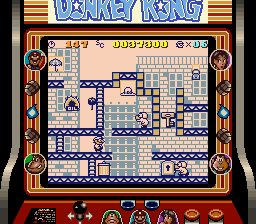
The game retains core platforming actions — running, jumping, climbing ladders and avoiding hazards — and presents them in a way tailored to the Game Boy's single-screen, portable format. Early stages closely mirror the layout and pacing of the arcade source, then progressively introduce fresh obstacles and environmental puzzles that require timing and planning rather than only reflexes. Typical features include hazards, moving platforms, items to manipulate and increasing variety across levels.
Structure and notable levels
The title is often described as having two halves: the opening stages that faithfully reproduce the original Donkey Kong arcade layouts, followed by many additional levels that depart from the arcade formula. These later stages are more puzzle-oriented and can be seen as a stylistic bridge toward later games that mix Mario-style platforming with puzzle elements.
History and relationship to other games
This handheld version is part of the larger Donkey Kong lineage and represents Nintendo's effort to put an arcade favorite onto a portable system. It sits alongside other Donkey Kong and Mario spin-offs, and is frequently compared with both the arcade Donkey Kong and subsequent puzzle-platform hybrids in the series. While it preserves the characters and basic story — Mario rescuing Pauline from Donkey Kong — its level design and pacing reflect the constraints and opportunities of the Game Boy hardware.
Reception and legacy
Players and commentators have generally noted the game for its faithful opening stages and for expanding the original into a longer, more varied portable experience. The mixture of classic arcade sequences with new puzzle-platform challenges makes it a distinctive entry in the Donkey Kong family and a useful example of how arcade concepts were adapted for handheld systems.
Further information and references
- Platform and genre context
- Video game series overview
- Nintendo as publisher and developer
- Game Boy hardware details
- Handheld gaming considerations
- Game console family
- Donkey Kong character and role
- Original Donkey Kong arcade relation
- Arcade origins and influence
For players seeking to understand how arcade designs translated to portable systems, this Game Boy title offers a clear example: it starts by honoring the arcade source and then expands into new territory, using the limitations of the handheld to encourage more puzzle-driven platforming gameplay.
Related articles
Author
AlegsaOnline.com Donkey Kong (Game Boy) — handheld platform reinterpretation Leandro Alegsa
URL: https://en.alegsaonline.com/art/28450