
Discharge (hydrology): volumetric flow of water in rivers, lakes and streams
Discharge is the volumetric flow of water passing a cross-section per unit time. Covers definition, units, measurement methods, factors that influence flow, uses in management and distinctions from related terms.
Overview
In hydrology the term discharge denotes the volume of water that flows through a channel, pipe, or outlet from a river, lake or other water body per unit time. Discharge is a volumetric flow rate commonly expressed in cubic metres per second (m3/s), often written as m3/s and described in words as cubic metres per second. It is distinct from but related to the inflow into a system and to spatially variable velocities within a cross-section.
Image gallery
3 Images

How discharge is measured
Measuring discharge requires determining the cross-sectional area of flow and the average velocity across that area, or using devices and empirical relations that relate water level to flow. Common approaches include:
- Velocity–area method: subdivide a channel cross-section, measure depth and velocity at points, and sum sectional flows.
- Stage–discharge rating curve: develop an empirical relation between water stage (height) and discharge at a gauging station; useful for continuous monitoring once established.
- Control structures: weirs and flumes impose a hydraulic relation allowing discharge to be computed from measured depth upstream or at a throat.
- Instrumental methods: acoustic Doppler current profilers (ADCPs) and other sensors can profile velocity and compute discharge rapidly.
Factors that influence discharge
Discharge at any point in a watershed varies in response to precipitation, snowmelt, groundwater contributions, evapotranspiration, land cover, soil type and slope, and human activities such as abstraction, regulation by reservoirs, or urban drainage. Seasonal cycles and storm events typically produce large short-term variability, while climate and land-use changes can alter long-term average flows.
Uses and practical importance
Quantifying discharge is essential for flood forecasting, design of bridges and culverts, water resource allocation, reservoir operation, and environmental flow assessments that support aquatic ecosystems. Engineers and water managers use discharge data to estimate sediment transport, pollutant loads, and to set permits for withdrawals and discharges.
Distinctions and notable concepts
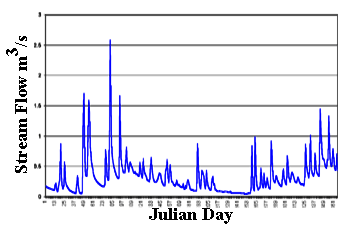
Several related terms appear in hydrology and hydraulics: "flow rate" and "volumetric discharge" are often interchangeable, while "specific discharge" or Darcy flux refers to discharge per unit area of porous media. Hydrologists commonly analyze hydrographs—plots of discharge versus time—to identify baseflow, peak discharge from storms, and recession behavior following precipitation. Accurate discharge records underpin many scientific and operational decisions about water and risk management.
Further reading
Introductory material and technical guidance on measuring and interpreting discharge are available from textbooks and hydrometric manuals; practitioners often consult regional gauging guidelines and instrumentation manufacturers for applied methods. For foundational concepts see resources in hydrology and applied measurement references linked from institutional sites. Additional overviews and case studies may be found through technical libraries and online repositories.
Related topics: channel hydraulics, runoff generation, stream gauging, and water balance studies.
Related articles
Author
AlegsaOnline.com Discharge (hydrology): volumetric flow of water in rivers, lakes and streams Leandro Alegsa
URL: https://en.alegsaonline.com/art/27636