
Dunkleosteus — the armored apex predator of the Late Devonian
Dunkleosteus, a large armored arthrodire placoderm from the Late Devonian (about 360 million years ago), is known for powerful shearing jaws, heavy cranial armor, and a global fossil record that reveals it as a top predator.
Dunkleosteus is an extinct genus of large, heavily armored fishes that lived during the Late Devonian, roughly 360 million years ago. The best-known species, Dunkleosteus terrelli, belonged to the group of armored jawed fishes called arthrodires. These animals are often described as primitive or early jawed fish that belonged to the class of armored fishes known as placoderms, and they appear in marine deposits of the Devonian period. The genus is named for a twentieth-century American paleontologist and is widely recognized in popular and scientific literature for its distinctive head and neck armor.
Image gallery
10 Images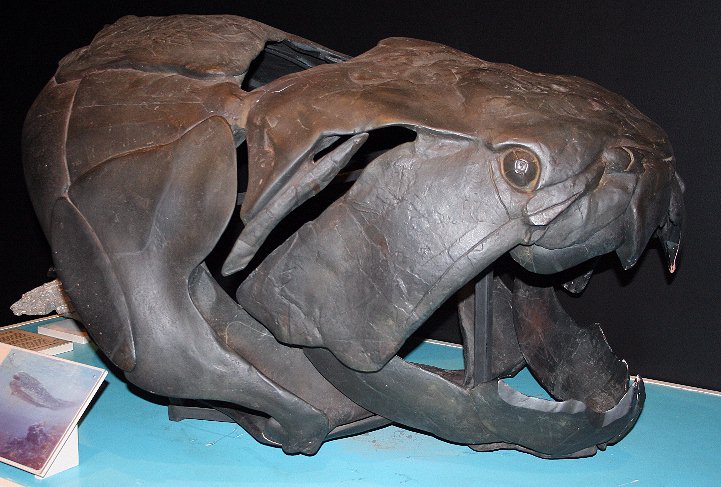


Anatomy and feeding
Dunkleosteus had large bony plates covering the head and the front of the body; the remainder of its skeleton was probably cartilaginous and is rarely preserved. It lacked true teeth; instead, paired bony plates formed sharp, blade-like shearing edges that functioned like scissors. This jaw arrangement, together with a mobile head joint, allowed rapid opening and powerful closing of the mouth. Biomechanical studies and comparisons with modern predators indicate a very strong bite and a role as an apex predator that could slice through the armor of other fishes and crush hard prey.
Fossil record and global distribution
Most specimens preserve only the armored head and thoracic shields, so reconstructions of the full body size vary. Partial remains and isolated plates have been reported from multiple continents, highlighting a broad distribution in Late Devonian seas. Notable fossil occurrences include finds in the United States, Morocco, Poland, Belgium, and China. Remains have also been reported from Africa more generally and other localities, emphasizing that Dunkleosteus and its relatives were widespread.
- Defining features: heavy cranial armor, sharp bony blades, jointed head shield.
- Typical finds: isolated skull plates and jaw elements; complete bodies are rare.
- Representative sites: Morocco, USA, Poland, Belgium, China.
Placoderms like Dunkleosteus first appear earlier in the fossil record during the Silurian and diversified in the Devonian, but the entire group disappears from later deposits during the major extinctions at the close of the Devonian and the transition toward the Carboniferous. The extinction of placoderms left no direct descendants among modern fishes; their evolutionary experiment with heavy external armor and unique jaw mechanisms ended before the age of modern shark lineages that later diversified for hundreds of millions of years (sharks remain a long-lived group).
Ecology, significance, and notable facts
As a top predator, Dunkleosteus likely shaped marine ecosystems by preying on other placoderms, armored fishes, and any suitably sized animals available. Its unique feeding apparatus and robust build make it a frequent subject in discussions about convergent evolution of predatory strategies. Fossils are important for understanding Devonian marine communities and the broader radiation of early jawed vertebrates. For an overview of arthrodire anatomy and research sources, see further references and museum collections (arthrodire summaries, early fish resources, Devonian context).
Although public reconstructions sometimes exaggerate length estimates, cautious study of fossil plates and comparison with related taxa provide the best present estimates. Dunkleosteus remains one of the most iconic and instructive examples of Devonian vertebrate life, illustrating both the diversity of ancient armored fishes and the dramatic turnover of ecosystems at the end of the Devonian (extinction events).
Questions and answers
Q: What is Dunkleosteus?
A: Dunkleosteus was a prehistoric arthrodire, a primitive fish from the later Devonian period, about 360 million years ago.
Q: What was the physical feature of Dunkleosteus?
A: Dunkleosteus was a heavily armoured placoderm.
Q: In which countries have fossils of Dunkleosteus been found?
A: Fossils of Dunkleosteus have been found in Morocco, Africa, Poland, Belgium, China, and the USA.
Q: When did Placodermi first appear?
A: Placodermi first appeared in the Silurian.
Q: When did the group Placodermi become extinct?
A: The group Placodermi became extinct during the transition from the Devonian to the Carboniferous, leaving no descendants.
Q: How long did the class Placodermi last?
A: The class Placodermi lasted barely 50 million years, in comparison to the 400 million year long history of sharks.
Q: What is the age of Dunkleosteus?
A: Dunkleosteus is from the later Devonian period, about 360 million years ago.
Related articles
Author
AlegsaOnline.com Dunkleosteus — the armored apex predator of the Late Devonian Leandro Alegsa
URL: https://en.alegsaonline.com/art/29254
Sources
- fossilmuseum.net : "Dunkleosteus Placodermi Devonian armored fish from Morocco"