
Dipsacaceae (teasel family): overview, characteristics and taxonomy
Dipsacaceae, traditionally the teasel family, comprised temperate perennial and biennial herbs and shrubs. Modern systems place its genera within an expanded Caprifoliaceae; familiar genera include Dipsacus and Scabiosa.
Overview
The group historically treated as Dipsacaceae (the teasel family) comprised a set of temperate flowering plants placed in the order Dipsacales. Members were mostly perennial or biennial plants with compact, often head-like inflorescences; the assemblage included species ranging from low herbs to taller, woody or semi-woody shrubs. Classical treatments estimated several hundred species distributed among roughly eleven genera, united by similar floral and fruit characters.
Image gallery
2 Images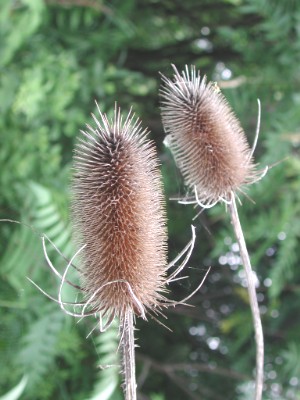

Morphology and identifying features
Typical characters include dense clusters or heads of small tubular flowers subtended by conspicuous involucral bracts. Leaves are frequently opposite and simple, and stems may be unbranched or sparsely branched. Flowers range from radially symmetric to weakly bilaterally symmetric, with a superior ovary producing an achene or small nutlet. In several genera the dried inflorescences persist as structurally distinctive seedheads that are easily recognised in the field.
Taxonomy and phylogenetic placement
Traditional, morphology-based classifications recognised Dipsacaceae as a distinct family. Beginning with molecular phylogenetic work in the late 20th century, evidence showed that the genera placed in Dipsacaceae are more appropriately treated within a broader circumscription of Caprifoliaceae in the order Dipsacales. As a result, many modern floras and classifications subsume the older family name while retaining the concept of a recognisable subgroup or subfamily. Careful interpretation of both morphological and genetic data remains important when comparing historical accounts to recent treatments.
Distribution and habitat
Species formerly placed in Dipsacaceae occur predominantly in temperate climates, with centres of diversity in Europe and parts of Asia, and representatives in Africa. They are commonly found in meadows, open woodlands, roadside verges, limestone outcrops and other well-drained, often sunny habitats. Several taxa tolerate disturbance and are known from anthropogenic habitats.
Ecology and uses
Plants in this group provide nectar and pollen resources to a variety of pollinators, including bees, butterflies and other insects. The persistent seedheads of some species are also used by birds as a winter food source. Historically, the seedheads of true teasels (Dipsacus) were used in textile processing to raise the nap on woolen cloth; today most such uses have been replaced by mechanical methods, though the historical practice is well documented. Several genera, especially Scabiosa, remain popular in horticulture and the cut-flower trade for their attractive flower heads.
Notable genera and horticultural value
- Dipsacus — the true teasels, recognised by spiny, conical seedheads.
- Scabiosa — often called pincushion flowers and grown as ornamentals.
- Cephalaria — tall perennials producing globe-like inflorescences valued in borders.
- Knautia — clump-forming species with colourful flower heads for mixed plantings.
Conservation and management
Conservation status varies by species and region. Some taxa have restricted ranges or specific habitat requirements and may be locally vulnerable to land-use change, while others are widespread or even naturalised beyond their native ranges. Management actions appropriate for rare species include habitat protection and monitoring; conversely, introduced or weedy species may require control measures to limit spread in sensitive ecosystems.
Further reading and resources
For more detailed accounts consult regional floras and specialist monographs that treat genera formerly placed in Dipsacaceae. Useful entry points include summaries of the order Dipsacales, family-level discussions under Caprifoliaceae, and genus-level keys and descriptions in local European, Asian and African floristic works. Practical cultivation notes and plant profiles appear in horticultural guides and seed-catalogue descriptions (herb descriptions, shrub descriptions, climate notes).
Because nomenclature and family concepts have changed, it is helpful to check both older treatments under the name Dipsacaceae and more recent classifications that place these genera within an expanded Caprifoliaceae to reconcile historical literature with current taxonomic frameworks.
Related articles
Author
AlegsaOnline.com Dipsacaceae (teasel family): overview, characteristics and taxonomy Leandro Alegsa
URL: https://en.alegsaonline.com/art/27576