
Dinosaur brains and intelligence
Summary of what scientists know about dinosaur brains, how they are studied, examples of relatively large-brained species, and common misconceptions about their intelligence.
Overview
Dinosaur brains are known only through indirect evidence, but paleontology has moved far beyond the notion that all dinosaurs were slow-witted. Fossil skulls, internal casts and modern imaging show wide variation in brain size, shape and likely capabilities across different groups. Some small theropods appear to have had proportionally large brains that supported greater sensory processing and behavioral flexibility than in many other reptiles.
Image gallery
10 Images




Anatomy and how intelligence is estimated
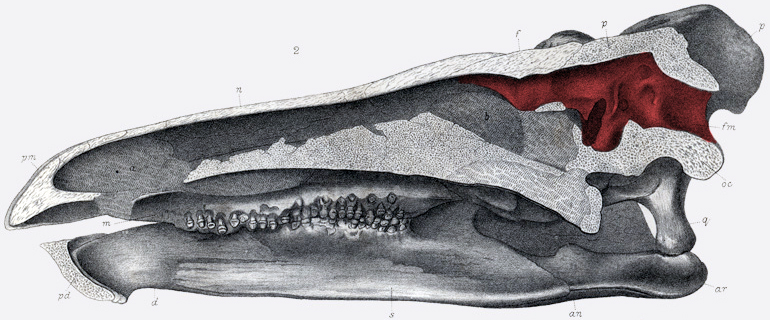
Because soft tissue is rarely preserved, researchers rely on endocasts—natural or digital molds of the brain cavity—to infer brain anatomy. Measures such as relative brain size and encephalization (a comparison of brain to body size) are used cautiously, together with the shape of regions like the cerebrum, optic lobes and olfactory bulbs. Modern techniques such as CT scanning let scientists reconstruct internal detail without damaging fossils.
Examples and notable groups
Among non-avian dinosaurs, certain small carnivores show features commonly associated with higher information processing. Troodontids and some dromaeosaurids are frequently cited for having large forebrains and forward-facing eyes, traits that suggest good vision and coordination. A historian or popular-science review might point readers to more background on these small predators via resources such as studies of smaller theropods. For broader comparisons with living reptiles, see comparative work on reptile brains.
Behavioral inferences and examples
Brain anatomy can hint at behaviors: enlarged optic lobes imply acute vision; well-developed cerebella suggest agility and balance; large olfactory bulbs indicate strong smell. From such traits, paleontologists infer abilities like active predation, complex hunting techniques, parental care, and social interactions in some species. However, the fossil record rarely preserves direct proof of cognition, so behavioral reconstructions remain hypotheses supported by anatomy and trace fossils.
Evolutionary context and living descendants
Birds are living dinosaurs, and their diverse cognitive achievements—tool use, problem solving, vocal learning—show that dinosaurian ancestry included pathways to high intelligence. Brain architecture changed over time: the forebrain expanded and cortical-like regions became more prominent in the lineage leading to birds. This evolutionary view helps explain why some non-avian dinosaurs had relatively large brains while others, such as giant sauropods, had much smaller brains for their body size.
Misconceptions and popular culture
Popular media often exaggerates or misrepresents dinosaur cognition. For example, films such as Jurassic Park dramatized pack hunting and human-like problem solving in ways not supported by evidence. Scientific accounts are more conservative: intelligence is multidimensional and cannot be reduced to a single score; many dinosaurs likely had specialized senses and behaviors rather than uniformly high or low intelligence.
Key points
- Brain size and structure varied widely across dinosaur groups.
- Endocasts and modern imaging provide the main evidence for brain anatomy.
- Some small theropods show traits associated with higher sensory and cognitive abilities.
- Birds represent the continuation of dinosaur brain evolution, demonstrating complex cognition in living descendants.
Ongoing discoveries and new imaging technologies continue to refine our picture of dinosaur brains. While many details remain uncertain, it is clear that intelligence among dinosaurs was neither uniform nor as simple as once thought.
Questions and answers
Q: What were dinosaurs once regarded as?
A: Dinosaurs were once regarded as stupid animals.
Q: Did all dinosaurs have low intelligence?
A: No, some of the smaller carnivores had above average intelligence for reptiles.
Q: What led to exaggerated portrayals of dinosaur intelligence in films like Jurassic Park?
A: The idea that some of the smaller carnivores had above average intelligence for reptiles led to exaggerated portrayals in films like Jurassic Park.
Q: Are there interesting topics related to dinosaur brains and intelligence?
A: Yes, dinosaur brains and intelligence are interesting topics.
Q: Is it known now that some dinosaurs had above average intelligence?
A: Yes, it is now realized that some of the smaller carnivores had above average intelligence for reptiles.
Q: What kind of dinosaurs had above average intelligence?
A: Some of the smaller carnivores had above average intelligence for reptiles.
Q: Was it commonly believed in the past that dinosaurs were intelligent?
A: No, it was commonly believed in the past that dinosaurs were stupid animals.
Related articles
Author
AlegsaOnline.com Dinosaur brains and intelligence Leandro Alegsa
URL: https://en.alegsaonline.com/art/27499
Sources
- serendip.brynmawr.edu : Brain and body size... and intelligence · webcitation.org
- ingentaconnect.com : "Cognitive behaviour in Asian elephants: use and modification of branches for fly switching"
- doi.org : 10.1006/anbe.2001.1815
- weber.ucsd.edu : Allometry
- serendip.brynmawr.edu : "Cortical folding and intelligence"
- sciencedirect.com : summary
- app.pan.pl : "A new troodontid (Theropoda: Troodontidae) from the late Cretaceous of central China, and the radiation of Asian troodontids"
- doi.org : 10.4202/app.2009.0047