
Digital-to-Analog Converter (DAC): Principles, Types, and Applications
An overview of digital-to-analog converters: what they are, main architectures, performance measures, historical development, and common applications such as audio, instrumentation, and communications.
A digital-to-analog converter (DAC) is an electronic device that transforms a discrete digital code, typically binary, into a continuous analog signal such as a voltage, current, or accumulated charge. DACs are complementary to analog-to-digital converters (ADCs) and form the output stage of any system that must produce real-world analog quantities from digital information. For technical background and standards information see additional resources.
Image gallery
5 Images

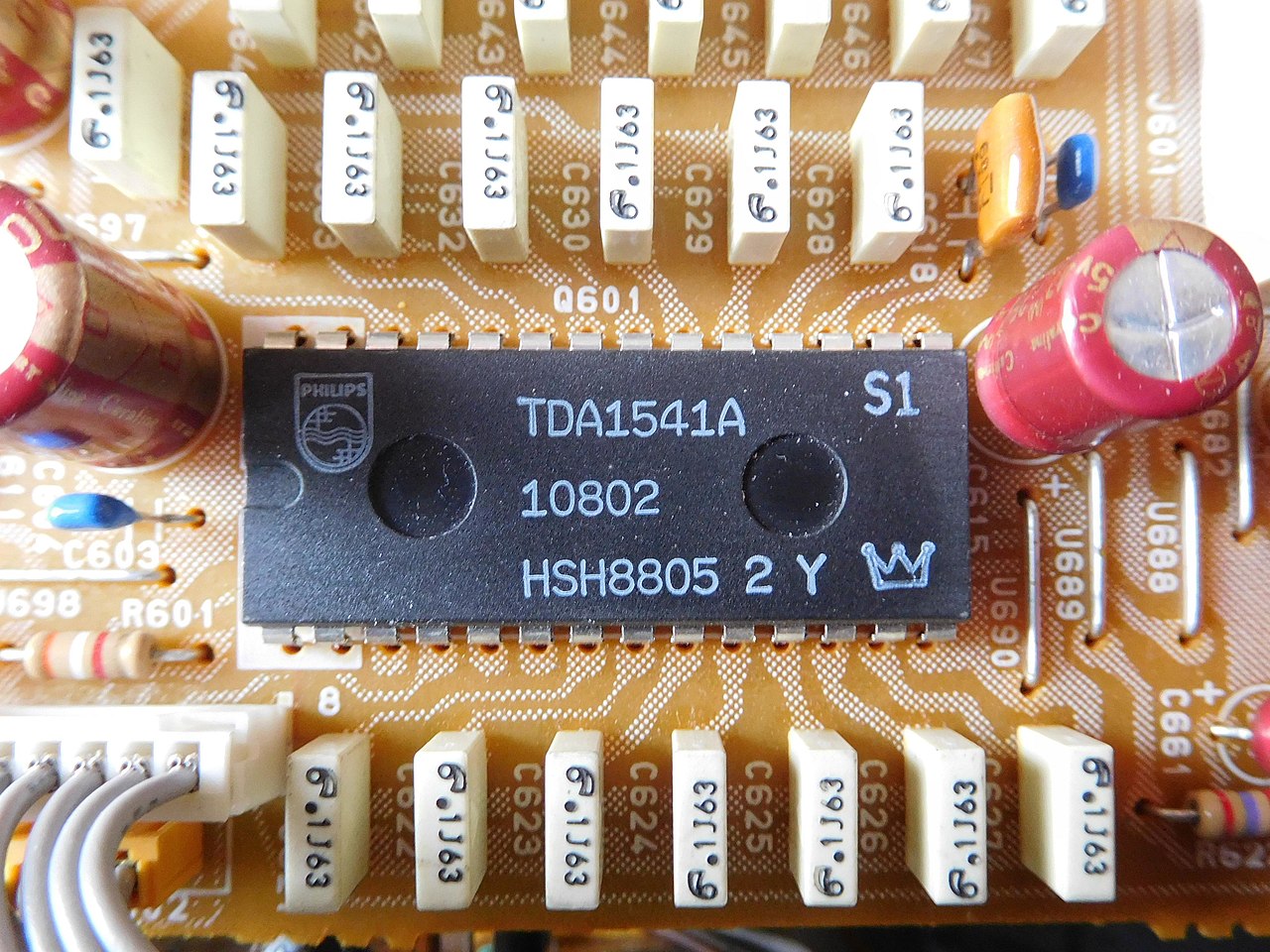


Basic principles and signal output
A DAC accepts a digital word—often a parallel or serial stream of bits—and maps that code to a proportional analog level. The resolution of a DAC is usually expressed in bits and determines the number of discrete output steps (2^N). Other key characteristics include accuracy, linearity, monotonicity, settling time, and dynamic performance such as signal-to-noise ratio (SNR) and total harmonic distortion (THD). For introductory tutorials, consult explanatory guides.
Common architectures
Several circuit topologies are used depending on speed, resolution, power, and cost requirements:
- Resistor ladder (R‑2R): simple, scalable resistor network good for moderate speeds and resolutions.
- Binary‑weighted resistor: uses weighted resistor values for direct summation of bit contributions; sensitive to resistor matching.
- Current‑steering: favored for high‑speed and RF applications where fast switching is required.
- Sigma‑delta (ΔΣ): uses oversampling and noise shaping to achieve high resolution at lower baseband bandwidths; common in audio DACs.
- PWM and filtering: low‑cost approach where pulse‑width modulated outputs are smoothed to produce an analog waveform.
Additional implementation details and design tradeoffs are discussed in application notes and textbooks; see technical notes and design references.
Performance parameters
When selecting or evaluating a DAC, engineers consider:
- Resolution (bits) and effective number of bits (ENOB).
- Linearity errors such as integral nonlinearity (INL) and differential nonlinearity (DNL).
- Dynamic errors: SNR, THD, spurious‑free dynamic range (SFDR).
- Speed: settling time and maximum sample/update rate.
- Output type: current‑source vs voltage‑output and the need for buffers or external references.
Manufacturers and standards documents provide measurement methods and typical specifications; for standards and comparator material see standards and measurement guides.
History, development and practical uses
Early DACs were built from discrete resistors and vacuum‑tube or transistor summing networks; advances in integrated circuits enabled compact, high‑precision DACs and dedicated architectures. Modern DACs appear in sound cards, audio players, arbitrary waveform generators, communications transceivers, and industrial control systems. In digital audio, sigma‑delta DACs provide excellent subjective and measured fidelity, while current‑steering DACs drive high‑speed digital communications.
Distinctions and notable considerations
DACs must be considered in system context: the choice of reference voltage, output buffering, filtering, and PCB layout can dominate real‑world performance. Unlike ADCs that measure real signals, DACs must drive loads and often require output reconstruction filters when creating continuous waveforms. For practical examples, datasheets and application notes are useful; see practical guides.
Overall, the DAC is a foundational building block in mixed‑signal electronics, bridging the binary world of processors and memories with the continuous analog world of sensors, actuators, and human senses.
Related articles
Author
AlegsaOnline.com Digital-to-Analog Converter (DAC): Principles, Types, and Applications Leandro Alegsa
URL: https://en.alegsaonline.com/art/27396