
DIP switch (dual in-line package switch)
A DIP switch is a small manually operated set of electrical switches packaged like an integrated circuit. Used for hardware configuration, addressing, and low-voltage signal selection on PCBs.
Overview
A DIP switch is a compact set of manual switches assembled in a housing shaped like a dual in-line package. Unlike an integrated circuit, the package contains several discrete on/off contacts that are toggled by hand to change electrical connections. Designers use DIP switches to set device options, configure addresses, or select modes without reprogramming or replacing components. For a basic reference, see DIP switch.
Image gallery
9 Images


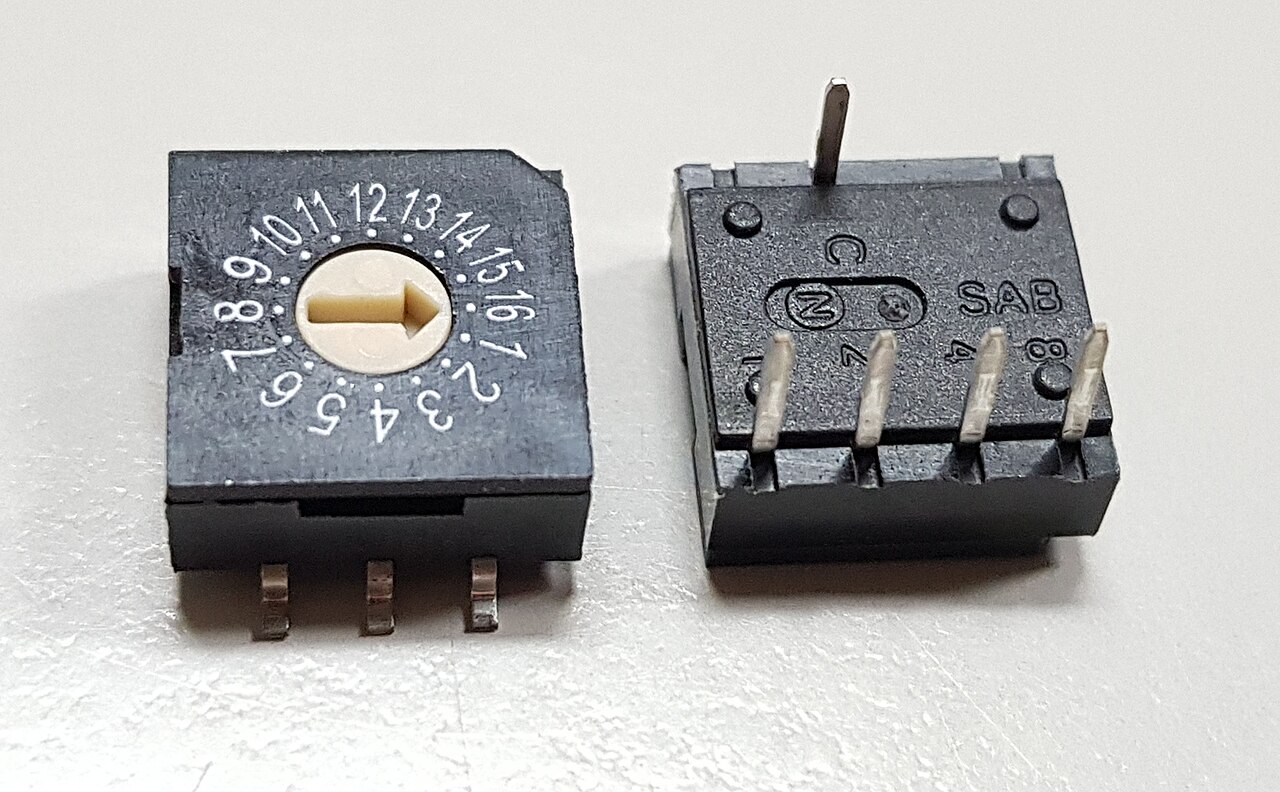


Construction and common types
Mechanically, a DIP switch consists of a row of individual single-pole switches with leads that match a standard in-line footprint. They are made for through-hole mounting or in surface-mount form and are available in sealed or unsealed versions. Common actuator styles include tiny slide levers, miniature rocker-style toggles, and soldered jumper-like blocks. The package follows the same pin spacing used for many chips so the switch can be placed on a printed circuit board; see dual in-line package.
Typical uses
- Hardware configuration and feature enabling on embedded boards.
- Setting device addresses or identification codes in networks and controllers.
- Selecting boot modes, ranges, or calibration offsets during manufacturing.
- Prototyping and low-volume products where a simple manual selector is sufficient.
History and development
DIP switches emerged as a convenient way to add selectable options directly on circuit boards at low cost. Their design mirrors the footprint of early integrated circuits, which allowed straightforward placement beside logic chips and easy human-accessible control. Over time they remained useful even as software configurability grew, because they provide a physical, tamper-evident setting that does not depend on stored memory or firmware.
Installation, ratings and limitations
When using DIP switches, observe their electrical ratings: they are intended for low-voltage, low-current signal work rather than power switching. Orientation is important—one side or end is usually marked to indicate the "ON" position—so documentation and PCB silkscreening should match the switch marking. They are reliable for occasional changes but not designed for high-frequency operation or harsh environmental exposure unless a sealed variant is chosen.
Distinctions and notable facts
DIP switches are often compared with jumpers and software configuration. Unlike jumpers, they provide multiple positions without removing parts; unlike software, they require no firmware support. There are many small variants and specialized forms; consult component datasheets or an electronics reference such as an integrated circuit guide when matching mechanical footprint and electrical requirements for a project.
Related articles
Author
AlegsaOnline.com DIP switch (dual in-line package switch) Leandro Alegsa
URL: https://en.alegsaonline.com/art/27558