
Curie (unit)
A non‑SI unit of radioactive activity equal to 3.7×10^10 decays per second, historically linked to radium and the Curies; largely superseded by the becquerel but still used in some fields.
Overview
The curie (symbol: Ci) is a legacy unit that measures radioactivity, specifically the rate of nuclear decays. It is defined as 3.7×10¹⁰ disintegrations (decays) per second. Because the becquerel (Bq), equal to one decay per second, is the SI derived unit for radioactivity, the curie is effectively an older, larger alternative: 1 Ci = 3.7×10¹⁰ Bq.
Image gallery
2 Images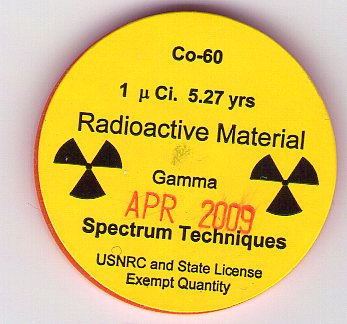

Definition and common conversions
By definition, a curie represents a very large activity. Typical conversions and submultiples in common use include:
- 1 Ci = 3.7×10¹⁰ Bq (37 gigabecquerel, GBq)
- 1 mCi (millicurie) = 3.7×10⁷ Bq (37 megabecquerel, MBq)
- 1 μCi (microcurie) = 3.7×10⁴ Bq (37 kilobecquerel, kBq)
- 1 Bq = 2.7×10⁻¹¹ Ci
These submultiples — mCi, μCi and others — are frequently encountered in medical, research and industrial contexts because a single curie is typically much larger than the activities used in those settings.
History and name
The name "curie" honors Marie and Pierre Curie, early investigators in radioactivity who worked with radium and other radioactive substances. Historically, the activity of one gram of radium‑226 was close to the numerical value chosen for the curie, so the unit provided an intuitive scale for materials studied at the time. Over the 20th century the International System of Units (SI) adopted the becquerel as the coherent unit of activity, and many international bodies have since encouraged use of the Bq; some organizations formally recommended the curie only for legacy or specific applications (see links below).
Uses, examples and practical context
The curie and its submultiples appear in nuclear medicine (for example, radiopharmaceutical doses are often expressed in millicuries or megabecquerels), in laboratory sources and in industrial gauges. Because the curie is large, occupational, environmental and regulatory documents tend to prefer becquerels for clear SI consistency. Nevertheless, the curie persists in some regulatory texts, historical reports, and practice in parts of the medical and industrial communities.
Distinctions and notable points
Key points to remember: the curie measures activity (decays per unit time), not absorbed dose or biological effect. Its symbol is Ci, and its use is not part of the SI system. Converting between curies and becquerels is straightforward via the exact factor 3.7×10¹⁰, which makes interchanging legacy and SI values possible without ambiguity.
Further reading and references
- Definition and basic facts
- Radioactivity and units overview
- Curie to becquerel conversions
- Radium-226 activity comparison
- History of radium research
- Isotopes and decay rates
- Early pioneers of radiology
- Marie Curie biographical resources
- Pierre Curie biographical resources
- Becquerel (SI unit) information
Related articles
Author
AlegsaOnline.com Curie (unit) Leandro Alegsa
URL: https://en.alegsaonline.com/art/24698