
Cross River gorilla
A critically endangered subspecies of the western gorilla found in a small forested region along the Nigeria–Cameroon border, notable for its fragmented range and distinct skull features.
Overview
The Cross River gorilla (Gorilla gorilla diehli) is a distinct population of western gorillas restricted to a small, forested area on the Nigeria–Cameroon border. Recognized as one of the world’s most endangered great apes, it is notable for its very small and fragmented population and for morphological differences from other western gorillas. It is often treated as a subspecies of the western gorilla (Gorilla gorilla).
Image gallery
5 Images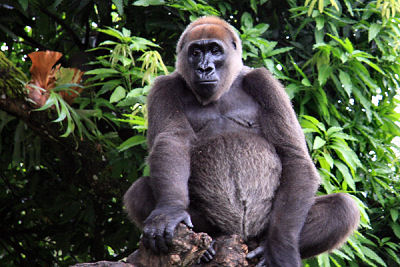


Physical characteristics
Compared with other western gorillas, Cross River gorillas tend to have smaller skulls, narrower palates and relatively reduced dentition. Their overall body size and pelage are similar to other western populations, though individual variation exists. These anatomical distinctions were among the characteristics used when the group was first described scientifically.
Distribution and habitat
This gorilla occurs in a limited range of montane and submontane forests, riverine corridors, and agricultural mosaics in the Cross River region. The range is highly fragmented into many small forest patches separated by farmland, roads and settlements. Such fragmentation constrains movement and the possibility of gene flow between groups.
Behavior and ecology
Ecologically the Cross River gorilla resembles other western gorillas: a largely herbivorous diet of fruit, leaves and herbaceous plants, a nest-building habit for sleeping, and social organization based on small family groups led by a dominant silverback. Their behavior has been less intensively studied than more accessible gorilla populations because of the remote and difficult terrain they occupy.
Conservation status and threats
The Cross River gorilla is classified as critically endangered. Its population is very small and fragmented, with fewer than several hundred individuals remaining in the wild. Major threats include habitat loss from agriculture and logging, hunting and snaring, and limited genetic exchange between isolated groups. Conservation efforts emphasize protected areas, anti-poaching patrols, community-based land-use planning, and cross-border cooperation between Nigeria and Cameroon.
Taxonomy and historical notes
The population was first described scientifically in the early 20th century. Researchers have since debated the precise taxonomic rank, but it is most often treated as a subspecies of the western gorilla. Morphological comparisons and genetic studies have helped clarify its distinctiveness, supporting targeted conservation actions that recognize the population’s unique status within Gorilla gorilla.
- Key threats: habitat fragmentation, hunting, small population size
- Conservation approaches: habitat protection, law enforcement, community engagement
- Research needs: more surveys, genetic monitoring, connectivity restoration
Related articles
Author
AlegsaOnline.com Cross River gorilla Leandro Alegsa
URL: https://en.alegsaonline.com/art/24331
Sources
- iucnredlist.org : "Gorilla gorilla ssp. diehli"
- primate-sg.org : "Regional Action Plan for the Conservation of the Cross River Gorilla (Gorilla gorilla diehli)"
- naturalsciences.be : "Gorilla gorilla diehli Taxonomy and Nomenclature"
- digitallibrary.amnh.org : "The Cross River Gorillas: A Distinct Subspecies, Gorilla gorilla diehli Matschie 1904"