
Western gorilla (Gorilla gorilla)
The western gorilla is a species of great ape from central and western Africa. This article summarizes its appearance, behavior, distribution, taxonomy, conservation status and key ecological roles.
Overview
The western gorilla (Gorilla gorilla) is one of the two living species in the genus Gorilla and a member of the great apes. It is closely related to other apes such as chimpanzees, humans and orangutans. Among gorillas, the western taxon contains the majority of individual animals and includes two recognised subspecies: the widespread western lowland gorilla and the more restricted Cross River gorilla.
Image gallery
8 Images




Appearance and behaviour
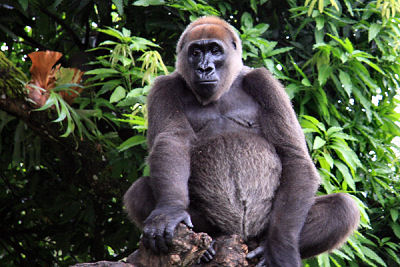
Western gorillas are large, strongly built primates with pronounced sexual dimorphism. Mature males develop a silver-grey saddle of hair on the back and are commonly called "silverbacks." They vary in colour from black to dark brown-grey with sometimes a brownish tint on the forehead. Western gorillas primarily move by knuckle-walking, are largely terrestrial but can climb trees, and show intelligence and tool use in some populations.
Distribution and habitat
These gorillas inhabit a range of forested environments across parts of central and western Africa, from lowland tropical rainforests to swamp forests and secondary growth. The western lowland gorilla occupies a wide area of countries in central Africa, while the Cross River gorilla is limited to a small border region between Nigeria and Cameroon.
Diet, social structure and life history
Western gorillas are primarily herbivorous and frugivorous: fruit makes up a large portion of the diet where available, supplemented by leaves, stems, bark and occasional invertebrates. They live in social groups typically led by a dominant adult male (the silverback) with several females and their offspring. Females give birth to a single infant after a pregnancy of about eight to nine months, and interbirth intervals are several years. Lifespans reach a few decades in the wild and often longer under human care.
Conservation and threats
Although once the most numerous gorilla species, western gorillas face serious threats from habitat loss, hunting for bushmeat, industrial development and infectious disease outbreaks such as Ebola, which have caused sharp population declines in parts of their range. Conservation actions include protected areas, anti-poaching patrols, community conservation, captive care programs and research monitoring.
Taxonomy and notable facts
Scientific classification recognises the western gorilla as Gorilla gorilla, with the subspecies G. g. gorilla (western lowland) and G. g. diehli (Cross River). It is the type species of the genus Gorilla. The western lowland form is more numerous and generally lighter in coat than eastern gorillas; the Cross River population is among the most restricted and carefully monitored of all great apes. For further context see entries on western lowland gorilla, Cross River gorilla and comparisons with eastern gorillas.
Related articles
Author
AlegsaOnline.com Western gorilla (Gorilla gorilla) Leandro Alegsa
URL: https://en.alegsaonline.com/art/107513
Sources
- bucknell.edu : Mammal Species of the World
- iucnredlist.org : "Gorilla gorilla"
- cbsnews.com : Planet Of No Apes? Experts Warn It's Close
- animalinfo.org : "Animal Info – Gorilla"