
Crown-of-thorns starfish (Acanthaster planci)
A large, spiny sea star of the Indo‑Pacific that feeds on coral polyps; notable for its venomous spines, population outbreaks, and significant impacts on reef ecosystems.
Overview
The crown-of-thorns starfish (Acanthaster planci) is a conspicuous, multi-armed sea star found across warm parts of the Indo‑Pacific, including the Red Sea. It is among the largest species of sea stars and is best known for its spiny appearance and its diet of hard coral. Individual animals can reach substantial diameters and display variable coloration and spine patterns.
Image gallery
10 Images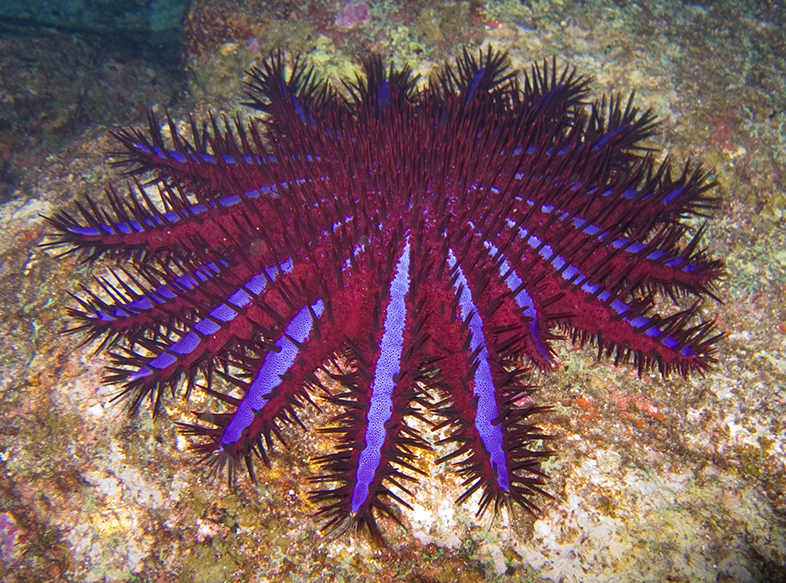


Description and distinguishing features
Crown-of-thorns typically have numerous long, sharp spines arranged on a central disc and on their radiating arms. These spines are rigid and can deliver a painful sting; bright or contrasting colours often serve as a warning to potential predators. For references on appearance and anatomy see spines and skin and general size descriptions such as diameter measurements. Their geographic distribution is widely recorded in regional faunal surveys: Pacific, Indian Ocean, and Red Sea.
Feeding behaviour and ecological impact
This species feeds almost exclusively on reef-building corals. Using its tube feet and arms it climbs onto coral colonies, everts its stomach onto the surface and secretes digestive enzymes to liquefy the living coral tissue before ingesting it. The consumed coral polyp tissue and the exposed calcium-carbonate skeleton are characteristic signs of its feeding; see more on coral relations at coral polyps and polyp biology. Feeding usually occurs at night, and a single starfish can consume large areas of coral over weeks to months.
Life cycle and population dynamics
Crown-of-thorns reproduce by broadcast spawning: adults release eggs and sperm into the water column where fertilization occurs. The resulting planktonic larvae spend days to weeks in the plankton before settling and metamorphosing into juveniles. Under certain environmental conditions — such as elevated nutrient levels and favourable currents — larval survival can be high, producing outbreaks in which many individuals appear on a reef. Outbreaks are a primary cause of rapid coral decline in affected areas.
Management, predators and human interactions
Natural predators include some reef fishes, a few species of shrimp and crabs, and historically the giant triton snail, though predation pressure is often insufficient to prevent outbreaks. Where outbreaks threaten high-value reefs, active control measures are used: manual removal, targeted injection with substances that kill the starfish (for example, bile-salts or other agents), and coordinated culling programs. For summaries of control techniques and monitoring efforts consult digestion and control methods and regional management pages at reef conservation sources.
Notable facts and distinctions
- Common name derives from the crown-like ring of long spines surrounding the central disc.
- Its coral-eating habit makes it an important, sometimes destructive, ecological agent on coral reefs.
- Colour and spine patterning vary geographically and with age; bright colours often indicate the presence of venomous spines.
Because the crown-of-thorns can both occur naturally at moderate densities and explode into damaging outbreaks, it remains a focus of ecological study and reef management. Research continues into the causes of outbreaks, effective non-harmful control methods, and the species' role in the resilience and recovery of coral reef ecosystems.
Questions and answers
Q: What is the crown-of-thorns starfish?
A: The crown-of-thorns starfish is a type of sea star.
Q: What color is the crown-of-thorns' skin?
A: Usually, the crown-of-thorns has orange-red to purplish skin, with yellow or pink spikes on its skin.
Q: How big can the crown-of-thorns starfish be?
A: The crown-of-thorns is one of the largest starfish in the world, with a diameter of up to 3 feet.
Q: Where does the crown-of-thorns live?
A: The crown-of-thorns lives in the warmer areas of the Pacific Ocean, Indian Ocean, and Red Sea.
Q: What does the crown-of-thorns feed on?
A: The crown-of-thorns only feeds on coral polyps, usually at night.
Q: How does the crown-of-thorns obtain its food?
A: The crown-of-thorns climbs over its prey, releases digestive enzymes to break down its food, and then absorbs the coral polyp, which has now turned into a liquid.
Q: Why do some parts of the crown-of-thorns starfish have bright warning colors?
A: In some parts of its wide range, the crown-of-thorns may be garish with bright warning colours. These colours warn animals that may want to eat it that it is venomous.
Related articles
Author
AlegsaOnline.com Crown-of-thorns starfish (Acanthaster planci) Leandro Alegsa
URL: https://en.alegsaonline.com/art/24398
Sources
- sea.sheddaquarium.org : "Crown of thorns sea star"