
Cottontail rabbit (genus Sylvilagus)
Cottontail rabbits are small to medium-sized American rabbits of the genus Sylvilagus, recognized by their white tail undersides, widespread across diverse habitats and important as prey and game species.
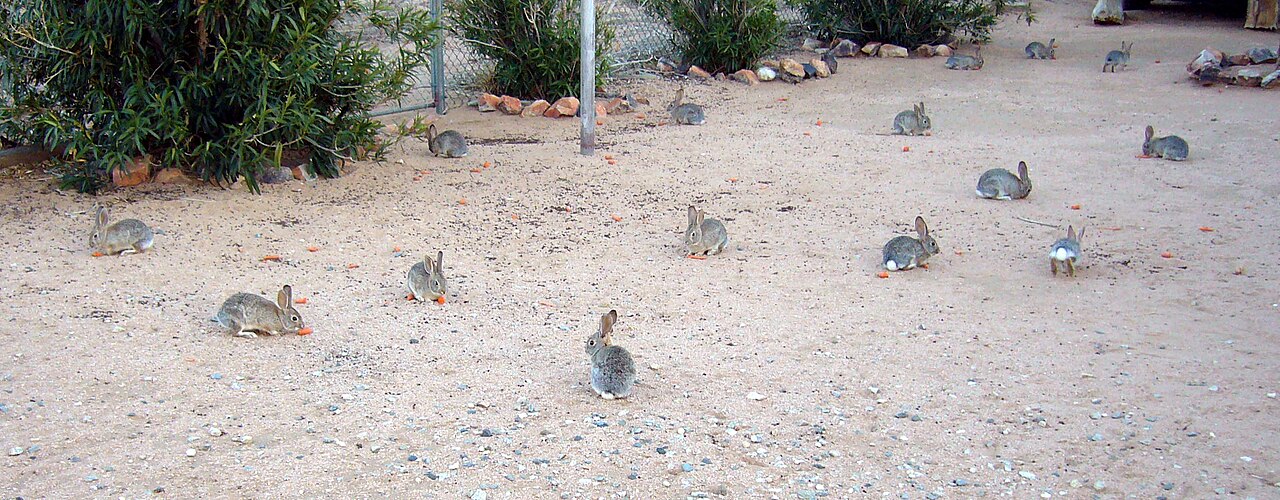
Cottontail rabbits are a group of rabbit species in the genus Sylvilagus native to North, Central and South America. They are commonly called "cottontails" because of the conspicuous white underside of their tails. These animals occupy a wide range of environments from brushy fields and woodlands to deserts and wetlands, and they play an important role in many food webs.
Image gallery
10 Images



Physical characteristics and reproduction
Cottontails are generally small-bodied with relatively short ears and strong hind legs. Their coat colors vary by species and season, providing camouflage. Unlike hares, young cottontails are born blind and helpless in simple ground nests, and females may produce more than one litter during a breeding season.
Habitat, diet and behaviour
These rabbits favor habitats with a mix of cover and open space: thickets, field edges and brushy understories. They are primarily herbivores, feeding on grasses, herbs, bark and buds depending on season. Cottontails are largely crepuscular and solitary; when threatened they rely on rapid, zigzag bounding and concealment rather than extensive burrowing.
Taxonomy and notable species
The genus Sylvilagus includes several species, such as the eastern cottontail, the desert cottontail and regionally restricted forms. Range maps and regional accounts summarize their distributions across the Americas; see distribution information. For more detailed species descriptions consult species accounts.
Ecological role and human interactions
Cottontails are a key prey item for foxes, coyotes, raptors and snakes, and they influence vegetation through grazing. Many species are hunted for sport and subsistence. Some local populations have declined from habitat loss, fragmentation or competition with introduced rabbits, prompting targeted conservation and habitat-management efforts.
Distinguishing facts
- Cottontails are true rabbits (not hares) and differ in reproductive development and behaviour.
- They typically make shallow nests called forms rather than extensive burrow systems.
- Species vary in range and habitat preference; some are widespread while others are localized and of conservation concern.
Overall, cottontails are adaptable, ecologically significant mammals whose presence shapes predator populations and plant communities across the American continents.
Related articles
Author
AlegsaOnline.com Cottontail rabbit (genus Sylvilagus) Leandro Alegsa
URL: https://en.alegsaonline.com/art/23381
Sources
- bucknell.edu : Mammal Species of the World
- britannica.com : "cottontail (mammal genus) -- Britannica Online Encyclopedia"
- ivis.org : "Poxviridae" · web.archive.org
- cnn.com : CNN.com