
Corythosaurus — the crested duck-billed dinosaur
Corythosaurus, a lambeosaurine hadrosaur from Late Cretaceous North America, is known for its helmet-like hollow crest, complex teeth, and facultative bipedal gait. It likely used its crest for display and sound.
Corythosaurus is a genus of large, herbivorous ornithopod notable for a tall, hollow cranial crest that gives the animal its name — "helmet lizard." It lived during the Late Cretaceous and is best known from richly fossiliferous rocks of western North America. As a member of the lambeosaurine subfamily of hadrosaurs, Corythosaurus shares many features with other crested duck-bills while retaining distinctive proportions and crest anatomy.
Image gallery
10 Images

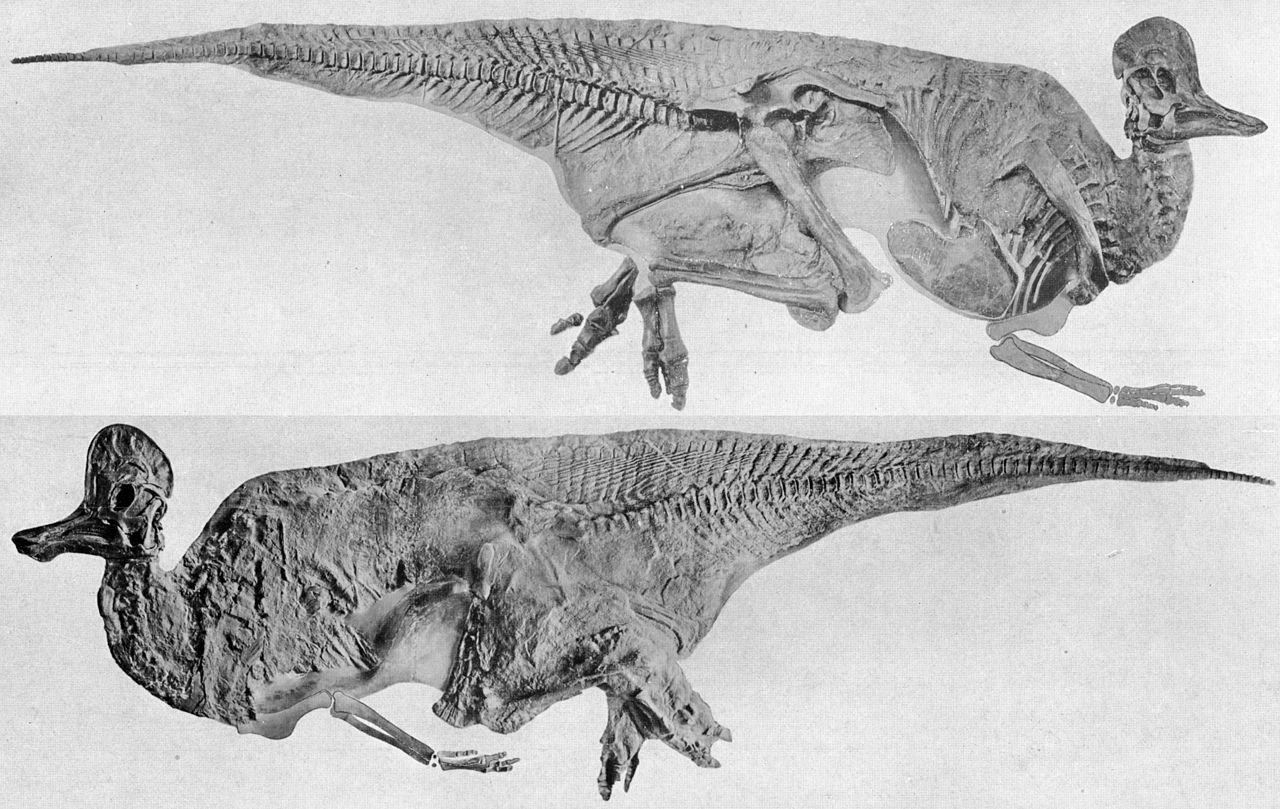


Overview and discovery
The type species, Corythosaurus casuarius, was described in the early 20th century from specimens recovered in Alberta, Canada. Fossils come mainly from the Dinosaur Park Formation (Campanian stage), where relatively complete skeletons and skin impressions have provided insight into the animal's anatomy. Typical adult length was about 9–10 metres, with a hip height near 2 metres and an estimated mass of several tonnes.
Physical characteristics
Corythosaurus combined the general hadrosaur body plan with a tall, laterally compressed crest rising from the skull. The crest contained a series of hollow chambers connected to the nasal passages. The skull terminated in a broad, toothless beak in front of densely packed cheek teeth arranged into grinding batteries adapted for processing plant material. The vertebral column featured a long, stiffened tail supported by ossified tendons.
- Skull: hollow, helmet-like crest likely involved in sound resonance and visual display.
- Teeth and jaws: dental batteries for grinding vegetation and a keratinous beak for cropping.
- Limbs: capable of both quadrupedal and bipedal locomotion; manus with reduced inner digit and weight-bearing outer digits; pes with three functional toes.
Behavior and function of the crest
The hollow crest is the most discussed feature of Corythosaurus. Paleontologists infer several non-exclusive functions: acting as a resonating chamber to produce low-frequency vocalizations, serving as a visual display for species and sexual recognition, and possibly housing enlarged nasal passages that affected scent or airflow. Growth studies show crests developed as individuals matured, and males typically had larger crests than females and juveniles, consistent with a role in social signaling.
Paleoecology and feeding
As an herbivore, Corythosaurus fed on a variety of Cretaceous plants. The combination of a toothless beak, muscular cheeks and dental batteries permitted efficient cropping and grinding of fibrous vegetation. Trackway evidence from related hadrosaurs demonstrates that these animals could move on all fours while grazing and switch to a bipedal stance for faster locomotion.
Classification and notable facts
Corythosaurus belongs to the lambeosaurine clade, a group of crested hadrosaurids that includes Lambeosaurus and Hypacrosaurus. Its crest shape — sometimes likened to a Corinthian helmet — inspired the genus name. Well-preserved specimens, including individuals with skin impressions, have made Corythosaurus an important taxon for understanding hadrosaur anatomy, growth, and display structures. For broader context on its anatomy and relationships see general entries on ornithopod dinosaurs and on hadrosaurs.
Questions and answers
Q: What is Corythosaurus?
A: Corythosaurus is a genus of ornithopod, a large plant-eating duck-billed dinosaur.
Q: What was the size of Corythosaurus?
A: Corythosaurus was about 30–33 feet (9–10 m) long, 6.6 feet (2 m) tall at the hips, and weighed 3-5 tons.
Q: What was the function of the crest on top of its long head?
A: The crest on top of its long head likely had functions of sound projection and recognition.
Q: Did males and females have the same size crest?
A: No, males had larger crests than females and juveniles.
Q: How could Corythosaurus move?
A: Corythosaurus could move on both two legs and all fours, as shown by footprints of related animals.
Q: What was the structure of its tail like?
A: It had a long tail stiffened by bony tendons that stopped it from drooping.
Q: How many fingers did Corythosaurus have on its hands?
A: It had four fingers on its hands, lacking the innermost finger of the hand. The second, third, and fourth fingers were bunched together and bore hooves, and the fifth finger was free and could be used to manipulate objects.
Related articles
Author
AlegsaOnline.com Corythosaurus — the crested duck-billed dinosaur Leandro Alegsa
URL: https://en.alegsaonline.com/art/23288