
CompactFlash (CF) — Removable storage standard for cameras and embedded systems
Overview of the CompactFlash card format: physical types, interface, performance, common uses, compatibility and its role compared with newer card families.
CompactFlash (commonly abbreviated CF) is a removable mass-storage card format widely used in digital photography, professional audio, industrial controls and other embedded applications. The format defines a consistent physical form factor, a 50‑pin edge connector and an electrical interface that originally mapped to an ATA-style (PATA/IDE) bus. Over time CF media evolved from small-capacity cards and microdrives to solid-state flash-based cards with higher capacities and greater sustained performance.
Image gallery
9 Images


Physical characteristics and variants
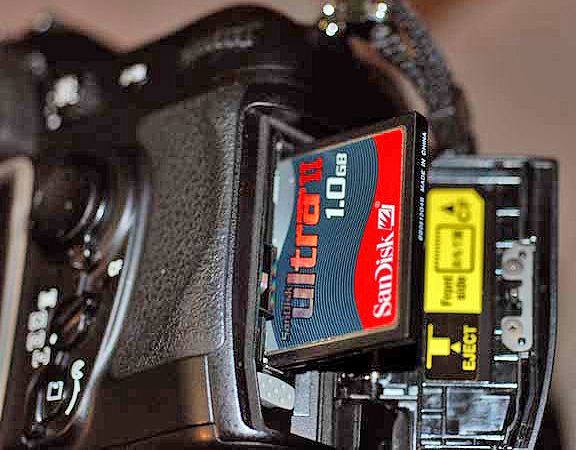
CompactFlash cards share a rectangular footprint and a standard connector arrangement. The typical external dimensions are approximately 36.4 mm by 42.8 mm. The specification defines two thicknesses: a thinner 3.3 mm card known as Type I, and a thicker 5 mm card known as Type II. Type I cards are most common and generally contain flash memory. Type II cards historically accommodated small mechanical hard disks called microdrives and some bulkier devices, though solid-state implementations have largely replaced moving parts.
Interface, modes and performance
From the outset CF used an interface compatible with the Parallel ATA protocol, which allowed cards to be addressed similarly to IDE disks when the host supported the mapping. Manufacturers later added higher transfer modes and proprietary enhancements to increase throughput. Speed ratings are sometimes given as an "×" multiple where 1× is conventionally 150 KB/s (the same base used for optical-disc ratings); for example, a "133×" rating is roughly equivalent to about 20 MB/s. Many cards advertise peak read and write rates in MB/s. In practical use, read operations are often faster than write operations, and sustained write performance can be lower than burst read speed — an important consideration for continuous photo and video capture.
Capacity, endurance and internal features
CompactFlash media have increased in capacity as NAND flash technology advanced. Early cards measured capacity in megabytes; modern flash-based CF cards range into multiple gigabytes and higher, addressing professional and industrial needs. To improve data integrity and device lifetime, CF cards commonly include internal features such as error-correcting code (ECC), wear leveling and bad-block management. These mechanisms help distribute write cycles across flash cells and recover from isolated failures, extending the useful service life of the card under heavy write workloads.
Common uses and practical considerations
- Digital still cameras and professional DSLRs that demand robust storage and fast write performance for burst shooting — see digital cameras.
- Embedded systems and industrial equipment requiring non-volatile, removable media with a durable electrical interface — see embedded systems.
- Portable audio recorders, data loggers and field devices where media are swapped or archived frequently.
- Media built from flash chips — generally called flash memory cards — that provide solid-state storage without moving parts.
Compatibility, adapters and legacy devices
Because CF originally exposes an ATA-like interface, adapters exist that allow cards to be used with a variety of hosts, including USB readers for desktop connection and passive adapters to interface with IDE-compatible electronics. In some systems firmware or driver support is required for full compatibility and optimal performance. Compared with smaller formats such as SD and microSD, CompactFlash is physically larger but often favored in applications that value a more direct electrical interface or larger contact spacing. A number of Type II cards historically contained small hard disks (microdrives), a capability that has been mostly superseded by solid-state flash.
Evolution and modern context
While many consumer devices shifted toward smaller and lower-cost card formats, CompactFlash remained relevant in professional and industrial niches because of its robustness, long-standing interface and availability of high-endurance products. Newer card families designed for higher performance and lower latency have since emerged, but CF cards continue to be used where their specific combination of size, durability and host-side compatibility are required.
When selecting a CompactFlash card for a particular device or workflow, consider the card's sustained write rating, advertised read speed, endurance characteristics and the host device's supported interface modes. Using a card reader or adapter rated for the card's speed class will help achieve expected performance in capture and transfer tasks.
For further device-specific guidance consult manufacturer documentation and reliable product reviews when evaluating cards for professional photography, continuous recording or industrial applications.
Related articles
Author
AlegsaOnline.com CompactFlash (CF) — Removable storage standard for cameras and embedded systems Leandro Alegsa
URL: https://en.alegsaonline.com/art/22206