
Chrome alum (potassium chromium sulfate)
Chrome alum (KCr(SO4)2·12H2O) is a violet, crystalline alum of chromium(III) used historically as a mordant and for laboratory demonstrations; it has distinctive coordination chemistry and safety considerations.
Overview
Chrome alum, commonly written as KCr(SO4)2 (usually encountered as the dodecahydrate KCr(SO4)2·12H2O), is a member of the alum family of double sulfates. It contains potassium cations, trivalent chromium (Cr3+), and sulfate anions. The chromium(III) center gives the compound its characteristic color and influences its chemical behavior. For a basic definition see compound overview.
Image gallery
2 Images
Properties and structure
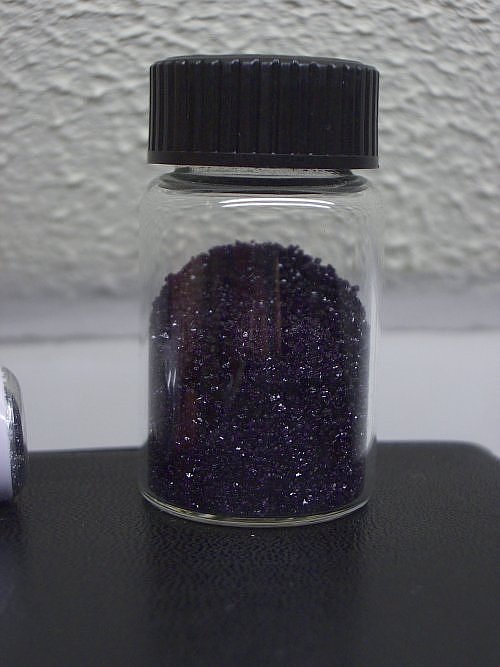
Chrome alum typically forms well-defined, often violet to purple cubic crystals. As with other alums, it crystallizes in an isometric lattice where the trivalent cation is octahedrally coordinated by water molecules and linked to sulfate groups. The Cr3+ ion is in the +3 oxidation state and produces visible color through d–d electronic transitions; the salt is paramagnetic. More on the chromium ion can be found at chromium information.
Preparation and related chemistry
In practice, chrome alum is prepared by combining a source of chromium(III) (such as chromium(III) sulfate) with potassium sulfate and allowing the mixture to crystallize. The formation of the characteristic dodecahydrate depends on concentration and temperature. The sulfate component and the potassium partner are the same species that appear in other alums (potassium salts, sulfate chemistry), which explains its structural similarity to potassium aluminum sulfate (common alum).
Uses and precautions
Historically, chrome alum served as a mordant in textile dyeing and was used in some leather-processing recipes because Cr3+ binds strongly to organic substrates. Today it is less common industrially than other chromium(III) salts but remains useful for crystal-growing demonstrations and as a reagent in teaching and research. Handling should be cautious: while chromium(III) is considerably less hazardous than hexavalent chromium, it should still be stored and disposed of responsibly to avoid oxidation to more toxic chromium(VI). See safety guidance at safety information.
Distinctions and notable facts
- Chrome alum is an example of an "alum": a double sulfate with formula M+M3+(SO4)2·12H2O.
- It differs from potassium dichromate and other chromium(VI) compounds by the oxidation state; chromium in chrome alum is trivalent and relatively stable.
- Because of its attractive crystals and color, it is popular in educational crystal-growth experiments.
For further reading and technical details consult specialist inorganic chemistry sources or material safety datasheets provided by suppliers and laboratories (reference, guidance).
Related articles
Author
AlegsaOnline.com Chrome alum (potassium chromium sulfate) Leandro Alegsa
URL: https://en.alegsaonline.com/art/20202