
Chesapeake Bay Bridge–Tunnel
A 23-mile bridge–tunnel complex across the mouth of Chesapeake Bay in Virginia that links the Delmarva Peninsula with Virginia Beach and the Hampton Roads region.
Overview
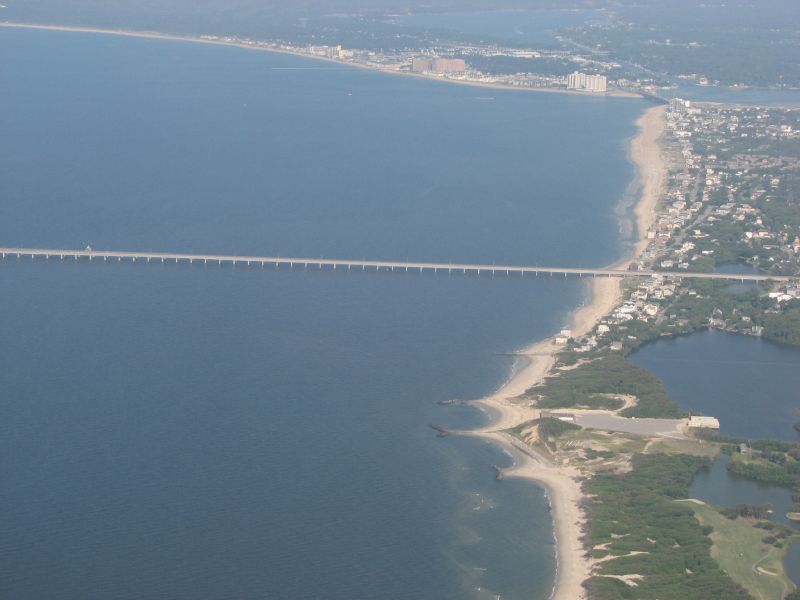
The Chesapeake Bay Bridge–Tunnel is a continuous transportation link spanning roughly 23 miles across the entrance to the Chesapeake Bay in the U.S. state of Virginia. It carries highway traffic between the Delaware–Maryland–Virginia Delmarva Peninsula and Virginia Beach, connecting mainland routes to the larger metropolitan area of Hampton Roads. The facility combines elevated bridge sections and submerged tunnels to accommodate navigation and weather conditions at the bay's mouth.
Image gallery
9 Images



Structure and components
The complex is made up of alternating long trestles, high-level bridge spans, and two underwater tunnel sections that pass beneath principal shipping channels. Between open-water and tunnel sections, man-made islands serve as transition points where the roadway descends or resurfaces. Key elements include:
- Bridge trestles and bridge spans that carry most of the length over open water.
- Tunnel tubes that allow large ships to pass safely above without the need for movable spans.
- Artificial islands, causeways, fender systems and approach roadways that join the separate structural types into a single continuous route.
History and development
Conceived to provide a direct all-weather link across the bay, the bridge–tunnel opened to traffic in the mid-20th century. Its design balanced economical long spans with the necessity of keeping deep shipping channels unobstructed, leading engineers to combine bridges and tunnels rather than build one very long elevated structure. Over time the facility has been maintained, upgraded and partially expanded to meet increasing traffic and modern safety standards.
Transport role and usage
Carrying a major U.S. highway route, the crossing is a tolled facility and a critical corridor for regional commerce, tourism and emergency movement. For many drivers the uninterrupted crossing reduces travel time compared with overland alternatives that route around the bay. Typical transit across the complex takes roughly a half-hour, depending on conditions.
Operations, safety and notable facts
The complex is operated by an authority responsible for inspections, toll collection and winter or storm response. Safety measures include navigation protection at channel spans and restrictions during severe weather. The Chesapeake Bay Bridge–Tunnel is widely recognized as one of the longer bridge–tunnel systems in the world and is notable both as an engineering achievement and as a scenic, sometimes dramatic, crossing of a major coastal estuary.
Visitor information and practical notes
Travelers planning to use the link should check current toll rates, weather advisories and any maintenance closures. The approach roads provide viewpoints and interpretive signs at several locations; commercial services and emergency assistance are available at designated points. For official information and traveler updates, consult the facility operator or designated state travel resources.
Learn more about the bridge sections, tunnels and regional context: bridges, tunnels, Chesapeake Bay, Delmarva Peninsula, Virginia Beach, metropolitan area, Hampton Roads, state, Virginia.
Related articles
Author
AlegsaOnline.com Chesapeake Bay Bridge–Tunnel Leandro Alegsa
URL: https://en.alegsaonline.com/art/19317
Sources
- cbbt.com : "Chesapeake Bay Bridge–Tunnel Facts"