
Charging Bull (Wall Street Bull)
Charging Bull is a bronze sculpture by Arturo Di Modica installed without permission in 1989 in Bowling Green, Manhattan. It symbolizes market confidence and is a major public-art landmark and tourist attraction.
Charging Bull, commonly called the Wall Street Bull, is a large bronze sculpture installed in the public plaza at Bowling Green in Manhattan. Created and placed by Italian-American artist Arturo Di Modica in 1989, the work quickly became a widely recognized emblem associated with the energy of the city’s financial community and with broader ideas of confidence and prosperity in the economy. It stands in a busy area of New York City and is frequently photographed by residents and visitors.
Image gallery
6 Images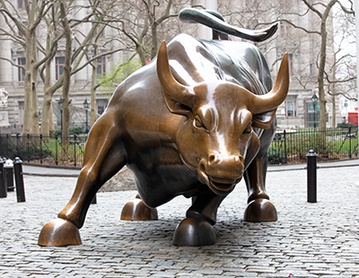



Appearance and symbolism
The sculpture depicts a powerful bull poised as if charging forward, with muscles tensed and head lowered. Cast in bronze, its form emphasizes motion and aggression without relying on literal portraiture. Observers interpret the figure as a representation of market strength, optimism, and entrepreneurial determination; it has also been adopted by tourists as a talisman of good luck, with many people touching certain parts of the sculpture for photographs and ritual.
Origins and installation
Di Modica created and installed the piece as an unauthorized public gesture during a period of financial turbulence in the late 1980s. He placed the work without formal permission, and it was initially removed by authorities; strong public interest and favorable press attention led to its reinstallation at its present site near the entry to the city’s historic green. The story of its guerrilla placement contributes to its cultural resonance as an artwork created outside normal institutional channels.
Public impact and controversies
As a piece of public art, Charging Bull has generated both affection and debate. It is a major tourist attraction and a backdrop for countless photographs, while also inspiring commentary and protest about the values it seems to represent. The 2017 placement of the statue Fearless Girl facing the bull led to renewed discussion about gender, symbolism, and the meanings attached to artworks in public space. There have also been disputes over commercial use, ownership claims, and the appropriate role of iconic sculptures in shared urban environments.
Visiting and cultural role
Located in a heavily visited part of the city, the sculpture is accessible to the public and often surrounded by crowds. It functions as both a local landmark and an international symbol in media coverage of finance and New York City street life. While opinions differ about its artistic merits and political connotations, the work remains an enduring example of how a single public sculpture can shape conversations about art, commerce, and civic space.
Quick facts
- Artist: Arturo Di Modica.
- Installed: placed in 1989 as an unsanctioned public work.
- Medium: bronze casting (public sculpture).
- Common interpretation: financial optimism, determination, and prosperity.
- Location reference: near the financial district of Manhattan.
Charging Bull continues to attract visitors and to prompt conversations about public art, symbolism, and the relationship between cultural landmarks and urban life.
Related articles
Author
AlegsaOnline.com Charging Bull (Wall Street Bull) Leandro Alegsa
URL: https://en.alegsaonline.com/art/18651
Sources
- nytimes.com : "The Bronze Bull Is for Sale, but There Are a Few Conditions"
- nytimes.com : "SoHo Gift to Wall St.: A 3½-Ton Bronze Bull"