
Charminar — Monument and Mosque of Hyderabad
Charminar is a 16th-century monument and mosque in Hyderabad, India, famed for its four minarets, Indo-Islamic design with Persian influences, and central role in the city's history, culture and tourism.
Overview
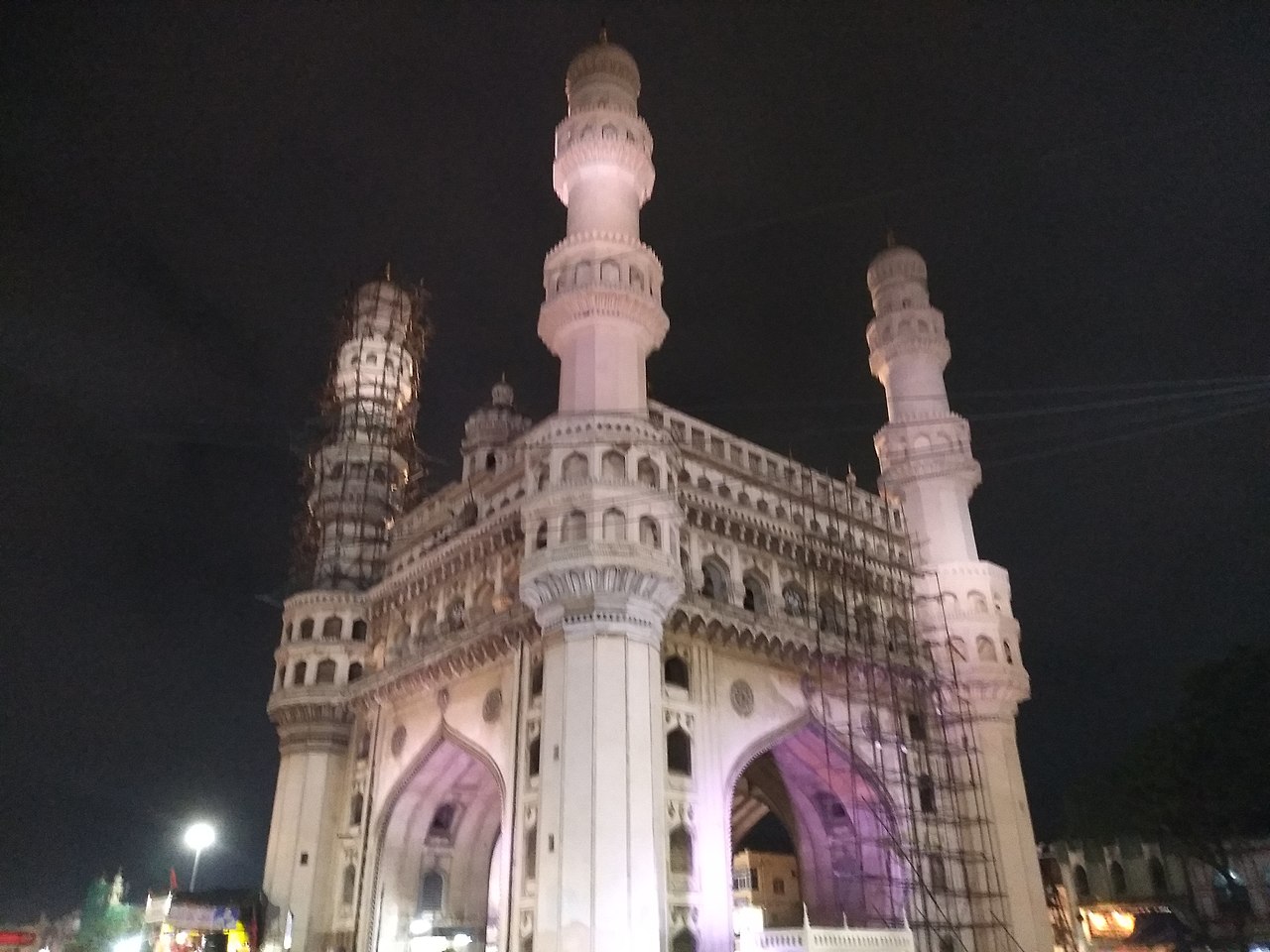
The Charminar is a late 16th-century monument and mosque located in the historic core of Hyderabad. Erected in 1591, it is one of the city's most recognizable landmarks and a frequent symbol of Hyderabad's identity. The name combines two words — char (four) and minar (towers) — reflecting the structure's distinctive quartet of minarets. The Charminar functions both as a place of prayer and as a public monument that anchors a dense market district.
Image gallery
10 Images



Architecture and layout
Charminar exhibits an Indo-Islamic architectural vocabulary with visible Persian influences that were common in the Deccan courts of its time. The main building rests on a square platform with four grand arches that face the cardinal directions. At each corner rises a fluted minaret that incorporates multiple stories, balconies and decorative stucco work. Above the arches is a central prayer hall with an arcade and roof terraces. Ornamentation includes vegetal and geometric motifs and carved details that blend local craft traditions with imported stylistic elements.
- Four soaring minarets, one at each corner
- Four large arches forming a cruciform plan
- Interior mosque space on the upper level
- Balconies and staircases leading up the minarets
History and origin
The monument is commonly attributed to Muhammad Quli Qutb Shah, the ruler who founded Hyderabad. Contemporary and later accounts say it was built as part of the new city's ceremonial center and to mark the end of a severe epidemic, after which the ruler vowed to build a mosque. Officials and advisers of the Qutb Shahi court contributed to the city's layout and to the design that situates Charminar at the heart of the old city. Its placement near the Musi river and next to major marketplaces established it as an urban focal point.
Cultural role and importance
For centuries Charminar has been more than an architectural object: it is a venue for religious observance, a backdrop for festivals, and a magnet for commerce and tourism. It sits close to historic shopping streets such as Laad Bazaar and other landmarks including the large congregational mosque known locally as Makkah Masjid. The site appears in countless photographs, postcards and representations of Hyderabad, and it continues to be an important meeting place for locals and visitors alike.
Conservation and notable facts
Because of its age and heavy urban surroundings, Charminar has been the subject of conservation efforts to address weathering, pollution and structural wear. Preservation involves local and national authorities and conservation specialists working to retain original materials and motifs while allowing continued public access. The building often features in discussions of Indo-Islamic architecture and remains a primary destination for those exploring the region's history. For general information on its identity as a combined religious and civic monument, see the site described as a monument and mosque.
Today, Charminar stands as a living monument: visited for its history and architecture, used in civic rituals and integrated into the everyday commercial life of Hyderabad's old quarter.
Questions and answers
Q: What is the Charminar?
A: The Charminar is a monument and mosque in Hyderabad, India. It was built in 1591 AD and is one of the most famous buildings in India.
Q: Who built the Charminar?
A: The Charminar was built by Muhammad Quli Qutb Shahi to celebrate the end of a deadly plague.
Q: Where is the Charminar located?
A: The Charminar lies near the bank of the river Musi, close to Laad Bazaar and Makkah Masjid.
Q: What does "Charminar" mean?
A: "Charminar" is taken from two words - "Char" and "Minar", which translate as Four Towers in English.
Q: Was it the first structure to be constructed in Hyderabad?
A: Some people say that Charminar was the first structure to be constructed in the newly built city of Hyderabad.
Q: Why did Quli Qutab Shah build it?
A: It is said that Quli Qutab Shah prayed for the end of a plague and vowed to build a mosque if it was eradicated.
Q: What type of architecture does it have?
A: The structure has Indo-Islamic architecture with some Persian elements.
Related articles
Author
AlegsaOnline.com Charminar — Monument and Mosque of Hyderabad Leandro Alegsa
URL: https://en.alegsaonline.com/art/18862
Sources
- commons.wikimedia.org : Charminar
- heraldscotland.com : "Richard Goslan travels to India - Herald Scotland"
- britannica.com : Charminar: Hyderabad
- whc.unesco.org : "The Qutb Shahi monuments of Hyderabad-Golconda Fort, Qutb Shachi Tombs, Charminar"
- english.irib.ir : "India: Charminar is in fact a madrasa and masjid"