
Cherenkov radiation (Vavilov–Cherenkov effect)
Electromagnetic radiation emitted when a charged particle travels faster than light's phase velocity in a medium; known for its blue glow and used in reactors, particle detectors and astrophysics.
Cherenkov radiation is electromagnetic light produced when a charged particle moves through a transparent dielectric medium at a speed greater than the phase velocity of light in that medium. The effect is often noticed as a characteristic blue glow in water-filled reactors and in experimental detectors. It is sometimes called the Vavilov–Cherenkov effect; the original Russian name is Черенков.
Image gallery
9 Images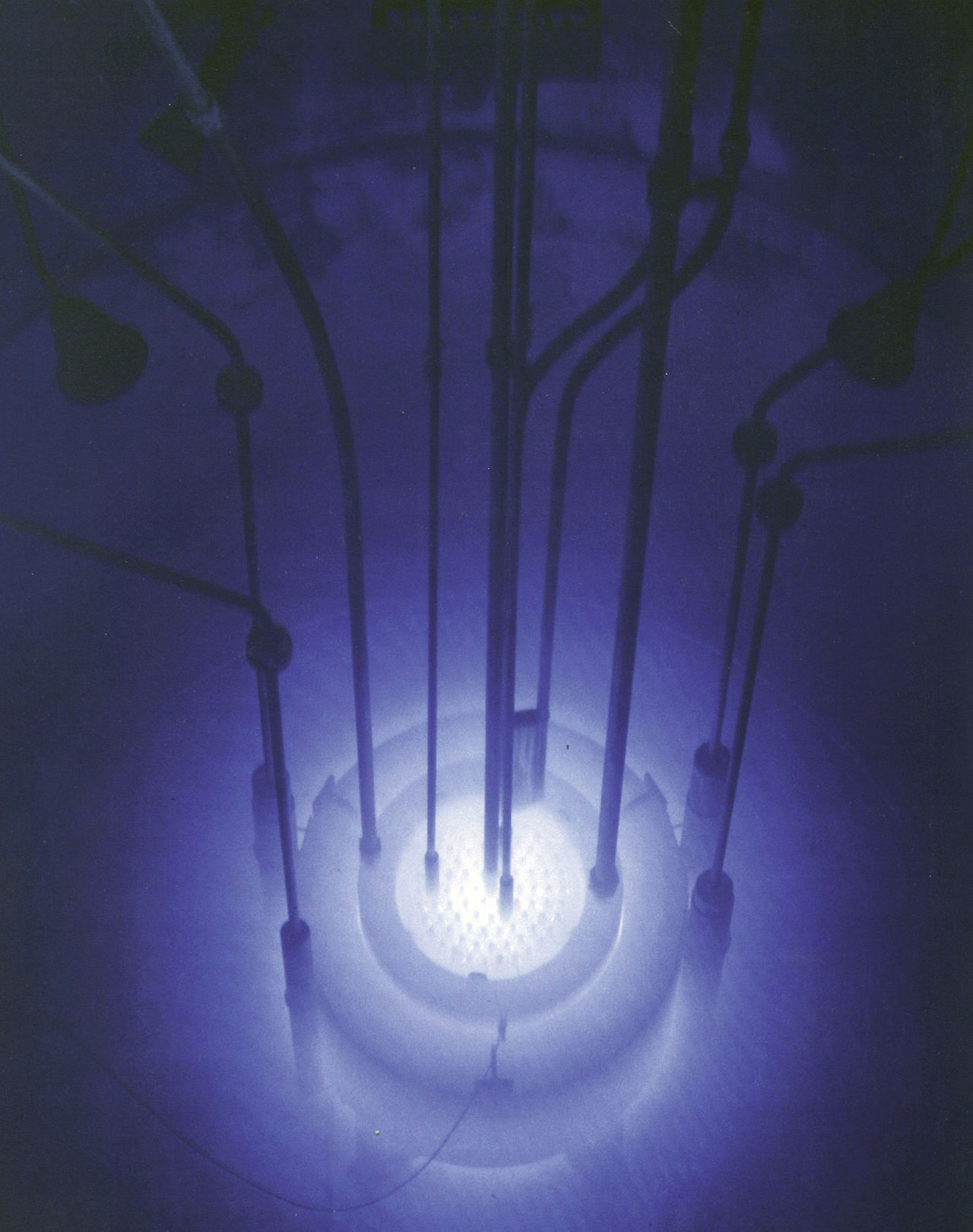




Physical mechanism
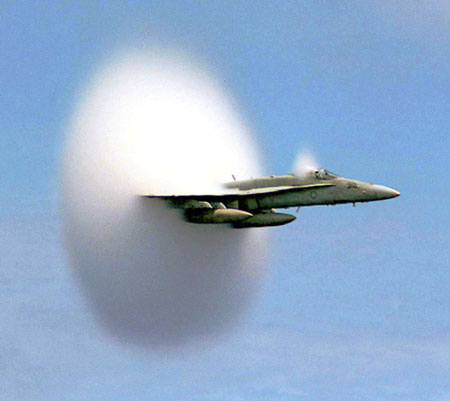
The phenomenon arises because the particle polarizes atoms along its path; when these atoms relax they emit electromagnetic waves. If the particle's speed exceeds the local light phase velocity (c/n, where n is the refractive index), these wavelets add coherently along a conical front, analogous to a sonic boom. The cone half-angle θ relative to the particle direction satisfies cosθ = 1/(nβ), where β = v/c and c is the speed of light in vacuum. The result is a forward-directed flash whose spectrum is weighted toward shorter wavelengths, giving the familiar blue appearance.
Key characteristics
- Threshold condition: v > c/n, so a higher refractive index lowers the speed threshold.
- Angular distribution: light is emitted on a cone; the opening angle depends on particle speed and refractive index.
- Spectral tendency: intensity increases at shorter wavelengths within the transparent window of the medium, often appearing blue.
- Dependence on charge and path: emission scales with the square of the particle charge and with the distance traversed in the medium.
History and theory
The effect was discovered experimentally in 1934 by Pavel A. Čerenkov under the supervision of Sergey Vavilov. A theoretical description based on classical electrodynamics was developed by Igor Tamm and Ilya Frank in 1937; their work explains the coherent superposition of emitted waves and predicts angular and spectral properties. In recognition of these contributions, Čerenkov, Tamm and Frank were awarded the Nobel Prize in Physics in 1958.
Detection methods and devices
Cherenkov light is used in a variety of detectors and instruments. Simple threshold counters register whether a particle exceeds the speed required to produce light in a chosen medium. Ring-imaging Cherenkov (RICH) detectors measure the emission angle to identify particle velocity and hence particle type when combined with momentum measurements. Large water or ice Cherenkov detectors instrumented with photomultiplier tubes, such as those used to observe neutrinos, record faint, fast flashes from rare interactions.
Applications and examples
- Nuclear reactors: the blue glow in reactor pools is visible Cherenkov radiation from β particles and secondary electrons.
- High-energy physics: particle identification and timing in collider experiments.
- Astroparticle physics: imaging atmospheric Cherenkov telescopes detect air showers produced by gamma rays and cosmic rays.
- Medical and industrial uses: Cherenkov luminescence imaging and beam diagnostics exploit the light produced by energetic charged particles.
Distinctions and notable facts
Cherenkov radiation is distinct from other emissions such as fluorescence or synchrotron radiation: it requires a medium and the particle speed to exceed the medium's light phase velocity, whereas fluorescence depends on atomic transitions and synchrotron radiation arises from acceleration in magnetic fields. It does not violate special relativity because no information or matter travels faster than light in vacuum. The effect is useful both as a diagnostic signature of fast charged particles and as a tool for precise measurements in physics and applied fields.
Overall, Cherenkov radiation links classical electrodynamics to practical detection techniques and remains a fundamental and widely exploited phenomenon in experimental science.
Related articles
Author
AlegsaOnline.com Cherenkov radiation (Vavilov–Cherenkov effect) Leandro Alegsa
URL: https://en.alegsaonline.com/art/18182