
List of Jupiter's moons
Comprehensive overview of Jupiter's natural satellites: the major Galilean moons, groups of smaller satellites, orbital characteristics, discovery history, and scientific importance.
Jupiter is the largest planet in the Solar System and is orbited by a large and diverse collection of natural satellites. The system includes a handful of very large moons and many dozens of much smaller objects. Over the centuries astronomers have progressively improved the census of these bodies and their classification. Modern studies emphasize contrasts between the few massive, geologically interesting moons and the numerous small, irregular satellites bound in complex groupings around Jupiter, reflecting the planet's dominant gravitational role among planets in the Solar System. For scale and context the Jovian system has been described as possessing the second-largest number of moons with reasonably stable orbits of any planet.
Image gallery
10 Images

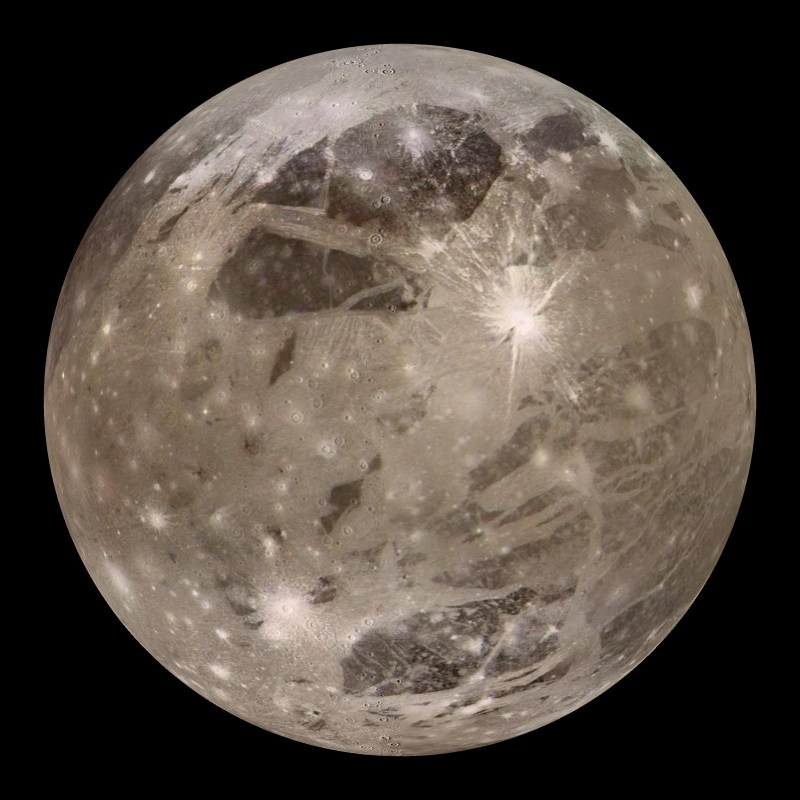


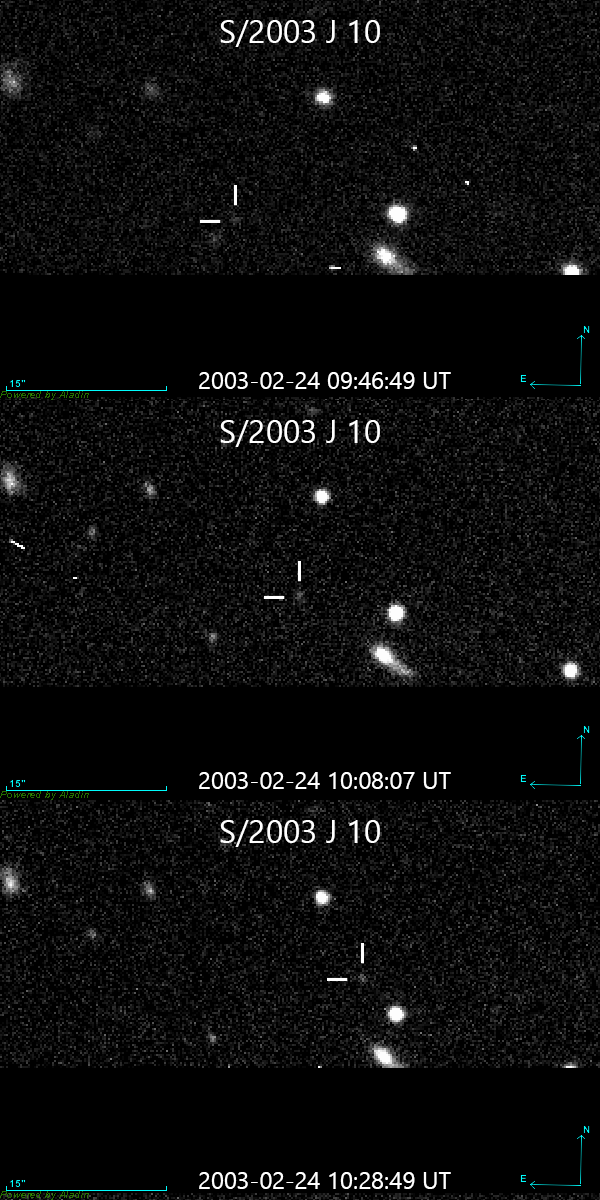


The Galilean satellites
The four Galilean moons are the single most prominent feature of Jupiter's satellite system. Known since their discovery in 1610 by Galileo Galilei (and observed independently by Simon Marius), the Galilean moons — Io, Europa, Ganymede, and Callisto — are comparable in size to Earth's Moon or larger and dominate the mass and dynamics of the inner Jovian system. Each displays distinctive geology and internal structure: Io is volcanically active, Europa shows evidence for a subsurface ocean, Ganymede carries its own intrinsic magnetic field, and Callisto is heavily cratered and ancient in appearance. Together these four are the principal targets for missions and for comparative studies of planetary satellites.
Smaller regular and irregular satellites
Beyond the Galilean group, many additional moons are small and irregular in shape. Typical dimensions for these bodies are far below the major moons; most have diameters under a few hundred kilometres and many are only a few kilometres across, a fact often summarized with reference to their diameter. Their surfaces and internal structures are generally simpler because self-gravity is weak and they are often fragments from past collisions or captured objects. The orbits of these satellites show a broad range of orbital shapes, from nearly circular to highly eccentric. Several groups share similar orbital inclinations and distances, which suggests common origins from parent bodies that were broken apart.
Orbital regimes and system properties
Jovian satellites occupy distinct orbital regimes: close, prograde, roughly equatorial orbits, where the largest moons reside; intermediate distances occupied by named groups such as the Himalia family; and distant, often retrograde populations with long, inclined orbits. Observed orbital periods therefore vary greatly — from a fraction of a Jovian day for the innermost objects to many months or years for distant irregulars. Despite the large number of satellites, the combined mass of all the small moons and Jupiter's faint rings is minuscule compared with the giant planet; estimates indicate that the total orbiting mass of these smaller components forms only a tiny fraction of the system's mass budget dominated by Jupiter itself and by the Galilean satellites.
Discovery, naming, and scientific importance
After Galileo's initial discoveries, further moons were found intermittently through telescopic advances in the 19th century and then in large numbers with 20th- and 21st-century digital detectors. New detections continue as surveys probe fainter objects. Naming conventions follow rules established by astronomical authorities and typically draw on characters from Greco-Roman mythology associated with Jupiter (Zeus). The scientific value of studying Jupiter's moons is high: they provide natural laboratories for tidal heating, magnetospheric interactions, planetary formation and capture processes, and the search for habitable environments beyond Earth — Europa's subsurface ocean being a prime example.
Practical considerations and further study
- Classification: major Galilean moons versus small regular and irregular satellites.
- Origins: co-formation for large moons; capture and collisional fragmentation for many small ones.
- Exploration: past missions (e.g., Galileo) and ongoing/future missions continue to refine knowledge of composition and habitability.
For concise cross-references and to follow up on particular names, terms and datasets related to Jupiter's satellites, see linked resources: Jupiter overview, moon counts, planetary context, Solar System scope, Galilean group, historical observers, ring system, mass estimates, Io, Europa, Ganymede, Callisto, size data, orbit shapes, eccentricity, and orbital periods.
Questions and answers
Q: How many moons does Jupiter have?
A: Jupiter has 79 known moons.
Q: Who discovered the four Galilean moons of Jupiter?
A: The four Galilean moons of Jupiter were independently discovered in 1610 by Galileo Galilei and Simon Marius.
Q: What are the names of the four Galilean moons?
A: The four Galilean moons are Io, Europa, Ganymede and Callisto.
Q: How do the sizes of the Galilean Moons compare to Earth's moon?
A: The Galilean Moons are roughly the same size as Earth's moon, some are a bit bigger, some are smaller.
Q: How big is each of the other 75 Jovian moons?
A: All 75 Jovian moons are less than 250 kilometres (160 mi) in diameter, with most barely exceeding 5 kilometres (3.1 mi).
Q: What is their orbital shape like?
A: Their orbital shapes range from nearly perfectly circular to highly eccentric and inclined. Many revolve in the direction opposite to Jupiter's spin (retrograde motion).
Q: What is their orbital period like compared to that of Jupiter?
A: Orbital periods range from seven hours (taking less time than Jupiter does to spin around its axis), to some three thousand times more (almost three Earth years).
Related articles
Author
AlegsaOnline.com List of Jupiter's moons Leandro Alegsa
URL: https://en.alegsaonline.com/art/124776
Sources
- sites.google.com : "The Jupiter Satellite and Moon Page"
- vox.com : "The Jupiter Satellite and Moon Page"
- carnegiescience.edu : "A dozen new moons of Jupiter discovered, including one "oddball""
- nationalgeographic.com : "12 New Moons Found Orbiting Jupiter"
- cfa-www.harvard.edu : "Natural Satellites Ephemeris Service"
- dtm.ciw.edu : "Jupiter's Known Satellites"
- planetarynames.wr.usgs.gov : "Gazetteer of Planetary Nomenclature"
- hnsky.org : The Planets and Satellites 2000