
Carnassial teeth
Carnassials are specialized shearing teeth of many meat-eating mammals, adapted for slicing flesh and crushing bone; they vary in position and form across groups and are important in ecology and paleontology.
Overview
Carnassial teeth are enlarged, blade-like chewing teeth found in many carnivorous mammals. Their principal function is to shear flesh and sometimes to crack bone, operating in a scissor- or shear-like motion that slices tissue as the jaws close. This adaptation is associated with a meat-focused diet and appears in both living and extinct groups of predators.
Image gallery
6 Images
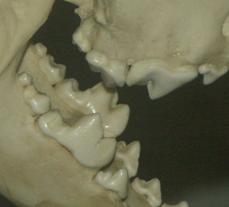


Anatomy and position
In modern members of the order Carnivora, the carnassials are typically formed by the upper fourth premolar and the lower first molar. These two teeth occlude with one another to create a slicing surface. More generally, carnassials are modified premolars or molars whose crowns become elongated and sharpened for cutting. For a concise description of the scissor-like action, see shear-like action.
Other, now-extinct mammal groups developed carnassial-like teeth in different positions. For example, the creodonts—an early group of predatory mammals—had the main shearing teeth farther back in the jaw, often involving different molar positions. See a comparative discussion of fossil dental arrangements in Creodonta.
Characteristics and examples
- Form: elongate blades on a tooth crown that create a sharp occluding edge.
- Location: in Carnivora, usually the last upper premolar and first lower molar; in some fossil groups the pair differs.
- Function: slicing meat, occasional bone-cracking depending on robustness.
Well-known modern predators that depend heavily on carnassials include wolves and lions; damage to these teeth can seriously reduce an animal's ability to feed. For field studies and species examples, see references to wolves and lions.
Wear, disease and ecological importance
Because carnassials are central to feeding, they are subject to heavy wear and risk of fracture when animals process tough materials like frozen meat or marrow-rich bone. Severe wear, infection or breakage can lead to reduced feeding efficiency and, in wild animals, may contribute to starvation. Veterinary and ecological reports often highlight carnassial health when assessing the condition of a carnivore population.
Evolutionary and paleontological significance
Carnassials are useful in classification and inferences about diet in both living and extinct mammals. The presence, position and shape of shearing teeth help paleontologists reconstruct feeding behavior and ecological niches. Comparative treatments of the order Carnivora and the fossil record often use carnassial morphology as a diagnostic trait. Differences in which tooth positions act as carnassials are documented in dental anatomy summaries such as descriptions of the upper premolar and lower molar roles: upper premolar and lower molar.
Overall, carnassial teeth illustrate how a specific feeding need—efficiently slicing meat—has shaped mammal dentition repeatedly through evolutionary time, producing similar functional structures across unrelated groups.
Related articles
Author
AlegsaOnline.com Carnassial teeth Leandro Alegsa
URL: https://en.alegsaonline.com/art/17145
Sources
- books.google.com : Evolution of mammalian molar teeth