
Capillary action
Capillary action is the movement of liquids through narrow spaces or porous materials driven by surface tension, adhesion, and cohesion; it explains wicking, plant water transport, and many practical devices.
Overview
Capillary action (also called capillarity) is the spontaneous movement of a liquid within narrow spaces, whether those spaces are the interior of a thin tube or the tiny pores of a material. It arises from an interplay of surface tension, adhesive forces between the liquid and the solid, and cohesive forces inside the liquid itself. The phenomenon can be observed in simple household items and in biological systems alike; it is not powered by pumps but by molecular interactions at interfaces.
Image gallery
10 Images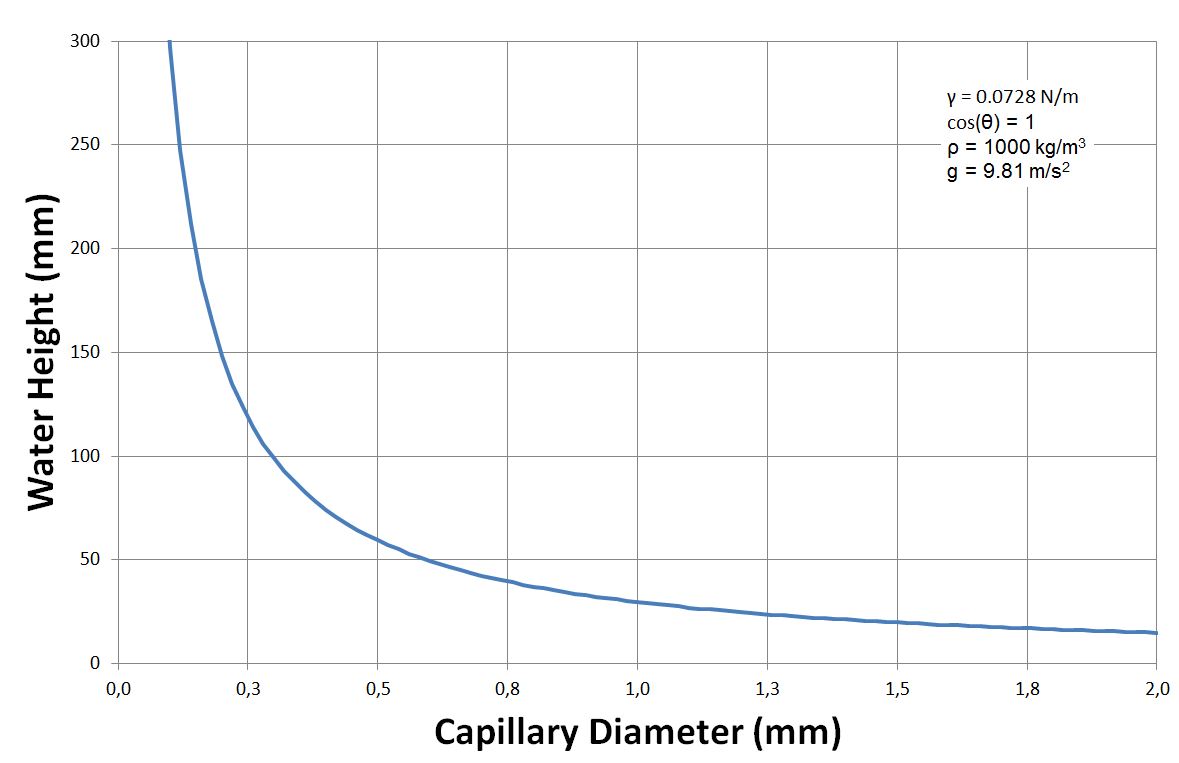


How it works
At the microscopic level, molecules of a liquid experience attraction to one another (cohesion) and to the walls of a container (adhesion). If adhesion to the solid is stronger than cohesion, the liquid wets the surface and climbs into narrow channels. The rise or depression of the liquid surface depends on the contact angle, the liquid's surface tension, and the size of the passage. Narrower passages produce larger curvature of the liquid surface and therefore larger capillary pressure. That upward force is eventually balanced by the weight of the column of liquid and by gravity, which limits how far the liquid can rise.
Key factors and typical behavior
- Channel size: thinner tubes or pores yield stronger capillary effects.
- Surface chemistry: more wetting surfaces increase upward movement through adhesive attraction.
- Liquid properties: higher surface tension usually enhances capillarity, while density and viscosity influence the rate and limit of rise.
- Orientation: capillary forces can lift liquid against gravity but only up to a finite height.
Examples and applications
Everyday demonstrations make the concept easy to picture. If you leave a drinking straw in a cup of water, the water inside the straw may sit slightly higher than the surrounding surface because adhesive forces pull it up along the straw walls. A sponge soaks up puddles because its interconnected pores act like countless tiny capillary tubes, pulling water inward. Capillarity also underlies how fabrics wick sweat away from skin and how inks travel through paper in chromatography.
Biological roles and technology
Plants rely on related mechanisms within xylem vessels to help move water from roots toward leaves, assisted by transpiration and pressure differences. In animals, capillary action helps clear fluids from small crevices; for instance, tear fluid can be drained along narrow channels near the eye (tears) as part of physiological drainage (human body function). Engineers exploit capillarity in wick-fed lamps, diagnostic test strips, microfluidic devices, and porous filters where passive, pump-free fluid transport is advantageous.
History and notable distinctions
Interest in capillary behavior dates back centuries and led to quantitative descriptions in the 18th and 19th centuries. It is important to distinguish capillary rise (wetting liquids) from capillary depression, which occurs when a liquid does not wet the surface and the liquid level falls in a narrow tube. In very small systems, such as microchannels or biological capillaries, surface forces dominate over bulk forces, making capillary design a crucial consideration in both nature and technology.
Practical considerations
When applying capillary principles, designers must consider pore geometry, surface treatments that alter wetting, and the interplay of evaporation and absorption. Simple experiments with straws, paper, and sponges illustrate the basic ideas, while modern applications extend from soil moisture management to lab-on-a-chip platforms. For further reading on related physical properties and examples, see sources on liquid behavior, narrow channels, porous media, surface tension, household demonstrations, water interactions, adhesive forces, gravity effects, physiological roles, and tear drainage.
Tags
Related articles
Author
AlegsaOnline.com Capillary action Leandro Alegsa
URL: https://en.alegsaonline.com/art/16747