
Caper (Capparis spinosa) — plant, buds, and culinary uses
Caper (Capparis spinosa) is a perennial shrub whose pickled flower buds are a staple Mediterranean condiment. This article summarizes its botany, cultivation, culinary uses, history and notable distinctions.
Overview
The caper is the unopened flower bud of the caper bush, Capparis spinosa, a perennial shrub or subshrub cultivated and gathered for both its buds and its fruit. The plant produces rounded, fleshy leaves and showy white to pinkish-white flowers. When preserved by pickling or brining the immature buds become the pungent, tangy condiment commonly known as capers; the larger ripe berries are known as caperberries and are also preserved for eating.
Image gallery
10 Images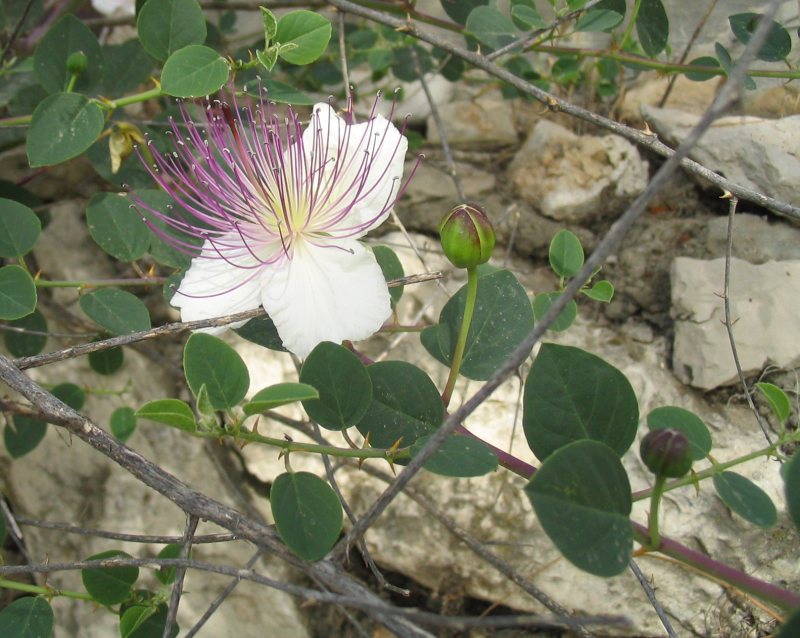


Botanical characteristics
Capparis spinosa belongs to a group of shrubby plants adapted to dry, rocky environments. Its stems are often sprawling, and leaves are succulent in texture to reduce water loss. Flowers are fragrant and conspicuous, with numerous long stamens. For more detailed taxonomic information see botanical classification and for leaf and flower descriptions consult leaf and flower details.
Cultivation and ecology
Caper bushes tolerate poor soils, coastal exposure, and drought, which makes them common on cliffs, walls and dry fields across warm regions. They reproduce vegetatively and by seed, and are often grown from cuttings in gardens and commercial plantings. Harvesting is done by hand because buds develop at different times; the buds are sorted by size and cured in salt or brine to develop the characteristic flavor.
Culinary uses and forms
Preserved capers are used worldwide as a salty, piquant seasoning. Typical uses include salads, sauces, dressings, fish and meat dishes, and regional specialties such as pasta sauces and tapenades. Capers are available in several forms—salt-packed, brine-cured, or packed in vinegar—and culinary guides often distinguish between bud sizes and the larger caperberry. A description of the pickled bud is available at culinary bud.
History and cultural importance
Capers have a long history of use in Mediterranean and adjacent cuisines and appear in classical medical and culinary texts. While they are widespread in the Mediterranean today, their precise origin is debated; some evidence suggests a broader native range including parts of Asia and possibly tropical regions. The plant has been naturalized in many temperate and subtropical zones and figures prominently in regional gastronomy and folk medicine.
Distinguishing facts
- Bud vs berry: The caper is the immature bud; the caperberry is the fruit that follows flowering.
- Processing: Brining or salting is essential to mellow bitterness and develop flavor.
- Habitat: Adapted to rocky, sun-exposed sites and poor soils.
- Further reading: For broader context on Mediterranean flora, see Mediterranean flora references.
Overall, the caper combines botanical interest, ecological hardiness and a distinct culinary role that has made it a recognizable ingredient far beyond its native or naturalized ranges.
Related articles
Author
AlegsaOnline.com Caper (Capparis spinosa) — plant, buds, and culinary uses Leandro Alegsa
URL: https://en.alegsaonline.com/art/16744