
Cabinet of Ministers of Ukraine
The Cabinet of Ministers of Ukraine is the country's highest executive body, led by the Prime Minister and responsible to parliament for implementing state policy, drafting the budget and managing government ministries.
Overview
The Cabinet of Ministers of Ukraine is the central executive organ of the Ukrainian state, charged with implementing laws, directing the work of ministries and administering public policy. It functions within Ukraine's semi-presidential system: the Prime Minister is nominated with presidential involvement but the Cabinet as a whole is politically accountable to the Verkhovna Rada, Ukraine's parliament. The Cabinet is commonly referred to as the government or executive cabinet in English-language sources.
Image gallery
1 Image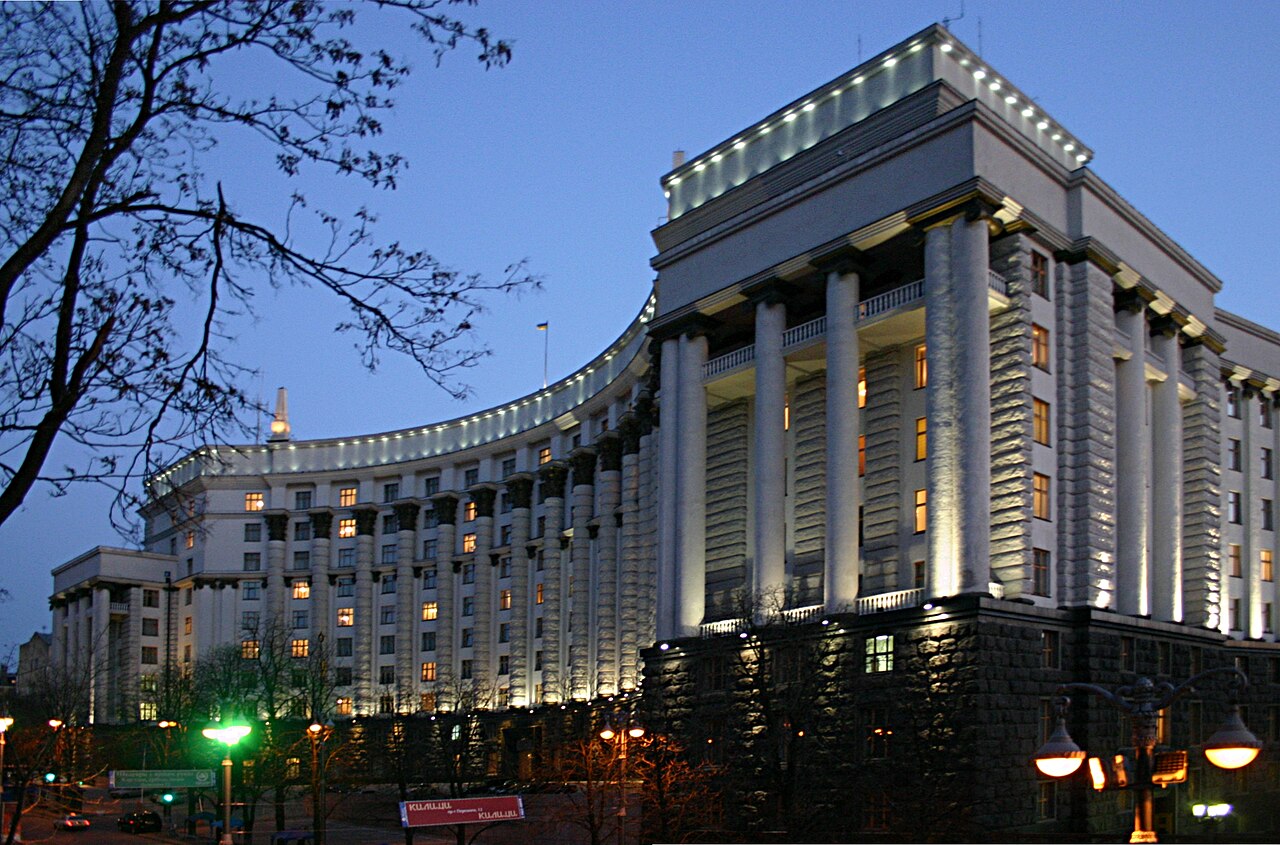
Composition and appointments
The Cabinet is headed by the Prime Minister and includes several senior officials who coordinate government activity. Typical membership includes:
- Prime Minister — the head of government and presiding officer of Cabinet meetings. See the office of the Prime Minister for related roles and protocol.
- First Vice Prime Minister and one or more Vice Prime Ministers
- Ministers who lead specific ministries (economy, health, education, defense, etc.) — a list and descriptions of ministries is available through official sources on ministers and ministries.
- Other senior officials who may be part of the Cabinet by statute or presidential decision
Formally, the President plays a role in proposing a candidate for Prime Minister, but that candidate and the ministers require confirmation through votes in the Verkhovna Rada. The parliament can express no confidence in the Cabinet; resignation procedures and reorganizations follow constitutional and statutory rules. The system of nomination and approval means the Cabinet operates under both presidential influence and parliamentary oversight.
Powers and functions
The Cabinet's principal functions include proposing the state budget, preparing and executing government policy, issuing resolutions and regulations within its competence, managing public services and coordinating the work of ministries. Practical duties commonly attributed to the Cabinet are:
- Drafting and submitting the national budget and overseeing its execution
- Implementing domestic economic and social policy, including public health, education and infrastructure
- Coordinating emergency responses and national modernization initiatives
- Representing the executive branch in relations with legislative bodies and other state authorities
The Cabinet operates through collective decision-making at regular meetings chaired by the Prime Minister. Individual ministers manage their respective departments but must comply with Cabinet-wide policy and legal limits.
History and development
The Cabinet of Ministers evolved from earlier executive institutions that administered Ukrainian territory in the 20th century. After Ukraine declared independence in 1991, a modern cabinet system developed under successive constitutions and laws; the 1996 Constitution set out the broad separation of powers and defined the Cabinet as the highest body of state executive power. Over the following decades, the structure and composition of ministries have been reformed several times to reflect policy priorities and administrative efficiency.
Role in the state and notable distinctions
In Ukraine's state system the Cabinet differs from the President (head of state) and the Verkhovna Rada (unicameral legislature). While the President has specific constitutional powers — including foreign policy influence and certain appointments — the Cabinet carries primary responsibility for day-to-day governance and law implementation. The Cabinet is also distinct from regional and local administrations, which carry out policies within their jurisdictions under national laws.
Further information
For official documents, lists of current ministers and legal texts, consult the Cabinet's official resources and parliamentary records. General background about the country is available through authoritative country profiles and summaries of Ukrainian government institutions: Ukraine, the Cabinet's legal framework and history can be explored via publications about the Cabinet (Ukrainian name), the role of the President, and the legislative oversight provided by the Verkhovna Rada. Official ministry directories and organizational charts are commonly published by the Cabinet and referenced in media and academic analyses (ministers and ministries, Prime Minister's office).
Related articles
Author
AlegsaOnline.com Cabinet of Ministers of Ukraine Leandro Alegsa
URL: https://en.alegsaonline.com/art/15851
Sources
- en.wikisource.org : "Article 116"