
AIDS (MS-DOS computer virus)
A file-infector from the MS-DOS era that targets .COM and .EXE files, becomes memory-resident, overwrites executable headers and displays a destructive message, requiring backup restoration or reinstallation.
Overview
The AIDS virus is a legacy computer virus that infected MS-DOS systems by attaching itself to executable files. It targets the common DOS program formats .COM and .EXE. When an infected program is run under MS-DOS, the virus becomes resident in the computer's memory and can spread by modifying other executables that are later executed. For a concise definition see virus and for the platform it affected see MS-DOS.
Image gallery
1 Image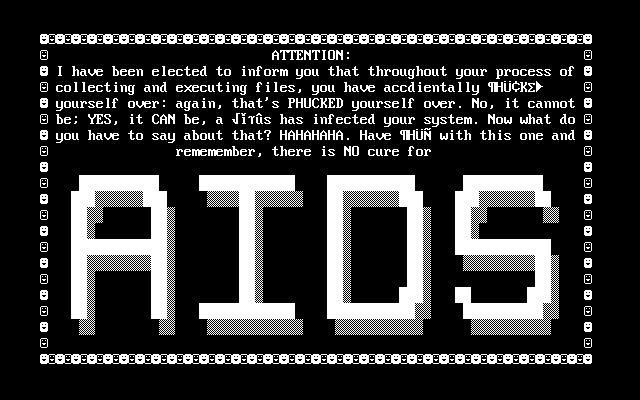
Behavior and technical characteristics
The AIDS virus operates as a file infector: once resident in memory (memory), it locates and infects additional programs when they are run. It specifically rewrites a portion of the beginning of infected executables — reported to be the first 13,952 bytes on disk — which destroys original code and data in that region. Because the virus overwrites actual bytes of the file header and code, the corrupted portion usually cannot be recovered from the infected file itself; removal therefore often requires a clean backup or a replacement copy.
- Targets: .COM and .EXE program files.
- Residency: becomes memory-resident while the system is running.
- Payload: overwrites initial bytes of executables and displays a message, then halts the system.
- Recoverability: overwritten parts are generally irretrievable without backups.
Names, discovery and historical context
This virus emerged during the MS-DOS era that spans the 1980s and early 1990s, when file-infecting viruses were common on personal computers. It has been reported under several informal names: some European sources referred to it as the "Hahaha virus" while IBM documentation used the term "Taunt virus". Precise authorship and initial distribution details are not broadly documented in public sources; as with many early DOS viruses, propagation was typically driven by the exchange of infected software on floppy disks and shared program collections.
Effects, detection and removal
On an infected machine the virus often displays a prominent message that can occupy much of the screen and then halt further operation, rendering the system unusable until cleaned or rebooted. Because the infection overwrites essential parts of executables, standard disinfecting routines that simply remove viral code are ineffective for files where original bytes have been destroyed. Detecting the presence of the virus was historically done with signature-based scanners and integrity checks.
- Isolate the machine to prevent further spread (avoid using removable media).
- Scan with an up-to-date antivirus utility capable of identifying MS-DOS file infectors.
- Restore corrupted programs from verified backups or reinstall from original media; do not attempt to run suspect copies.
- In severe cases, reformatting and reinstalling the operating system and applications may be necessary.
Prevention and legacy
Prevention practices that became standard during and after the MS-DOS period include maintaining verified backups, using write-protected or read-only media for distribution, exercising caution when running unknown programs, and keeping anti-malware tools current. The AIDS virus and similar file infectors helped shape early antivirus research and user awareness about executable integrity. For modern readers researching historical reports or technical descriptions, consult general resources on operating systems, archived technical analyses, and vendor advisories such as those once provided by IBM or other security organizations. Regional references sometimes appear in period literature — for example, European reports cited the alternate name linked to Europe.
Because many details about vintage viruses are scattered across technical bulletins and user accounts, further reading in historical malware surveys and archived security advisories is recommended. General discussions of executable infection techniques and memory-resident viruses can be found via introductory material linked from virus overviews and platform-specific pages on MS-DOS.
Related articles
Author
AlegsaOnline.com AIDS (MS-DOS computer virus) Leandro Alegsa
URL: https://en.alegsaonline.com/art/1533
Sources
- mcafee.com : "AIDS" · web.archive.org