
British Rail Class 450 electric multiple unit (Desiro)
A 100 mph third-rail electric multiple unit of the Siemens Desiro family introduced in 2003 for suburban and outer‑suburban services, operated chiefly by South Western Railway.
Overview
The British Rail Class 450 is a four‑car electric multiple unit designed for suburban and outer‑suburban passenger services. Built as part of the Siemens Desiro family, it entered passenger service in 2003 and is commonly called the "Blue Desiro". The units are third‑rail DC powered and are operated primarily by South Western Railway on routes radiating from London. For clarity, the diesel multiple unit that carries the same class number in Northern Ireland is a different type; see the NIR Class 450 reference for that vehicle.
Image gallery
10 Images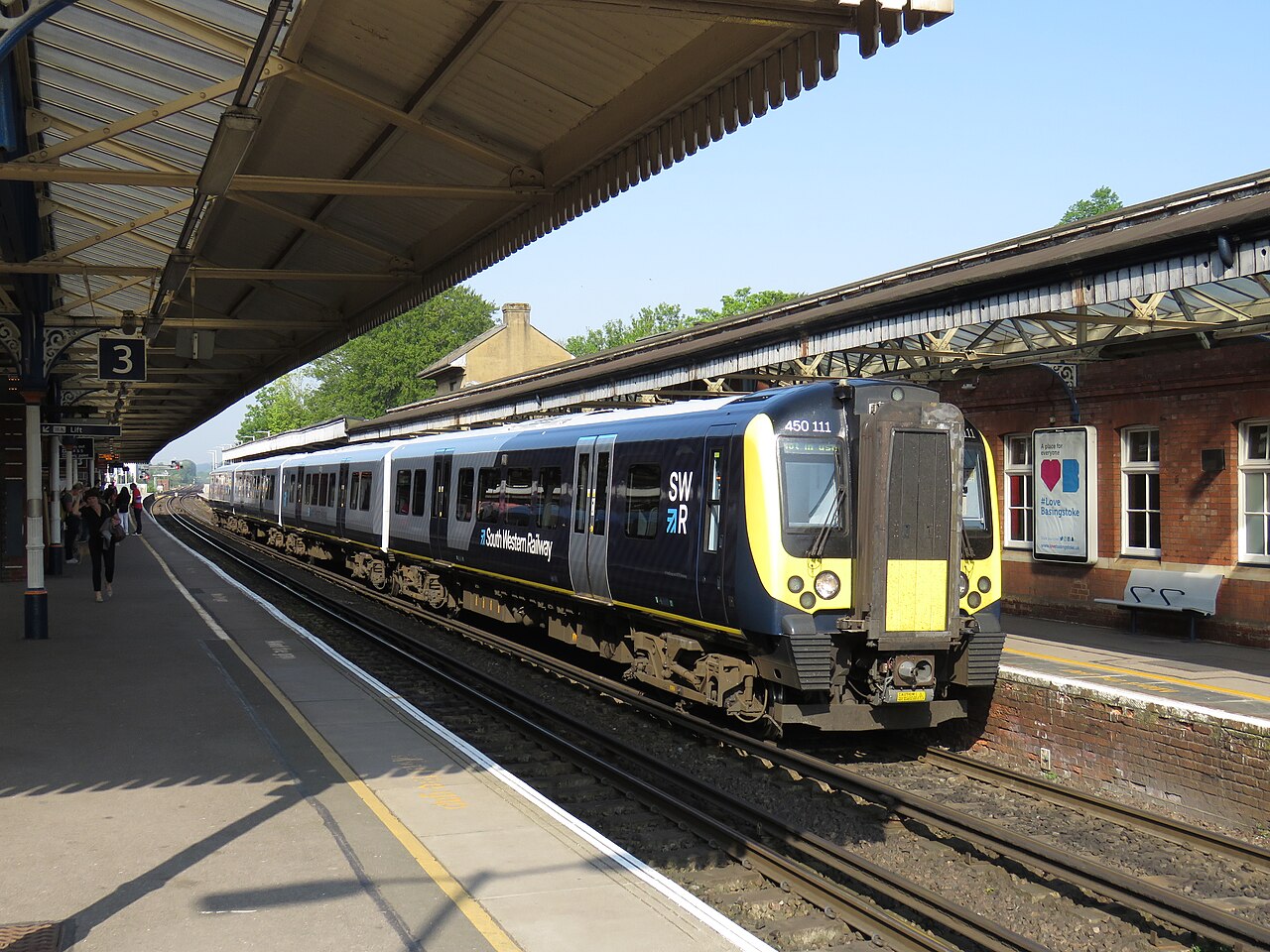





Design and features
The Class 450 was delivered as a 4‑car formation with a mix of Standard and First class accommodation and is intended for frequent stop services where rapid acceleration and a 100 mph maximum speed are advantageous. Typical installations include air‑conditioning, passenger information systems, priority seating and accessible spaces. Although built as a third‑rail DC unit, the design includes provision for future conversion to overhead electrification if required.
Technical characteristics
- Power system: third‑rail DC supply (nominally 750 V), with structural provision for 25 kV AC operation and overhead supply equipment if conversion occurs.
- Speed and formation: 4‑car sets, maximum speed 100 mph (160 km/h).
- Family: part of the Siemens Desiro modular platform; frequently referred to as the electric multiple unit type within that family.
- Onboard systems: modern passenger information, driver controls consistent with contemporary UK EMUs, and compatibility with depot maintenance regimes.
History and development
The Class 450s were procured to replace older rolling stock and to expand capacity on busy commuter corridors. They followed requirements set for new rolling stock in the South East region, including accessibility and emissions improvements. The manufacturer incorporated a modular construction approach to simplify maintenance and allow future system upgrades. No Class 450 currently carries a pantograph, although the structure allows fitting one in the event of a change to overhead electrification; the units therefore remain third‑rail DC vehicles in daily use without a pantograph.
Operation, routes and notable facts
In regular service the Class 450 operates on a range of suburban and outer‑suburban routes where its balance of seating and performance suits journeys of up to about an hour. The fleet complements other Desiro variants used elsewhere in the UK, sharing common maintenance practices and some spare‑parts compatibility. Operators have adapted interiors over time for passenger needs; some units have received software or minor hardware upgrades to improve reliability and information systems. The Class 450 is an example of a modern regional EMU designed to meet dense commuter demands while allowing for later electrical upgrades, bridging current third rail DC infrastructure with potential overhead supply futures.
For technical data, maintenance practices or service details consult operator and manufacturer sources: the type is commonly described as an EMU and discussed in rolling stock summaries and fleet lists by operators and rail industry publications. Additional background on the Desiro family and related units can be found via manufacturer material and operator fleets summaries available from public resources.
Related articles
Author
AlegsaOnline.com British Rail Class 450 electric multiple unit (Desiro) Leandro Alegsa
URL: https://en.alegsaonline.com/art/14460