
British Rail Class 455
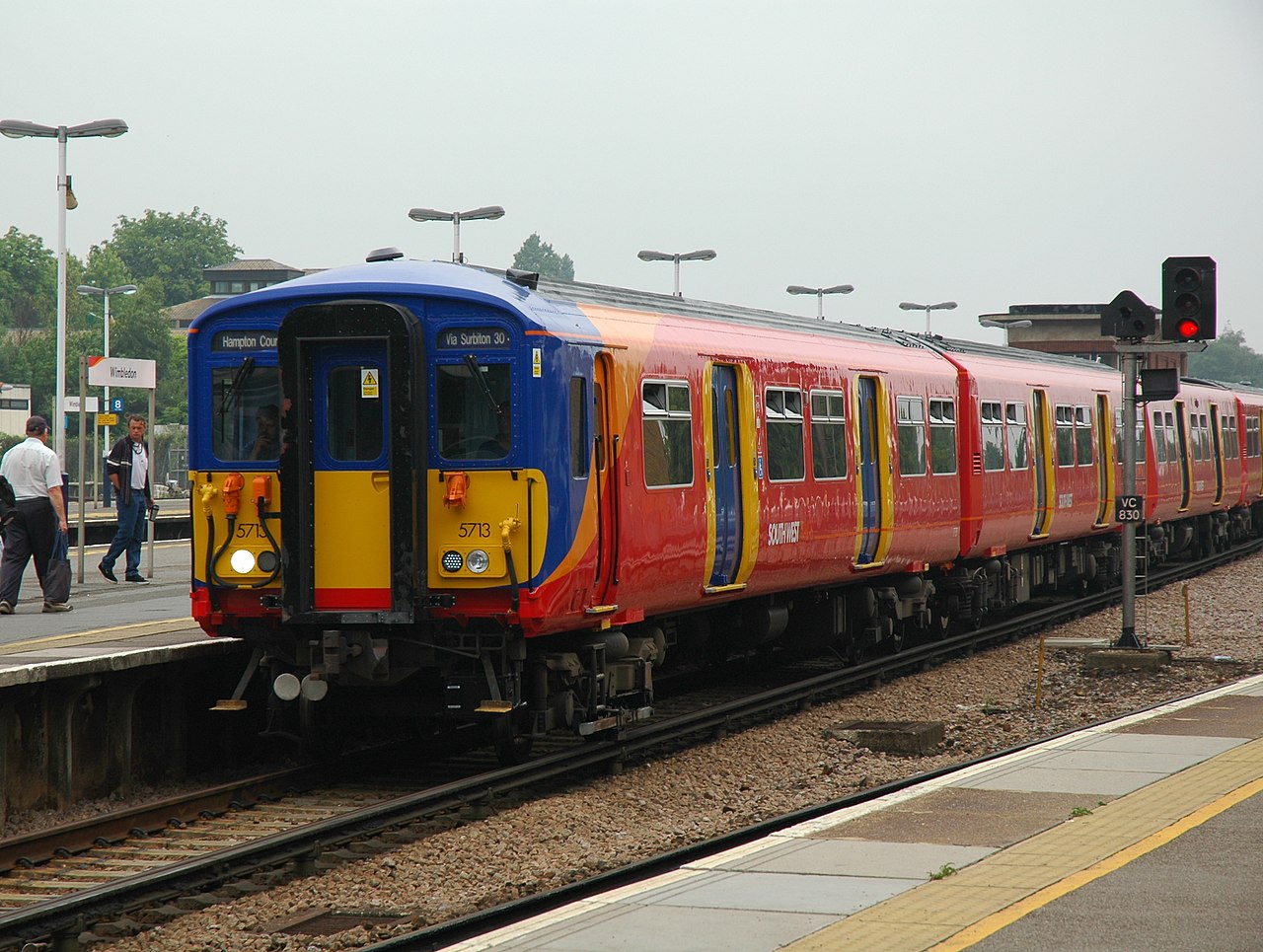
A 1980s four-car third-rail electric multiple unit used on suburban routes in and around south London, built by BREL at York and long employed by operators such as South West Trains and Southern.
Overview
The British Rail Class 455 is a family of four-car electric multiple units built in the early to mid-1980s for suburban commuter services. These units draw their traction power from a 750 V DC third rail and were constructed by BREL at the York works. Designed for frequent stop-start operation, the Class 455 has been a familiar presence on routes serving South London and surrounding commuter areas. The type is generally described as an electric multiple unit intended to provide robust, high-capacity suburban services.
Image gallery
10 Images


Design and characteristics
Class 455 sets are formed as four-car trains with driving cabs at each end, allowing single units to work alone or to be coupled together for longer formations. Their design emphasizes reliability, straightforward maintenance and passenger flow for short journeys. Key technical features include third-rail DC collection, multiple-unit control across vehicles, and arrangements suited to dense stopping patterns rather than high-speed running.
Service and operators
Since introduction, the Class 455 has been widely used on commuter services radiating into central London and across suburban networks. They have been operated by several train companies over the decades, including South West Trains and other regional operators, and have regularly appeared on routes serving inner and outer suburban stations. Their deployment has focused on reliability and capacity for peak flows.
History, refurbishment and replacement
Produced during a period of fleet renewal in British Rail, the Class 455 was part of a broader move to replace ageing slam-door and early EMU types. Over time many units underwent mid-life refurbishment programmes to refresh interiors, upgrade equipment and comply with evolving accessibility and safety standards. From the 2000s onwards the fleet has been gradually supplemented and in some areas replaced by newer electric multiple units, but the Class 455 has remained in service well beyond its original introduction era.
Notable facts and distinctions
- Purpose-built for suburban duties rather than long-distance travel, emphasizing door arrangements and standing room.
- Uses a bottom-contact third-rail power system, distinguishing it from overhead AC electrified fleets.
- Simple, modular construction has eased refurbishment and maintenance over decades of operation.
- Seen as a durable and utilitarian design that served a key role in late 20th-century commuter rail modernisation.
For more specific technical data, class diagrams and historical details consult specialist sources and fleet records; the Class 455 remains an important example of British Rail's suburban EMU strategy in the 1980s and beyond.
Related articles
Author
AlegsaOnline.com British Rail Class 455 Leandro Alegsa
URL: https://en.alegsaonline.com/art/14461