
British Rail Class 438 (4‑TC) multiple units
Unpowered four‑car push–pull sets converted from Mark 1 coaching stock for use with locomotives; introduced by British Rail in the late 1960s and 1970s and reclassified several times before withdrawal.
Overview
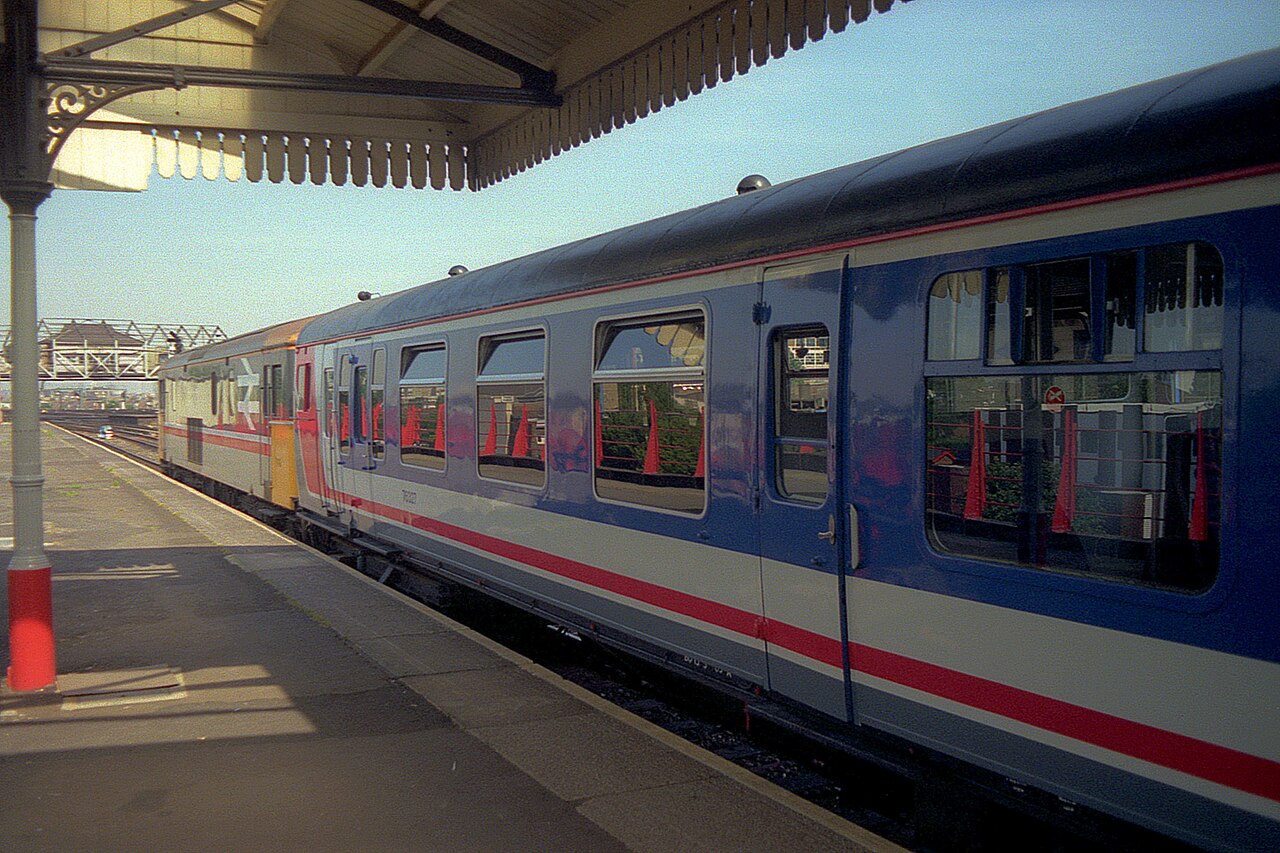
The British Rail Class 438 commonly became known by its operational code 4‑TC: a set of unpowered, fixed‑formation four‑car multiple units fitted with driving cabs at each end. These sets were not self‑propelled but were adapted so that a locomotive could control brakes and some train functions from either end, enabling push–pull operation without requiring a locomotive to run round the train at termini. The project was carried out by British Rail using surplus Mark 1 coaching stock.
Image gallery
6 Images




Design and characteristics
Each 4‑TC comprised four converted Mark 1 carriages arranged in a fixed formation. Typical features included driving cabs at both outer ends, electro‑pneumatic braking controls, and multiple‑unit control jumpers that allowed the attached locomotive to operate the unit’s systems remotely. As unpowered coaching sets they carried no traction equipment, relying on the hauled locomotive for motive power, train heating and electrical supply where required.
Development and numbering
The conversions were performed at York Works in two main periods, during 1966–67 and again in 1974. The 4‑TC concept built on experience obtained from an earlier 6‑car prototype (6TC). Over their careers the sets were subject to a number of reclassifications and renumberings: initially allocated under early classification schemes, they spent much of their working lives listed as Class 491, and just before withdrawal were redesignated Class 438 and renumbered in the series 8001–8034.
Operation and uses
4‑TC sets provided operational flexibility on routes where full electrification was not available or where locomotive‑hauled expresses needed rapid reversal at terminal stations. By allowing a locomotive to remain coupled to the train while controlling it from the opposite end, turnaround times were reduced and operational efficiency improved. They were commonly paired with Southern Region motive power types during their service life.
Legacy and preservation
The 4‑TC concept influenced later push–pull and multiple‑unit practices in British passenger operations. After withdrawal from regular service in the late 20th century, a number of sets and individual vehicles found their way into preservation on heritage railways, where they illustrate an economical approach to converting existing rolling stock for multiple‑unit use. The Class 438/4‑TC remains notable as an example of adapting conventional coaching stock to modern operational requirements without full rebuilds.
Related articles
Author
AlegsaOnline.com British Rail Class 438 (4‑TC) multiple units Leandro Alegsa
URL: https://en.alegsaonline.com/art/14454