
Olivier Messiaen: French composer, organist, teacher and innovator
Comprehensive overview of Olivier Messiaen (1908–1992): his life, musical language, major works, teaching, and lasting influence on 20th‑century music.
Overview
Olivier Messiaen (born Avignon, 10 December 1908; died Clichy, 27 April 1992) was a French composer and organist whose work ranks among the most distinctive of the mid‑20th century. He held the post of organist at the church of La Trinité in Paris for more than sixty years while composing for orchestra, piano and organ as well as chamber ensembles. Messiaen combined a deep Catholic faith with curiosity about non‑Western rhythms, ornithology and color, producing music that is both technically demanding and idiosyncratic. He is widely regarded as one of the leading figures of the mid-20th-century musical avant-garde.
Image gallery
10 Images




Style and musical techniques
Messiaen developed a personal musical language characterized by several recurring features. He used "modes of limited transposition"—scales that can be transposed only a few times without repeating their pitch content—to produce distinctive harmonic color. Rhythmic innovation was another hallmark: he employed nonretrogradable rhythms (palindromic rhythmic patterns), additive and irregular metrical groupings, and borrowed patterns from ancient Greek and Hindu rhythmic traditions.
Birdsong is central to much of his output; Messiaen transcribed the calls of birds and treated them as melodic material. He also described a form of synesthetic perception of harmony and color, assigning hues to chords and intervals, which informed orchestration and timbre. The resulting textures range from austere, meditative passages to towering, ecstatic climaxes.
Major works and typical ensembles
Messiaen wrote in a variety of genres. Some important and often-cited pieces include:
- Chamber and solo: Quartet for the End of Time (written during World War II), a seminal work for clarinet, violin, cello and piano.
- Orchestral: Turangalîla‑Symphonie, which expanded the orchestra with piano and ondes Martenot and explored love, rhythm and motoric energy (orchestral music).
- Piano and vocal cycle: Vingt regards sur l'enfant‑Jésus and other keyboard works (piano works).
- Organ and solo instrumental: Catalogue d'oiseaux and numerous organ pieces that reflect his mastery of the instrument (organ music).
Teaching, pupils and influence
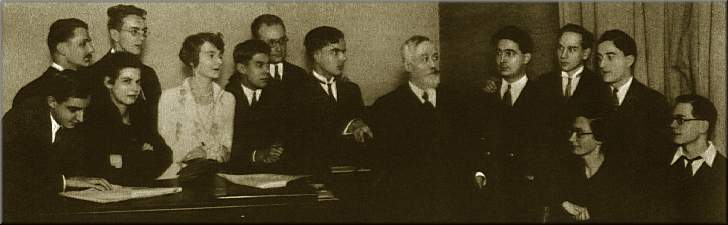
Messiaen taught composition at the Paris Conservatoire from 1941 to 1978, where his classes attracted many students who became major composers. His teaching emphasized rhythm, harmony, and color, and he encouraged originality and close listening to non‑European musical sources. Notable pupils include Pierre Boulez, Karlheinz Stockhausen and George Benjamin, among others. His influence extended beyond direct pupils: composers, performers and scholars studied his techniques, and his fascination with birdsong and rhythm opened new avenues in contemporary composition.
Historical context and legacy
Working through war and social change in 20th‑century France, Messiaen combined traditional liturgical roles with adventurous compositional experiments. He occupied a unique position: an organist rooted in Catholic ritual who also embraced cutting‑edge serial and rhythmic ideas without abandoning personal spirituality. His music remains frequently performed and recorded, and his theoretical writings—on rhythm, modes and birds—continue to be studied by composers and performers.
Notable facts and distinctions
- He served as titular organist at La Trinité for over sixty years, a rare long‑term clerical-musical appointment.
- Messiaen's Quartet for the End of Time was composed and premiered while he was a prisoner of war; it is often cited for its originality and expressive power.
- Beyond composition, his transcriptions of birdcalls represent a bridge between scientific observation and musical imagination.
For further reading and performance guides, consult specialized biographies and musicological studies that examine his scores, lectures and recordings in detail. Contemporary ensembles and conservatories continue to explore his catalog and pedagogical methods, ensuring that his distinctive voice remains part of the modern repertoire.
Author
AlegsaOnline.com Olivier Messiaen: French composer, organist, teacher and innovator Leandro Alegsa
URL: https://en.alegsaonline.com/art/127889