
List of rivers of Wisconsin
Overview of Wisconsin's rivers, major drainage basins, notable waterways, and their ecological, historical, and recreational importance.
This article describes the rivers of the U.S. state of Wisconsin. Wisconsin's network of rivers and streams shapes its landscapes, links interior lakes to the oceans, and supports diverse ecosystems and human uses. Rivers vary from large, navigable channels to small, clear trout streams that flow through forests and farmland.
Image gallery
7 Images
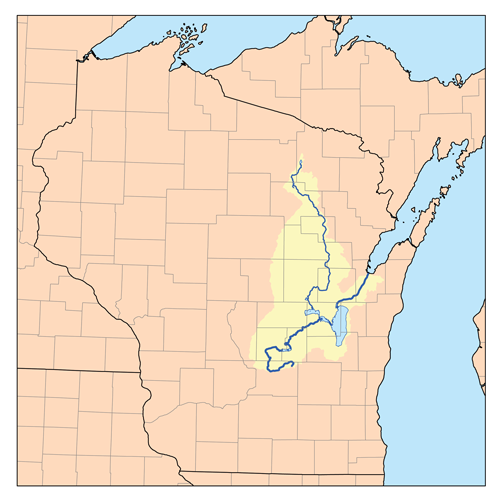


Drainage basins and patterns
Most Wisconsin rivers drain into two broad systems: the Great Lakes watershed (principally Lake Michigan and Lake Superior, which eventually connect to the Atlantic Ocean through the St. Lawrence) and the Mississippi River basin, which carries water south to the Gulf of Mexico. Because of glacial geology, many waterways have winding courses, braided channels, and associated wetlands that are important for flood control and wildlife.
Major rivers and examples
- Mississippi River — forms part of Wisconsin's western border and receives many tributaries from the state.
- Wisconsin River — a long, central watercourse that flows southward to the Mississippi, historically important for log driving and now for recreation and hydroelectric power.
- Fox River (Green Bay tributary) — flows northeast into Green Bay and supports urban and industrial areas as well as fisheries.
- Chippewa, Black, Rock, and St. Croix rivers — significant tributaries of the Mississippi with notable recreational and ecological value.
- Rivers to Lake Superior and Lake Michigan — including the Bad, Brule, Menominee, Peshtigo, and Milwaukee rivers, among others.
Beyond these, Wisconsin contains many smaller named streams used for trout fishing, canoeing, and conservation. Some river names are repeated in different parts of the state; local context is often needed to identify a particular stream.
History, names, and human use
Rivers in Wisconsin were central to Native American life and later European exploration, transportation, and industry. Many names derive from Indigenous languages (for example, Chippewa and Menominee) or from early French and English explorers. During the 19th century, rivers carried logs to mills; later, dams produced hydropower and created reservoirs. Urban rivers, by contrast, have been channels for commerce, waste management challenges, and restoration efforts.
Ecology and recreation
Wisconsin rivers host rich aquatic and riparian habitats: migratory fish, freshwater mussels, waterfowl, and riverine forests. Conservation efforts focus on improving water quality, restoring fish passage, and protecting wetlands. Recreational activities include canoeing, kayaking, fishing, hunting, and birdwatching; rivers also attract tourism for scenic paddling routes and state parks.
For an alphabetical or comprehensive compiled list of named rivers in the state, see additional resources and databases at state and federal water resource sites. These sources provide maps, watershed boundaries, and management information useful for recreation, study, and conservation planning.
Related articles
Author
AlegsaOnline.com List of rivers of Wisconsin Leandro Alegsa
URL: https://en.alegsaonline.com/art/125098